Article
What Is a Non-Executive Director, and When Does an Owner Need One?
6 min read · Published 30.10.2026
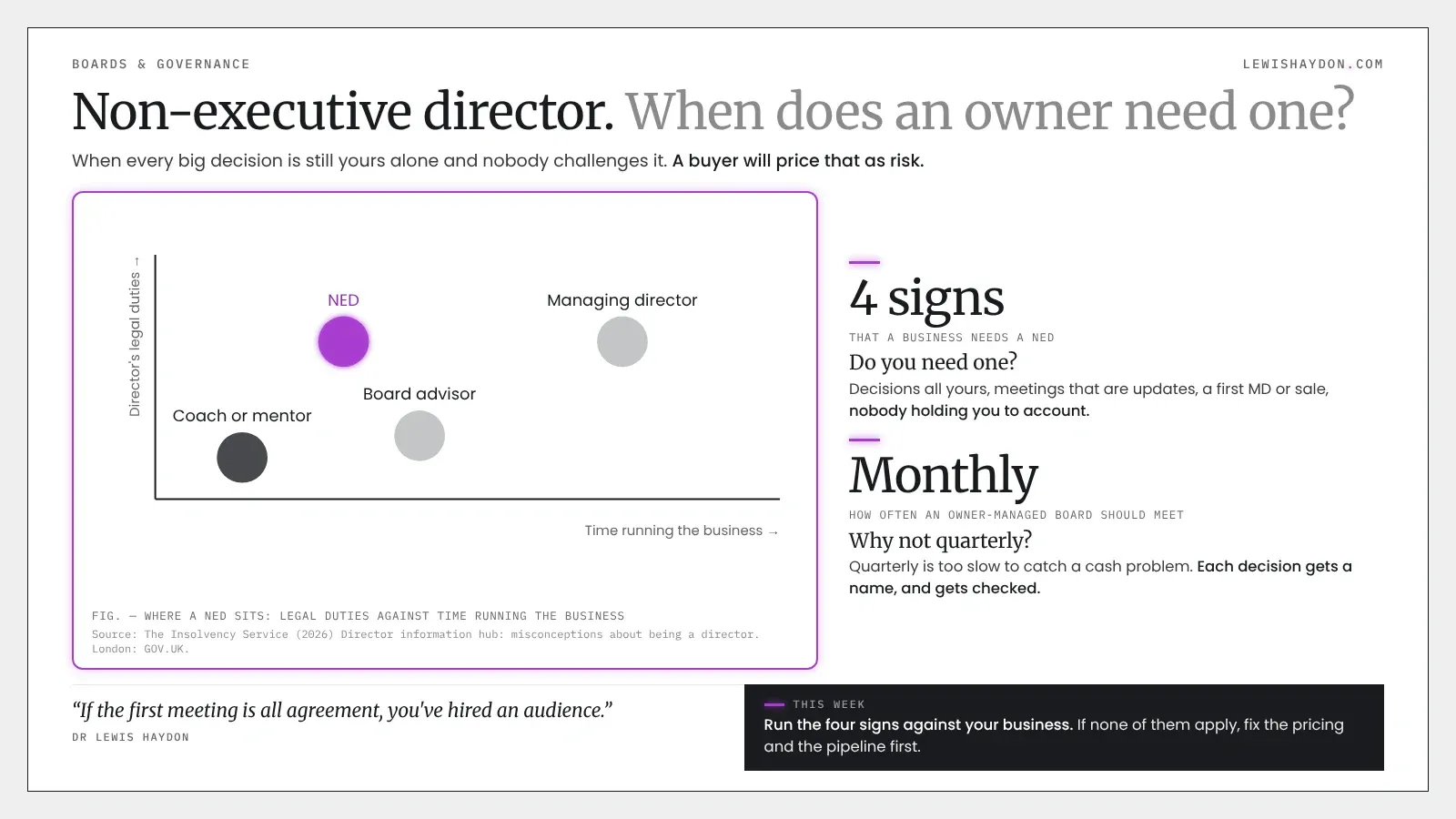
A non-executive director (NED) sits on the board of a company without running it day to day. In a large company that means governance and oversight. In an owner-managed business the job is more practical: review the numbers before each meeting, challenge the owner and the senior team, make sure decisions are made and followed through, and bring experience of the next stage, whether that’s a management team, investment or a sale.
This is for owners of established businesses, from about £250k turnover, who are wondering whether a NED is something they need or something only big companies have. I’ve sat on more than 20 boards, and I own and invest in businesses myself, so I’ve been on both sides of the table.
What does a non-executive director actually do?
The executive directors run the business: the managing director, the finance director, the operations director. A non-executive director is a director in law, with the same legal duties, but doesn’t run anything. They turn up to the board, usually monthly, having read the numbers, and they ask the questions nobody inside the business is asking.
In practice, in an owner-managed business, that looks like:
- The numbers, before the meeting. Cash, margin, debtor days, wage bill, and what the business is paying its owner. The questions an investor asks, every month.
- Challenge in the room. Every big decision in most owner-managed businesses is still the owner’s alone, and nobody challenges it. A good NED does, in front of the senior team, so the team learns it’s allowed.
- Decisions written down, with a name against each one. Then checked next month. Board meetings in a lot of SMEs are updates, not decisions. The NED’s job is to turn them into decisions.
- Experience of the next stage. Hiring a managing director, bringing in investment, preparing to sell. Most owners are doing it for the first time. A NED has done it before.
- The call you can make when something’s gone wrong and you can’t say it to your team.
What a NED doesn’t do is run the business. If you need someone to run it, that’s a managing director or a general manager, and it’s a different hire at a different price.
Non-executive director or board advisor?
The difference is the appointment. A non-executive director is formally appointed to the board and registered at Companies House, with a director’s legal duties and liabilities. A board advisor attends and advises without the appointment.
Most owner-managed businesses start with an advisor seat, because it’s simpler, and formalise it into a directorship when they bring in investment or prepare to sell, when buyers and investors want to see a proper board. I do either, and I’ll tell you which fits before we start.
The four signs you need one
- Every big decision is still yours alone, and nobody challenges it. That’s not strength. It’s the single biggest risk in the business, and a buyer will price it that way.
- Board meetings, if you have them, are updates rather than decisions. Everyone reports what happened. Nobody decides what happens next, and last month’s actions aren’t checked.
- You’re planning a managing director, investment or a sale, and you haven’t done it before. This is where owners lose the most money, because they only do it once and the people across the table do it every week.
- Your senior team reports to you, but nobody holds you to account. The team can’t, because you pay them. A NED can, because you’ve asked them to.
If none of those apply, you probably don’t need a NED yet. Fix the pricing and the pipeline first.
How much does a non-executive director cost?
In large companies it’s a fee per year for a handful of meetings. In owner-managed businesses the honest range is wide, because “NED” covers everything from a retired friend who turns up quarterly for lunch to someone who reads your management accounts every month and sits in the room with your team.
My own fee is published: non-executive director and board advisor services start from a monthly fee for a monthly board meeting, the numbers reviewed before it, and support between meetings, all agreed in writing before we start. Where it fits, I’ll take equity as part of the role, agreed alongside the fee. It’s an option, never a condition.
Whatever you pay, measure it against the decision it changes. One hire you didn’t make, one price rise you did, or one buyer you didn’t give the business away to pays for years of board meetings.
What to look for in a NED for an owner-managed business
Not a badge. Plenty of people call themselves non-executive directors because they sat on a committee once. For a business of your size, look for three things:
- They’ve owned or run a business at your stage, with their own wage bill and cash flow, so they sit on your board as an owner and not as a visitor.
- They’ve done the thing you’re about to do: built a management team, brought in investment, or sold.
- They’ll say no to you. If the first meeting is all agreement, you’ve hired an audience.
And check for conflicts. I own businesses in medical technology, manufacturing, care and supported living, marketing and sales, and accounting and finance. I won’t sit on a board that competes with one of them, and I’ll say so before we start. Anyone you appoint should be as clear.
What a NED is not
A NED is not a consultant with a project, not a coach for you personally (that’s business coaching and mentoring, a different relationship), and not a non-paid favour you can call in forever. The value is in the regular rhythm: the numbers, the meeting, the decisions, the check next month. A board that meets when it feels like it isn’t a board.
Questions owners ask
Is a non-executive director legally liable? Yes. An appointed NED has the same duties under the Companies Act as every other director, which is one reason some owners start with an advisor seat. The Insolvency Service’s guidance for directors puts it plainly: all directors are accountable, including non-executive directors, and they share responsibility for the company even if they’re not involved in running it day to day (The Insolvency Service, 2026).
How many non-executive directors does a small business need? One is usually enough. The point is challenge and experience in the room, not a quorum.
Can a NED invest in the business? Sometimes, and it can align interests well. Agree it in writing, alongside the fee, and be clear about what happens to the shares if either side wants to stop.
How often should a NED meet the board? Monthly for an owner-managed business that’s growing or preparing for a sale. Quarterly is too slow to catch a cash problem. A study of 561 SMEs found outside directors add most when management shares the business’s own information with the board, and that infrequent board meetings work against that (Uhlaner et al., 2021).
References
- The Insolvency Service (2026) Director information hub: misconceptions about being a director. London: GOV.UK. Available at: https://www.gov.uk/guidance/director-information-hub-misconceptions-about-being-a-director (Accessed: 1 November 2026).
- Uhlaner, L., De Massis, A., Jorissen, A. and Du, Y. (2021) ‘Are outside directors on the small and medium-sized enterprise board always beneficial? Disclosure of firm-specific information in board-management relations as the missing mechanism’, Human Relations, 74(11), pp. 1781–1819. Available at: https://eprints.lancs.ac.uk/id/eprint/146112 (Accessed: 1 November 2026).
I’m Dr Lewis Haydon, a business coach and mentor in Birmingham, UK. I own and invest in businesses, I’ve sat on more than 20 boards, and I work with owners of established businesses from about £250k turnover, scaling to £1m and on to £20m. If you want a board that challenges you, the non-executive director and board advisor page sets out how it works and what it costs. If you’d rather talk it through first, bring it to a virtual coffee.