Article
Do I Need a Business Coach? A Business Owner's Honest Answer
10 min read · Published 11.11.2026

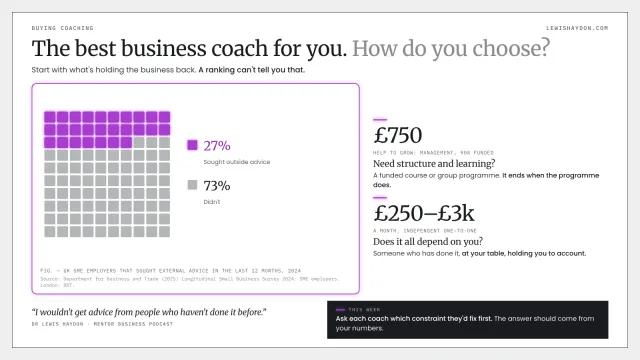
You need a business coach when you’re working harder than ever, the business isn’t giving you the result you want, and you’re ready to change how you work. You don’t need one if you, or the people around you, aren’t open to change. Coaching doesn’t work for people who don’t want it.
I’m a business owner first. So read this as a business owner’s review of business coaches: what we should expect, and what to walk away from.
I’ve been on the other side of the table. As I grew my own businesses, I worked with franchise coaches, and it only got us so far. We did group planning days together, and my team didn’t enjoy them: it felt like generic training, and the system couldn’t stretch to a modern business. So I moved my own companies to coaching built around each stage of growth, from £250k to £1m, £1m to £5m and £5m to £20m, because what got us here won’t get us there. It worked, so I went independent, to be the coach I wish I’d had from the start: no time lost on generic models, just the one constraint standing between you and your goals.
Do I need a business coach? The short answer
| You probably need a business coach if… | You probably don’t, yet, if… |
|---|---|
| You’re putting in more hours and the results aren’t following | You, or your senior team, don’t want to change how things are done |
| You’ve more ideas than direction, and keep switching plans | Someone has to be the one with every answer and all the recognition |
| The business still depends on you for most decisions | You want a coach to do the work for you |
| You’re making money, but not much of it reaches you | You’re after motivation rather than results |
| You want the business to grow without you | You need one specific fix, such as a website or a bookkeeper |
When you don’t need a business coach
A lot of us have a team already full of experts, or someone in the business with a negative attitude to coaching. It usually looks like a person with a long track record who likes to be the one bringing all the new ideas to the table, and wants the recognition. You can spot them easily, because they don’t like change.
That goes for owners as much as teams. Coaching only works when people are open to it and ready to learn and develop. In my doctorate, the clients who did best were those committed to changing, not just talking about it (Haydon, 2025). If that isn’t where you are yet, keep your money.
How can a business coach help me?
Most people think a business coach is like a sports coach: there to pull the best out of people. That’s true, and it’s what coaching is about. But for those of us who run businesses, none of it matters if it stays as theory and nice leadership talk. What matters is results:
- more revenue
- more efficient operations
- more profit
- more cash left in the business, so there’s money to pay the team better, hire great people and pay ourselves in dividends.
Everybody loves the motivational coach. That’s great until the motivation runs out, until real results matter, until you have to make payroll and pay the tax bill and there’s no money left in the business. That’s where motivational coaches who call themselves business coaches fall down, and it leaves a mark on the whole industry.
Coaching done properly does work. A meta-analysis of coaching studies in organisations found positive effects on performance and skills, wellbeing, coping, work attitudes and goal-directed behaviour (Theeboom, Beersma and van Vianen, 2014). The question is whether the coach you pick can turn that into money in your business.
What to expect from a business coach
Here’s how working with me starts. It’s what I’d expect from any business coach.
First, find the one thing blocking the business
You might not need ongoing coaching at all. A business gap analysis finds the main constraint holding the business back: where the problem really is and where your focus needs to go.
A real example. An owner came to me excited about coaching. They were sure they needed better marketing: a new strategy, a whole new pipeline, a CRM, more leads. The gap analysis showed they already had leads; they just weren’t converting them. More marketing would have been filling a bucket full of holes. I told them they didn’t need me yet, just a few fast wins on sales from the leads they had. Three months later they’d seen the results, and then they came back for coaching. (The gap analysis fee comes off your first month if you do carry on to mentoring.)
A lot of us are climbing a ladder: lots of hard work, lots of extra hours, burning out, and still not getting the result. Usually we’re working on the wrong thing, because we’re following generic advice from social media and AI tools that can’t see our business. Advice without context can add fuel to the fire and lead you down a rabbit hole with nothing to show for it in 3, 6, 9 or 12 months.
Then a planning day for the next 18 months
If there’s more than one constraint, or you want to scale, we plan the next 18 months. Not a to-do list. It’s a day set aside to unpack why you went into business in the first place, the constraints likely to come one after another, and how you’ll manage your time around them. Most of us are time poor and stuck in the operations, so we work out how to get the most from the business, its resources and the team.
On that day I also look for where my fee comes off the table fastest, so the coaching pays for itself and what comes after is profit. I’m a business owner. I understand a P&L and a return on investment.
Then the team takes ownership
It isn’t only about you. It’s about the people in the business taking accountability for the results on the constraints that stop it growing.
Expect resistance, and a culture shift
People don’t change in a day or a session. They change over time. You can change a mindset and you can change a strategy, but changing behaviour is hard. That’s where ongoing coaching and mentoring earns its place. Once a business passes £1m, it can stall on people: the owner ends up doing all the work unless the team does it. My doctorate, from Aston University’s Work and Organisational Psychology department, gives me a deeper understanding of how behaviour plays out inside a business, which matters most as you scale past £5m. But it’s a nice to have. The real results come from running businesses and coaching them: knowing what it’s like to carry payroll. If you want results that last, look at the behaviour of the people, the team and the culture, not just the strategy.
Do I need a business mentor or a business coach?
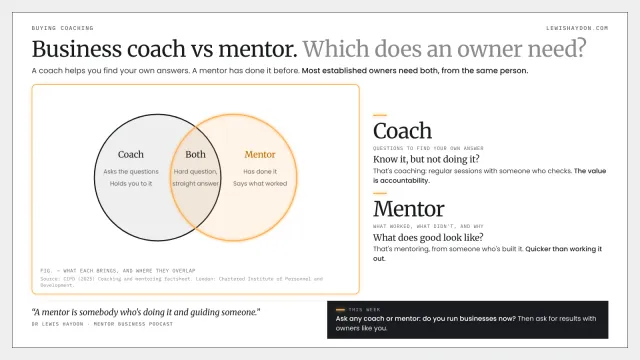
A coach helps you get the best out of yourself and your team. A mentor has done what you’re trying to do and tells you what they’d do in your seat. Most of us running established businesses need both: someone to hold us to what we said we’d do, and someone who has carried payroll recently. I do both, which is why I call it business mentoring. More in business coach vs mentor.
Does business coaching work? “My last coach didn’t”
Have you ever eaten in a bad restaurant? Did you stop eating in restaurants?
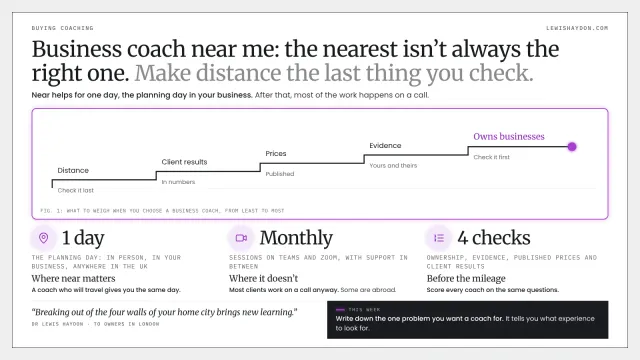
Anyone can change their title on LinkedIn and become a business coach. Everybody has a success story from a job or a business they had 10 years ago. Not many have had to carry payroll in the world we run businesses in now: AI changing jobs, competitors getting savvier with their marketing, payroll tougher than ever, a new generation coming into the workforce, and opportunities we miss if we don’t move. Most business coaches are also trained in one generic method, because their own speciality doesn’t cover everything.
So before you hire again, ask:
- Do they own a business today, one that grows without them?
- Can they show you that business, and how it’s run? You can come and look round mine: the systems, the processes, and the people. Talk to the operations and sales managers, the directors I’ve put in place, and the managing director who now runs one of my businesses for me. I’d rather walk the talk than just talk it.
- Is the plan built around your business, or a method they apply to everyone?
- Reviews help, but can they tell you whether the coach owns a business today?
If your last coach didn’t work, what did you learn, and what do you need to see next time? It’s not that business coaching doesn’t work. It’s that the business coach you had didn’t.
Should I get a business coach? Red flags before you sign
- A long contract. Mine is rolling, with 30 days’ notice. Things change in business; we all know that. A big contract gets a lot of money out of you before anyone has to deliver.
- Results promised in 30 days, 3 months or even 6 months. Results take longer, and they depend on you doing the work. It’s like joining a gym and expecting to lose weight without exercising.
- A coach who seems desperate to sign you. A good coach only takes on owners who’ll do the work, because they’re judged on their clients’ results. If a coach signed you knowing you wouldn’t do the work, that’s on them too. Why would a good coach take someone on just to take their money?
- Awards and credentials you can’t check. Ask who gave them and whether they gain from it. There’s a four-point check on my awards page.
What is the wrong coach costing your business?
Think about the last six months. How many hours went into work that didn’t move the numbers? What did it cost in profit, in dividends you didn’t take, in time with the people you started the business for?
Now picture the next 18 months with the one constraint found, a plan that isn’t a to-do list, and a team that owns the results. What would the business pay you then?
First steps with me
- Book a 30-minute virtual coffee. Bring the one question you most want answered, and leave knowing your next step.
- Not sure what’s holding the business back? Start with a business gap analysis.
- Want ongoing support? Every price is on the pricing page, and you can see how I compare to business coaches and coaching franchise companies.
FAQs
Do I need a business coach or can I do it myself?
You can do it yourself if you already know the one thing holding the business back and you’re fixing it. If you’re working harder and the results aren’t following, or you keep switching plans, an outside view finds the constraint faster than another year of guessing.
How can a business coach help a small business?
By finding the main constraint, building a plan around it, and holding you and your team to it until the numbers move: revenue, profit and cash left in the business to pay the team and pay you.
What should I expect from my first session with a business coach?
Questions about your numbers, your time and your goals, not a sales pitch. A good first session leaves you clearer on the one thing to focus on.
How long does business coaching take to work?
Months, not weeks, and it depends on the work you put in. Be wary of anyone promising results in 30 or 90 days. People change their behaviour over time, not in one session.
Do business coaches tie you into contracts?
Some do. Mine is rolling, with 30 days’ notice. If a coach needs a long contract to keep you, ask why.
Do I need a business mentor if I already have a business coach?
If your coach has never owned a business like yours, a mentor who has can fill the gap. Better still, find one person who does both: coaches you and your team, and owns businesses today.
References
- Haydon, L. J. (2025) How UK business coaches cope and persist towards higher levels of objective and subjective success in boundaryless careers. DBA thesis. Aston University. Available at: https://lewishaydon.com/research/ (Accessed: 11 November 2026).
- Theeboom, T., Beersma, B. and van Vianen, A. E. M. (2014) ‘Does coaching work? A meta-analysis on the effects of coaching on individual level outcomes in an organizational context’, The Journal of Positive Psychology, 9(1), pp. 1–18. Available at: https://research.vu.nl/en/publications/does-coaching-work-a-meta-analysis-on-the-effects-of-coaching-on-/ (Accessed: 11 November 2026).