Article
How Much Dividend Can I Pay Myself Tax-Free? The 2026/27 Allowance, Rates and Limits
Topic · Owner payoff and profit · 6 min read · Published 03.11.2026
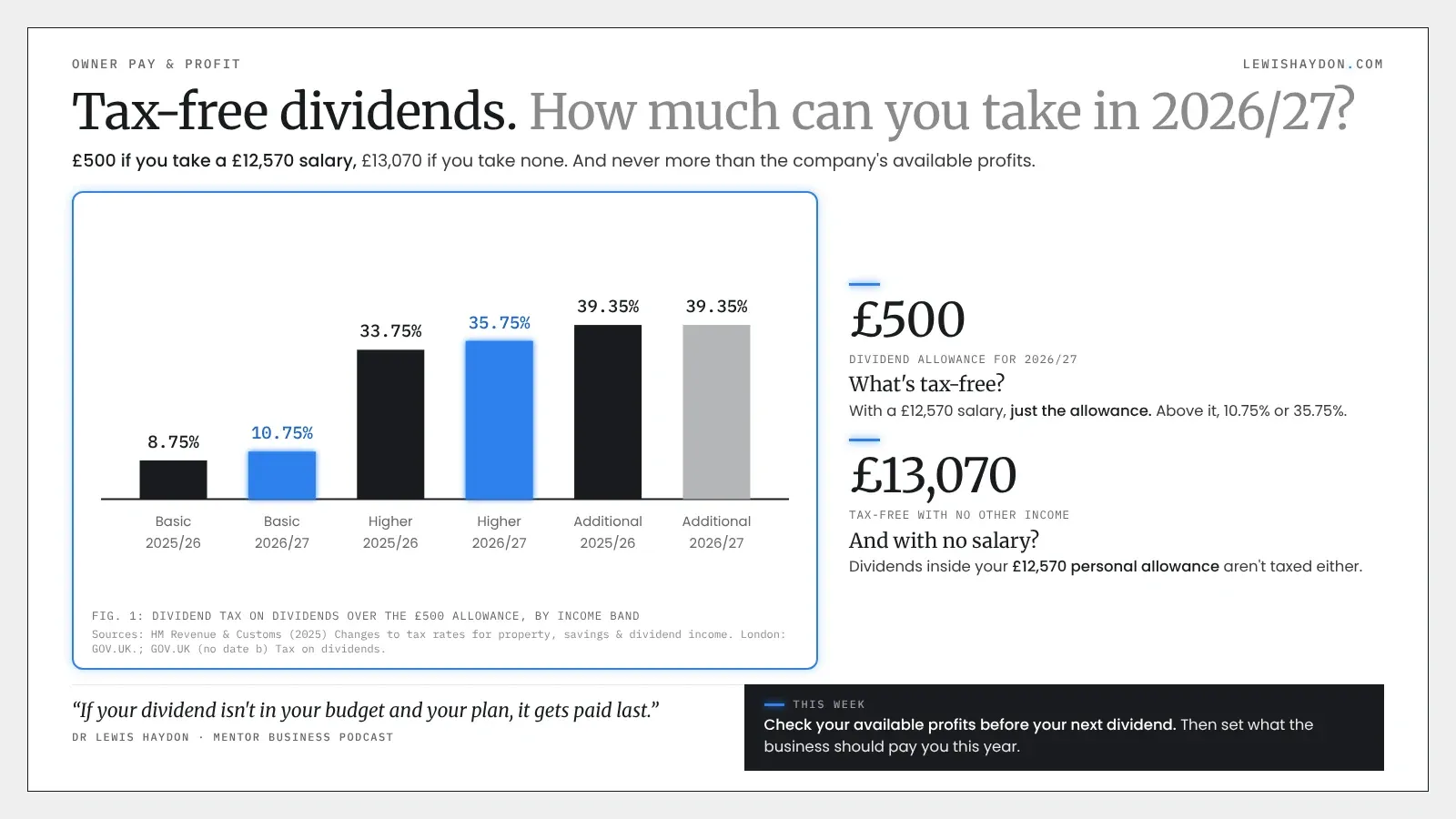
If you already take a £12,570 salary, £500. That’s the dividend allowance for 2026/27, and dividends above it are taxed at 10.75%, 35.75% or 39.35% depending on your income band. If you take no salary and have no other income, it’s £13,070, because dividends that fall within your £12,570 personal allowance aren’t taxed either. How much dividend you can pay yourself at all is a different question: never more than the company’s available profits, whatever’s in the bank.
The figures below are for the 2026/27 tax year. It’s general information, not tax advice, and your other income, where you live in the UK and how the company is set up all change the answer. Check with your accountant before you declare anything.
How much dividend can I pay myself tax-free in 2026/27?
It depends on what else you earn, because your personal allowance gets used up first.
You don’t pay tax on dividend income that falls within your personal allowance, and on top of that you get a dividend allowance of £500 a year (GOV.UK, no date b). The standard personal allowance is £12,570 (GOV.UK, 2024). So:
| Your salary and other income | Tax-free dividends in 2026/27 |
|---|---|
| £0 | £13,070 |
| £6,000 | £7,070 |
| £12,570 | £500 |
| £50,000 | £500 |
Most owner-directors take a £12,570 salary, because it uses the personal allowance with no income tax or employee National Insurance on it. The reasons, and the numbers, are in how to pay yourself from a limited company. So for most owners, the honest answer is £500.
The company has still paid corporation tax on it, at 19% on profits under £50,000 and up to 25% above £250,000 (HM Revenue & Customs, 2026). So a £500 tax-free dividend took at least £617 of profit to pay, and more if your company pays above the small profits rate.
Dividend tax rates 2026/27
The rates went up in April 2026. The ordinary rate rose from 8.75% to 10.75% and the upper rate from 33.75% to 35.75%. The additional rate stayed at 39.35% (HM Revenue & Customs, 2025).
| Income tax band | Taxable income | Dividend tax, 2025/26 | Dividend tax, 2026/27 |
|---|---|---|---|
| Personal allowance | Up to £12,570 | 0% | 0% |
| Basic rate | £12,571 to £50,270 | 8.75% | 10.75% |
| Higher rate | £50,271 to £125,140 | 33.75% | 35.75% |
| Additional rate | Over £125,140 | 39.35% | 39.35% |
The bands are from GOV.UK (GOV.UK, 2024) and the 2026/27 dividend rates apply to dividends over the £500 allowance (GOV.UK, no date b).
Your dividends sit on top of your salary. GOV.UK’s own example is someone with £29,570 in wages and £3,000 in dividends in 2026/27: after the £12,570 personal allowance they pay 20% on £17,000 of wages, nothing on £500 of dividends because of the dividend allowance, and 10.75% on the other £2,500 (GOV.UK, no date b).
What is the dividend allowance for 2026/27?
£500 a year (GOV.UK, no date b). It’s yours as a person, not per company, so two companies paying you dividends still means one £500.
Dividends inside the allowance are taxed at 0%, but they still count as income. In the GOV.UK example above, the £3,000 of dividends is part of the £32,570 total income. The allowance takes the tax off the first £500 and that’s all; it doesn’t stretch your basic rate band.
If your dividends come to more than your unused personal allowance plus the £500 dividend allowance, you need to report them to HMRC (GOV.UK, no date b).
How much dividend can I pay myself? The legal limit
Your company must not pay out more in dividends than its available profits from the current and previous financial years (GOV.UK, no date a). That’s profit after corporation tax, because a dividend isn’t a business cost and doesn’t reduce the tax.
Owners mix this up with turnover all the time. I sit with owners who tell me they’ve hit 10 million, 12 million in revenue. Great, so what are you going to do with the money you’re making as dividends? “Well, actually, I can’t take a dividend.” Why not? “There isn’t enough profit in the business.” All that revenue, and they didn’t actually make any money.
Or with the bank balance. A healthy-looking balance can be mostly spoken for already, by the VAT bill, suppliers, a loan and next month’s wages, and a profitable business can still be short of cash. Before you declare anything, check both: the profit with your accountant, and the cash with a 13-week cash flow forecast.
Then the paperwork. For each dividend, you hold a directors’ meeting to declare it and keep minutes, even if you’re the only director. You write a dividend voucher with the date, the company name, the shareholders’ names and the amount, give a copy to whoever receives it and keep a copy. And you must usually pay dividends to all shareholders (GOV.UK, no date a).
Pay out more than the available profits and it isn’t a dividend you can keep, so speak to your accountant first.
A worked example: what each dividend costs you
Here’s what the tax looks like on different dividends in 2026/27, for an owner in England who takes a £12,570 salary and has no other income:
| Dividend | Dividend tax | Effective rate on the dividend |
|---|---|---|
| £500 | £0 | 0% |
| £10,000 | £1,021 | 10.2% |
| £37,700 | £3,999 | 10.6% |
| £60,000 | £11,971 | 20.0% |
| £87,430 | £21,777 | 24.9% |
£37,700 is the top of the basic rate band with that salary. Past it, every extra £1 of dividend costs 35.75p in tax. And once your total income passes £100,000, your personal allowance goes down by £1 for every £2 above it (GOV.UK, 2024), which is why the last row stops at a total of £100,000.
Should you stop at the tax-free amount?
No. The tax-free figure says nothing about what the business should pay you.
Taking £13,070 a year because it’s tax-free means your pay is set by a tax threshold. Plenty of owners take that or less. A Startups.co.uk survey of 295 UK founders found three-quarters had given up part of their own salary in the past 12 months, an average of £13,940, which it described as a 36% pay cut (O’Sullivan, 2026).
Work it the other way round. Decide what the business should pay you this year, work out the profit it needs to make to pay it with the profit margin calculator, and then let your accountant set the most efficient mix of salary and dividends to get it to you. I go through the bigger picture in how to pay yourself as a business owner.
Dividend questions owners ask
Is the £500 dividend allowance per company? No, it’s per person, per tax year. However many companies pay you dividends, you get one £500.
Can I pay myself dividends every month? Yes, as long as the company has available profits each time, and you hold the meeting, keep the minutes and write a voucher for each one.
Do I pay National Insurance on dividends? No. National Insurance is charged on earnings like salary. Dividends are taxed through income tax at the dividend rates.
What were the dividend tax rates in 2025/26? 8.75% in the basic rate band, 33.75% in the higher rate band and 39.35% in the additional rate band (HM Revenue & Customs, 2025).
Can I pay a dividend if the company made a loss this year? Only if there are enough profits kept from previous years to cover it. The test is available profits from the current and previous financial years (GOV.UK, no date a).
References
- GOV.UK (2024) Income Tax rates and Personal Allowances. Available at: https://www.gov.uk/income-tax-rates (Accessed: 1 November 2026).
- GOV.UK (no date a) Running a limited company: taking money out of a limited company. Available at: https://www.gov.uk/running-a-limited-company/taking-money-out-of-a-limited-company (Accessed: 1 November 2026).
- GOV.UK (no date b) Tax on dividends. Available at: https://www.gov.uk/tax-on-dividends (Accessed: 1 November 2026).
- HM Revenue & Customs (2025) Changes to tax rates for property, savings & dividend income. London: GOV.UK. Available at: https://www.gov.uk/government/publications/changes-to-tax-rates-for-property-savings-dividend-income/changes-to-tax-rates-for-property-savings-dividend-income (Accessed: 1 November 2026).
- HM Revenue & Customs (2026) Corporation Tax rates and allowances. London: GOV.UK. Available at: https://www.gov.uk/government/publications/rates-and-allowances-corporation-tax/rates-and-allowances-corporation-tax (Accessed: 1 November 2026).
- O’Sullivan, I. (2026) ‘39% of founders earn close to minimum wage, before cutting their pay further’, Startups.co.uk, 27 October. Available at: https://startups.co.uk/news/third-of-founders-earn-minimum-wage/ (Accessed: 1 November 2026).
If your dividend is set by what’s tax-free rather than what you need, bring your number to a virtual coffee and we’ll look at what has to change. I’m Dr Lewis Haydon, a business coach and mentor in Birmingham, UK, who ACTUALLY owns businesses.