Article
How to Pay Yourself From a Limited Company: Salary, Dividends and the 2026/27 Numbers
Topic · Owner payoff and profit · 9 min read · Published 03.11.2026
Most owners of a UK limited company pay themselves in two parts: a salary of £12,570, then dividends out of the profit left after corporation tax. In 2026/27 that salary has no income tax or employee National Insurance on it, and dividends on top are taxed at 10.75% in the basic rate band and 35.75% in the higher rate band. Decide the number first, then the mix: what should the business pay you, and which salary and dividends get it to you?
This is the UK limited company version of how to pay yourself as a business owner. That one is about getting your pay into the plan. This one is the mechanics, with this year’s tax rates.
It’s general information, not tax advice. Your own circumstances change the answer, so check with your accountant before you take a penny.
What are the ways to pay yourself from a limited company?
There are four. Most owners use the first two.
- Salary. You’re an employee of your own company, so your salary goes through payroll and the company takes off income tax and National Insurance (GOV.UK, no date a). The salary, and the employer’s National Insurance on it, are business costs, so they come off the profit before corporation tax.
- Dividends. A payment to shareholders when the company has made a profit. A dividend isn’t a business cost, so it doesn’t reduce your corporation tax (GOV.UK, no date a).
- A director’s loan. Money you take out that isn’t salary or a dividend, beyond what you’ve put in. It has to be recorded and it has its own tax rules (GOV.UK, no date a). Treat it as a stopgap rather than a way to get paid.
- Pension contributions. The company pays into your pension directly. Worth a proper conversation with your accountant or financial adviser, especially once you’re into the higher rate band.
What’s the best director salary for 2026/27?
For most owner-directors, £12,570.
That’s the personal allowance for 2026/27, and it’s also the primary threshold, where employee National Insurance starts (HM Revenue & Customs, 2026b). So a £12,570 salary comes to you with no income tax and no employee National Insurance taken off.
The company does pay employer National Insurance: 15% on everything above the secondary threshold of £5,000 (HM Revenue & Customs, 2026b). On £12,570 that’s £1,135.50. The Employment Allowance, £10,500 for 2026/27 (HM Revenue & Customs, 2026b), can cover it.
Two catches. A limited company can’t claim the Employment Allowance at all if it has one director and that director is the only employee paid above the secondary threshold (HM Revenue & Customs, 2026c). And if you’ve got a team, their employer National Insurance usually uses up the £10,500 long before it gets to you. So treat the £1,135.50 as a real cost.
Is it still worth it? Yes. Take the £7,570 between £5,000 and £12,570 as salary and it lands in your pocket untouched, at a cost to the company of £8,705.50 including the employer National Insurance. Put that same £8,705.50 through corporation tax and out as a dividend instead and, even at the 19% small profits rate, you’d get about £7,051. The salary wins.
Salary vs dividends: which pays you more?
Above £12,570, it’s closer than it used to be.
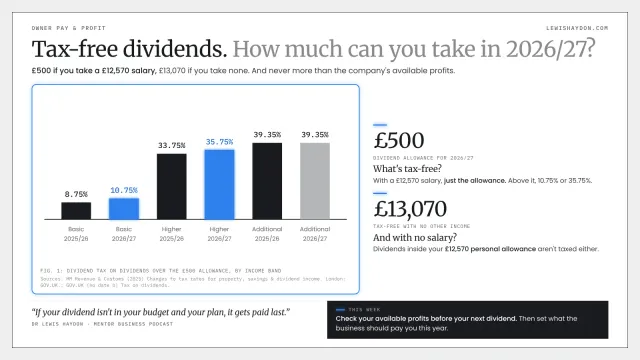
From April 2026 the dividend tax rates went up. The ordinary rate rose from 8.75% to 10.75% and the upper rate from 33.75% to 35.75%, while the additional rate stayed at 39.35% (HM Revenue & Customs, 2025). So for 2026/27, dividends over the £500 dividend allowance are taxed at 10.75% in the basic rate band, 35.75% in the higher rate band and 39.35% in the additional rate band (GOV.UK, no date b).
And before any dividend, the company pays corporation tax. That’s 19% on profits under £50,000, 25% on profits over £250,000, and in between, the 25% main rate less marginal relief at a standard fraction of 3/200 (HM Revenue & Customs, 2026a). That works out at 26.5p of corporation tax on each extra pound of profit between £50,000 and £250,000. Those limits are shared out if your company has associated companies (HM Revenue & Customs, 2023).
Put that together and here’s what reaches you from each £1 of profit at this year’s rates, with the employer National Insurance counted on any extra salary:
| Your income band | As extra salary | As a dividend, 25% corporation tax | As a dividend, 26.5% marginal rate |
|---|---|---|---|
| Basic rate | 63p | 67p | 66p |
| Higher rate | 50p | 48p | 47p |
So in the basic rate band, dividends still win by a few pence. Into the higher rate band, at this year’s rates, extra salary edges it, unless your company only pays the 19% small profits rate, where the dividend still comes out at about 52p.
It’s a couple of pence in the pound either way, so don’t rip up your structure on your own. Get your accountant to model it with your actual profit, because pension contributions, the £100,000 taper and your other income can all swing it.
A worked example: £150,000 of profit
Say you’re the only director and you own all the shares. The business turns over about £900,000 and makes £150,000 profit before you take anything. You live in England and have no other income, the team’s employer National Insurance already uses up the Employment Allowance, and there are no associated companies and no losses from earlier years.
The company side is the same whatever you take:
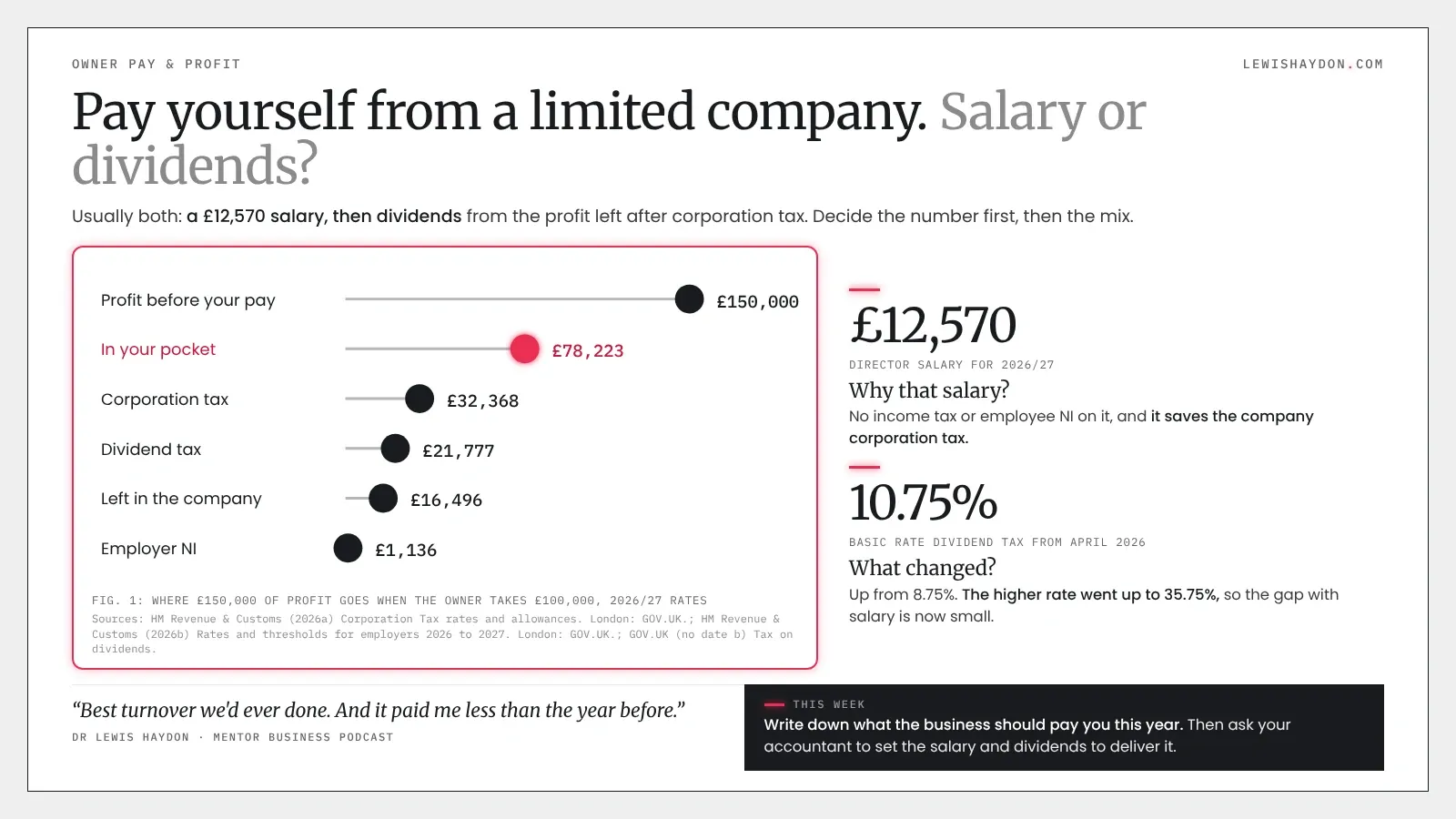
- Profit before your pay: £150,000
- Your salary: £12,570, plus £1,136 employer National Insurance
- Corporation tax on the £136,295 left: £32,368 (25%, less marginal relief)
- Profit after tax, available for dividends: £103,926
Then it’s a choice of how much to take:
| A: fill the basic rate band | B: £62,570 | C: £100,000 | |
|---|---|---|---|
| Salary | £12,570 | £12,570 | £12,570 |
| Dividends | £37,700 | £50,000 | £87,430 |
| Total you take | £50,270 | £62,570 | £100,000 |
| Income tax and NI on your salary | £0 | £0 | £0 |
| Dividend tax | £3,999 | £8,396 | £21,777 |
| In your pocket | £46,271 | £54,174 | £78,223 |
| Left in the company | £66,226 | £53,926 | £16,496 |
Column A stops at £50,270 because that’s where the higher rate starts (GOV.UK, 2024). Column C stops at £100,000 because above that your personal allowance goes down by £1 for every £2 of income (GOV.UK, 2024), which makes the next slice of pay very expensive.
Look at column C as a whole. Of £150,000 of profit, £78,223 reaches you, £55,281 goes in tax (corporation tax, dividend tax and employer National Insurance) and £16,496 stays in the business.
Column A leaves £66,226 in the company to invest, hire or hold as a cash buffer. Column C pays you properly and leaves the business thinner. Which is right depends on what the money left behind is for.
I always believe 10% of your revenue should be in the bank at some point, so you can make investments and hire new people. On £900,000 of turnover that’s £90,000. Holding on to money in the business as if the company account were your personal savings account is a different thing, and it’s one of the mindsets that nearly cost me millions.
How much should you pay yourself from your limited company?
Pay yourself a figure you’ve decided in advance and built into the plan.
One of my businesses had its best year on record. Best turnover we had ever done. And it paid me less than the year before. The accounts didn’t show why.
Plenty of owners are in the same position. In Enterprise Nation’s Small Business Barometer for Q2 2026, 65% of owners of businesses with staff were paying themselves less than £20,000 a year (Gardner, 2026). A lot of them are paying themselves less than their own staff, and the salary and dividend split won’t fix that.
Start from the other end:
- Set your number. What does your life actually cost, and what should the business pay you this year? Write a figure down.
- Work back to the profit. In the example above, £78,223 in your pocket needed about £150,000 of profit before your pay. Check your margin can get you there with the profit margin calculator.
- Put it in the cash plan. A dividend needs cash as well as profit. Put your salary and dividend dates into the 13-week cash flow forecast so you know the money’s there before you declare it.
Then hand it to your accountant to set the mix of salary and dividends that gets it to you.
What can stop you taking a dividend?
Usually, a lack of profit: the law looks at the company’s available profits, whatever is in the bank.
Your company must not pay out more in dividends than its available profits from the current and previous financial years (GOV.UK, no date a). A business can have £80,000 in the account and nothing it can pay a dividend from, because that cash already belongs to a VAT bill, a supplier or a loan.
The paperwork matters too. For each dividend you hold a directors’ meeting to declare it and keep minutes, even if you’re the only director, and you write a dividend voucher showing the date, the company name, the shareholders’ names and the amount. You must usually pay dividends to all shareholders (GOV.UK, no date a).
Take money out without either, and it’s a director’s loan, with its own records and tax rules.
The tax-free amount and the 2026/27 dividend rates are in how much dividend can I pay myself tax-free.
Questions owners ask
What’s the most tax-efficient way to pay yourself from a limited company in 2026/27? For most owner-directors, a £12,570 salary and dividends on top. Above the basic rate band the gap between salary and dividends is now small, so get your accountant to model your own numbers.
Can I take dividends and no salary? You can, but you’d usually be worse off. Salary up to £12,570 reaches you with no income tax or employee National Insurance, and it saves the company corporation tax.
How often can I pay myself dividends? As often as you like, as long as there are available profits each time and you do the minutes and the voucher each time. Monthly or quarterly is common.
Do I pay National Insurance on dividends? No. National Insurance is charged on earnings like salary. Dividends are taxed through income tax at the dividend rates.
Do I have to tell HMRC about my dividends? If they come to more than your unused personal allowance plus the £500 dividend allowance, yes, you need to report them (GOV.UK, no date b).
Is it different in Scotland? The salary side is, because Scotland has its own income tax bands (HM Revenue & Customs, 2026b). Ask your accountant how that changes your mix.
References
- Gardner, M. (2026) ‘Three in four small business owners now pay themselves less than £20,000’, Enterprise Nation, 4 August. Available at: https://www.enterprisenation.com/learn-something/3-in-4-small-business-owners-pay-themselves-less-than-20k/ (Accessed: 1 November 2026).
- GOV.UK (2024) Income Tax rates and Personal Allowances. Available at: https://www.gov.uk/income-tax-rates (Accessed: 1 November 2026).
- GOV.UK (no date a) Running a limited company: taking money out of a limited company. Available at: https://www.gov.uk/running-a-limited-company/taking-money-out-of-a-limited-company (Accessed: 1 November 2026).
- GOV.UK (no date b) Tax on dividends. Available at: https://www.gov.uk/tax-on-dividends (Accessed: 1 November 2026).
- HM Revenue & Customs (2023) Marginal Relief for Corporation Tax. London: GOV.UK. Available at: https://www.gov.uk/guidance/corporation-tax-marginal-relief (Accessed: 1 November 2026).
- HM Revenue & Customs (2025) Changes to tax rates for property, savings & dividend income. London: GOV.UK. Available at: https://www.gov.uk/government/publications/changes-to-tax-rates-for-property-savings-dividend-income/changes-to-tax-rates-for-property-savings-dividend-income (Accessed: 1 November 2026).
- HM Revenue & Customs (2026a) Corporation Tax rates and allowances. London: GOV.UK. Available at: https://www.gov.uk/government/publications/rates-and-allowances-corporation-tax/rates-and-allowances-corporation-tax (Accessed: 1 November 2026).
- HM Revenue & Customs (2026b) Rates and thresholds for employers 2026 to 2027. London: GOV.UK. Available at: https://www.gov.uk/guidance/rates-and-thresholds-for-employers-2026-to-2027 (Accessed: 1 November 2026).
- HM Revenue & Customs (2026c) Single-director companies and Employment Allowance: further guidance. London: GOV.UK. Available at: https://www.gov.uk/government/publications/employment-allowance-more-detailed-guidance/single-director-companies-and-employment-allowance-further-employer-guidance (Accessed: 1 November 2026).
Know what you take, but not why? Bring your number to a virtual coffee. I’m Dr Lewis Haydon, a business coach and mentor in Birmingham, UK, working with owners from £250k to £20m turnover.