Article
How to Find a Business Mentor: A Guide for UK Business Owners
7 min read · Published 04.11.2026

Most owners I talk to have at some point paid for advice from someone who’d never run a business like theirs. So the one rule before anything else: find someone who has done what you’re trying to do, and can show you.
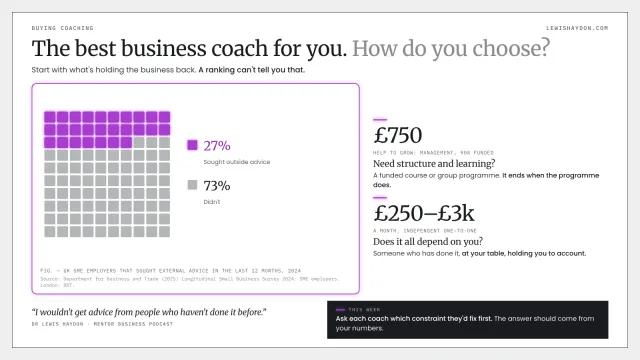
To find a business mentor, go where owners like you already are: other business owners you respect, your accountant, your regional business support service and funded programmes such as Help to Grow: Management. Then shortlist two or three people and keep only the ones who can show you a business they own and run now, results with owners at your size, and their prices in writing.
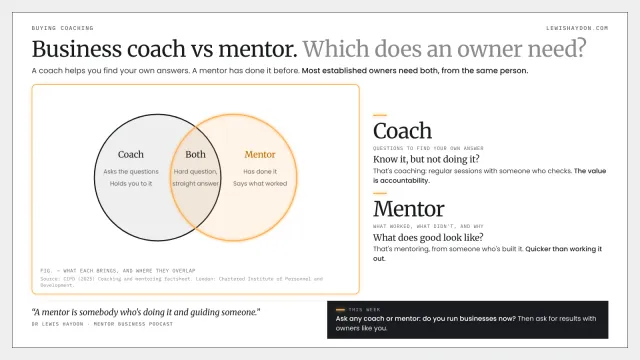
For an established business, the free routes make a good sounding board, but the hours are limited. If the business still depends on you and you want someone at your table every month, holding you to what you said you’d do, you’ll be paying for it. If you’re working out how to find a business coach rather than a mentor, the process is the same. The title matters less than the evidence. The difference between the two is set out in business coach vs mentor.
Where to look for a business mentor in the UK
- Other owners. Ask two or three owners you respect, who are a few steps ahead of you, who they’ve worked with and what changed. When they recommend someone, you can see the business that person helped.
- Your accountant, solicitor or bank manager. They see which of their clients grew, and often know who was in the room when it happened.
- Your regional business support service. In Birmingham, UK, and the wider West Midlands, that’s Business Growth West Midlands, run by the West Midlands Combined Authority. It was overhauled in 2025 to focus on businesses with the most potential to grow (West Midlands Combined Authority, 2025). Elsewhere in England, ask your council or combined authority for its Growth Hub.
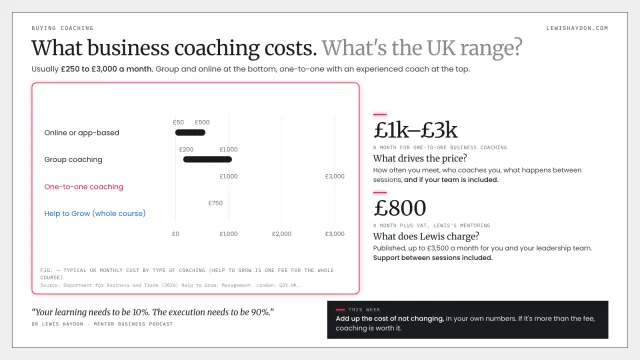
- Help to Grow: Management. A 12-week course for SME leaders, 90% funded by the government, at £750 per participant, with 10 hours of one-to-one mentoring. Your business needs 5 to 249 employees and at least a year’s trading. Aston Business School runs it in Birmingham, alongside business schools across the UK (Aston University, 2026).
- Adviser marketplaces. Enterprise Nation lists small business advisers you can contact directly. You usually get a short discovery call first; after that, expect to pay (Enterprise Nation, no date).
| Route | What it costs | Who it suits | What you get |
|---|---|---|---|
| Owners you know | Nothing to ask | Any owner | A name with evidence behind it |
| Regional support (Growth Hubs, Business Growth West Midlands) | Publicly funded; ask what, if anything, is charged | Owners after a first conversation, programmes or grants | Advice and signposting, not ongoing support |
| Help to Grow: Management | £750 for the course | 5 to 249 employees, trading a year or more | A course plus 10 hours of one-to-one mentoring |
| Adviser marketplaces | Set by each adviser after the first call | One specific gap, such as marketing or finance | A specialist for a project |
| Paid one-to-one mentor | Roughly £250 to £3,000 a month, before VAT | Owners whose business still depends on them | Regular sessions, accountability, someone who has done it |
The paid range is what I see in the UK market; the other figures are referenced.
Free business mentoring, and where it runs out
Look, free help is fine for a chat. But ten hours spread over a 12-week course isn’t going to change how a £3m business runs. The government’s own evaluation of Help to Grow: Management, published in June 2026, found that 89% of completers matched with a mentor were satisfied. But only 61% of those matched used all ten hours of mentoring, around a third of everyone who finished the course. It also found no statistically significant evidence of business growth or better productivity yet, which the evaluators say usually takes longer to show (Ipsos and Institute for Employment Studies, 2026).
It’s also worth asking whether the mentor you’re matched with owns a business today, or ran one years ago. Both can help, but they’re not the same thing when you’re dealing with this year’s wage bill.
And most owners already have a free mentor: family. On the podcast I put it like this: “Maybe you’ll get advice from your stepdad or an uncle or an auntie or sister. People who want the best for you, but it’s not helping you move forward.”
Check they’ve actually done it
Ask to see it. This is what I said on an episode about how owners pay themselves:
“Think about the mentors and the coaches and the consultants that you’re bringing in and go, all right, mate, cool. Well, show me your business. Show me your bank account. Show me that you’ve got the evidence that you’ve done it.”
And if they’ve built it for clients rather than themselves, the evidence looks different: “Here’s the portfolio of the people that we’ve done it with and what they’re saying.” Either way, you need some sort of evidence behind it.
In the UK you can check part of this yourself in a couple of minutes. Search the person’s name on Companies House. It’s free to use and lets you search officers as well as companies (Companies House, 2021), so you can see which companies they’re a director of. It won’t tell you whether those businesses are any good, but you’ll see whether they’re a director of one today.
Then ask to speak to two owners they’ve worked with, at roughly your size. A good mentor can set that up without a fuss.
My four questions
In an episode on the true cost of the wrong advice, I boiled it down to four questions to ask about anyone you take advice from:
- Are they aligned with your mission, your values and your goals?
- Are they still learning? What does their circle look like, and where do they get their own advice?
- Are they doing it? Today, in a business of their own, not in one they sold years ago.
- Are they doing the right thing? How they treat people, and whether their values sit well with yours.
If you’ve got two or three names on the list, go to lewishaydon.com/tools and use the choose a business coach tool to put them through ten questions side by side.
What to ask on the first call
Ask these in the first conversation, and notice how easily the answers come:
- Which businesses do you own and run now, and can I meet an owner you’ve worked with?
- What would you want to see in my numbers before you tell me what to do?
- Have you turned anyone down recently? Why?
- What would you expect to have changed in my business after six months, and how would we measure it?
- If something goes wrong between sessions, can I call you?
- What’s the minimum term, and how do I leave if it isn’t working?
- What are you learning at the moment, and who from?
Red flags I’d walk away from
- They can’t show you anything they’ve built, for themselves or for clients.
- They’ll take anyone. In a KPIs episode I said: “The coaches and mentors and personal trainers that sack the clients are the ones that you probably should be hanging around more. Because they know that it’s just wasting everybody’s time. They’re not there to take money.”
- You only see a price after a long sales process.
- They tell you what to do before they’ve asked about your numbers.
- Pressure to sign on the call, or a long contract with no way out.
- Every story is from a business they ran a long time ago.
How much does a business mentor cost in the UK?
The free routes cost you time. Help to Grow: Management is £750 for the course. Paid one-to-one mentoring in the UK runs from roughly £250 to £3,000 a month, depending on how often you meet, who the mentor is, what happens between sessions and whether your team is included. The full breakdown is in how much business coaching costs in the UK.
Judge it against what carrying on as you are is costing you.
Where I fit
I’m one of the options, so read this part with that in mind.
I’m Dr Lewis Haydon, a business coach and mentor who ACTUALLY owns businesses. I work with owners of established businesses from £250k to £20m turnover, usually where everything still goes through the owner, and the aim is a business that grows without you. I mentor owners on Zoom wherever they are, and in person in Birmingham and across the West Midlands. Mentoring is from £800 a month plus VAT, and every price is on the pricing page. If I’m not the right person for you, I’ll say so and point you to someone who is.
If you’re weighing up a mentor and want a second opinion, book a virtual coffee. Bring your biggest question about scaling the business, and leave with a straight answer.
References
- Aston University (2026) Help to Grow: Management. Birmingham: Aston Business School. Available at: https://www.aston.ac.uk/research/bss/abs/centres-hubs/aston-centre-for-growth/help-to-grow-management (Accessed: 2 November 2026).
- Companies House (2021) Using the Find and update company information service. Companies House blog, 3 September. Available at: https://companieshouse.blog.gov.uk/2021/09/03/using-the-find-and-update-company-information-service/ (Accessed: 2 November 2026).
- Enterprise Nation (no date) Why you should connect with an adviser on Enterprise Nation. London: Enterprise Nation. Available at: https://www.enterprisenation.com/learn-something/why-you-should-connect-with-an-adviser-on-enterprise-nation/ (Accessed: 2 November 2026).
- Ipsos and Institute for Employment Studies (2026) Evaluation of Help to Grow: Management Phase 1 (2021-2025): final evaluation report. London: Department for Business and Trade. Available at: https://assets.publishing.service.gov.uk/media/6a297517d95ffddb05d4ae28/help-to-grow-management-phase-1-final-evaluation-report-process-and-impact-evaluation.pdf (Accessed: 2 November 2026).
- West Midlands Combined Authority (2025) Mayor announces business support shake-up. Birmingham: WMCA, 29 July. Available at: https://www.wmca.org.uk/news/mayor-announces-business-support-shake-up/ (Accessed: 2 November 2026).