Article
Mindset Coaching for Business Owners: What It Is and When It Works
7 min read · Published 16.11.2026
Mindset coaching starts with how you think. What you do comes after that. For a business owner that means the beliefs behind your decisions: what you think is possible, who you blame when it goes wrong, and whether you’re prepared to invest. It works when it’s tied to the numbers in the business. I don’t think it works on its own.
I’ve got a view on this from two sides. I own and invest in businesses, and some of the mindsets below nearly cost me millions. I also spent my doctorate studying it.
What is mindset coaching?
It’s coaching that looks at the way you think and how that shows up in the business. It asks why the plan you already have hasn’t happened yet.
I speak to a lot of business owners, from one-man bands to people with a hundred employees. On the podcast I said what interests me is “not just what they’re saying, but how their brains are thinking, how their minds are wired.” Two owners in the same trade, with the same market, will get very different results, and a lot of that comes down to how they think.
Does mindset matter in business? What the research says
When I went to the university to do my doctorate, I said I wanted to study emotional intelligence in business, and they went: here we go again. So it became psychological capital: what changes how someone behaves from one day to the next, what makes them have a good day or a bad one, and how you measure it.
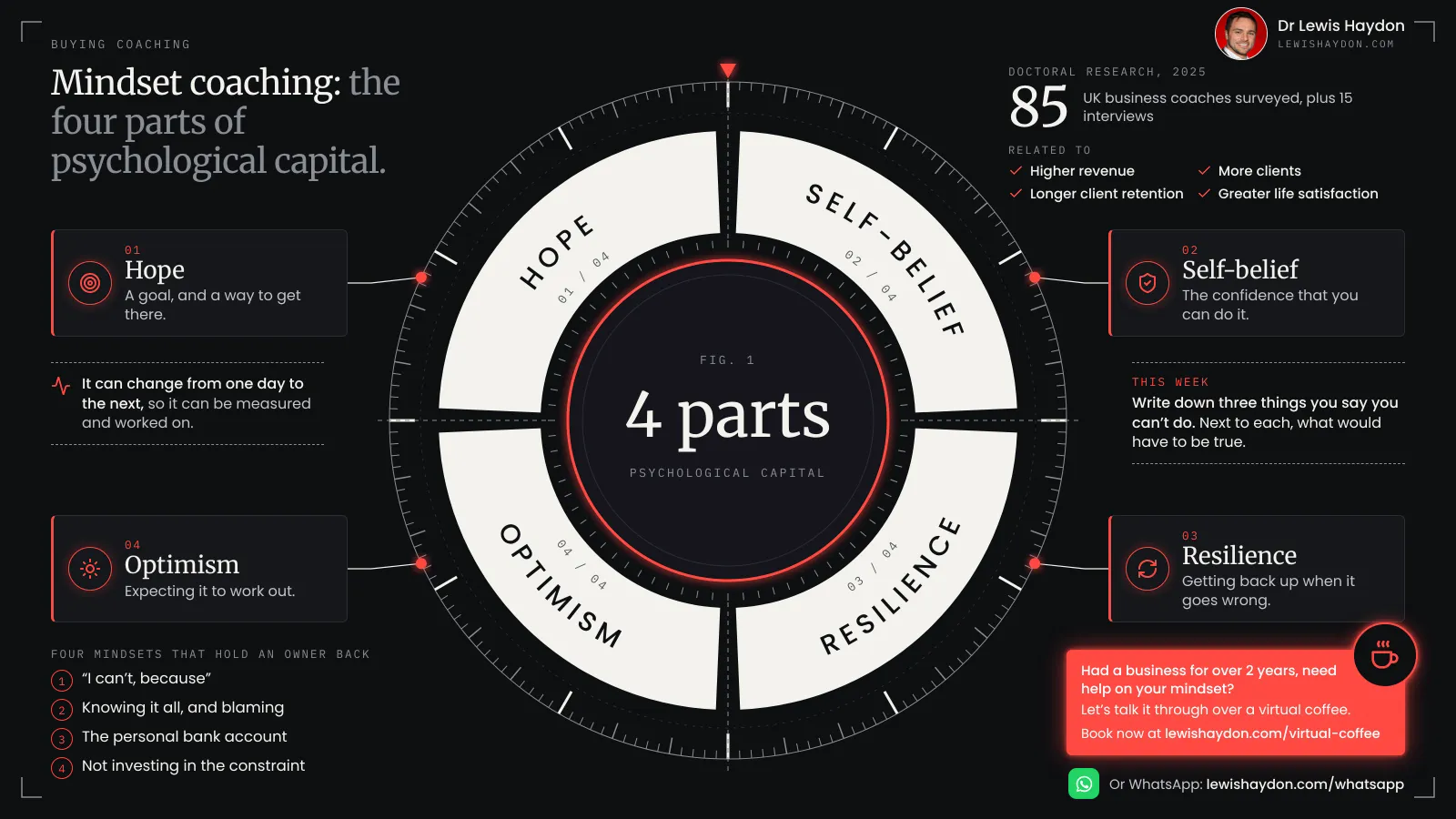
Psychological capital is made up of four things: hope, self-belief, resilience and optimism. Hope is having a goal and a way to get there. Self-belief is the confidence that you can do it. Resilience is getting back up when it goes wrong. Optimism is expecting it to work out. My research was with UK business coaches, through 15 interviews and a survey of 85. It found that psychological capital was related to higher revenue, more clients, longer client retention and greater life satisfaction (Haydon, 2025).
That was a study of coaches building their own practices, so I won’t claim it proves the same for every business. But it’s evidence that the way a person thinks is tied to results you can count, and it matches what I see in the owners I work with.
The four mindsets that nearly cost me millions
I went through these on the podcast. They come in stages, and each one held me back at the time.
1. “I can’t, because”
If you think you can or you think you can’t, you’re right. Owners at this stage have a reason why it isn’t possible. “I can’t find great people” is the one I hear most. I don’t mean excuse in an offensive way. But while you believe it, you won’t do anything about it.
2. Thinking you know it all, and blaming everything else
I wish I’d known this one earlier. When I started putting managers in, I blamed them when it went wrong. If the hire didn’t work, it was my recruitment process that wasn’t good enough.
3. Treating the business like your personal bank account
Business growth costs money. You have to invest. If every pound the business makes is already spent in your head, you won’t put it into the people and systems that get you to the next level.
4. Investing, but not in the constraint
This is the one for bigger businesses. You’ve got systems, you’ve got time back, and you’re prepared to spend. If you invest in the business but not in the constraint, it won’t make a difference. You have to get comfortable with pressure and keep looking for the next constraint.
The full episode is the four stages of business mindset.
Mindset coaching vs business coaching: do you need both?
Yes, and in that order. One of my podcast episodes is called Confidence comes first, strategy comes second, and I still think that’s right. If you don’t believe the plan is possible, you won’t carry it out, however good it is.
But mindset without the business side doesn’t pay you either. You can feel great and still have no sales process and no idea what your margin is. So I work on both together. We find the constraint in the business, and we deal with whatever thinking has kept it there. That’s how business coaching and mentoring works with me, and for you and your senior team it’s executive coaching.
How do you know if mindset is your constraint?
Listen to your own language for a week.
- Do you say “I can’t, because” more than “how could I”?
- When something goes wrong, is your first thought about who did it, or about which process let it happen?
- When did you last invest in the business and feel uncomfortable about it?
- Can you name the one constraint holding the business back right now?
If you want to figure out where the constraint is, go to lewishaydon.com/tools and use the gap analysis template. The scorecard takes a few minutes and shows which part of the business is furthest behind.
What is the wrong mindset costing your business?
Stage one costs you the hires you never make and the customers you never go after. Then you lose good people, because they get blamed for a process that was never there. At stage three the business stays the size you can run from your own pocket. At stage four you spend real money and nothing changes, because it went on the wrong thing.
It also costs time. These held me back for a long time before I saw them, and a coach who has been through them can point at one while it’s happening.
Once you think differently, you start asking how you’d do it, who could do it and what it would cost. You look at your own process before you look at your people. You invest where the business is stuck, and you can see the result in the numbers.
First steps with me
- Write down the three things you say you can’t do in the business. Next to each one, write what would have to be true for it to be possible.
- Use the free scorecard to find the part of the business that’s furthest behind. That’s usually where the thinking is stuck too.
- Bring both to a virtual coffee: 30 minutes on Zoom, no charge. Or WhatsApp me. Mentoring is from £800 a month plus VAT, and every price is published.
FAQs
What does a mindset coach do?
A mindset coach works on how you think when you make decisions. For a business owner, that means what you believe is possible, how you respond when things go wrong, and whether you’re willing to invest in growth.
Is mindset coaching worth it for a business owner?
It is when it’s tied to the business. My doctoral research found psychological capital was related to higher revenue, more clients and longer client retention among UK business coaches. Mindset work with no link to your numbers is harder to judge.
What is psychological capital?
It’s a measure made up of hope, self-belief, resilience and optimism. It can change from one day to the next, so it can be measured and worked on.
What is the difference between a mindset coach and a business coach?
A mindset coach focuses on how you think. A business coach focuses on the business: sales, marketing, the team, the numbers. In my experience an owner needs both, with the thinking dealt with first.
How long does it take to change your mindset?
It depends on the person and how long they’ve held the belief. I wish I’d seen mine a lot earlier. With someone who has been through the same stages it’s quicker.
How does working with you start?
With a virtual coffee: 30 minutes on Zoom, no charge. Bring the thing you keep saying you can’t do and I’ll give you a straight answer. If it’s worth going further, mentoring starts from £800 a month plus VAT and every price is published.
References
- Haydon, L. J. (2025) How UK business coaches cope and persist towards higher levels of objective and subjective success in boundaryless careers. DBA thesis. Aston University. Available at: https://doi.org/10.48780/publications.aston.ac.uk.00048796
- Haydon, L. (2025) ‘4 stages of mindset that nearly cost me millions’, Mentor Business Podcast, 18 June. Available at: https://lewishaydon.com/podcast/4-stages-of-mindset-that-nearly-cost-me-millions-dont-do-the-same/
- Haydon, L. (2025) ‘Confidence comes first, strategy comes second’, Mentor Business Podcast, 23 July. Available at: https://lewishaydon.com/podcast/confidence-comes-first-strategy-comes-second/
Want a straight answer on what’s holding you back?
If you can’t tell whether it’s the business or your own thinking, book a virtual coffee and bring your numbers. I’m Dr Lewis Haydon, a business coach and mentor who ACTUALLY owns businesses, and my doctorate studied how UK business coaches cope and persist. My prices are published if you’d like to see them first.