Article
Time Management Tips for Business Owners: Where Your Week Really Goes
Topic · Owner payoff and profit · 6 min read · Published 25.03.2025 · Updated 23.10.2026
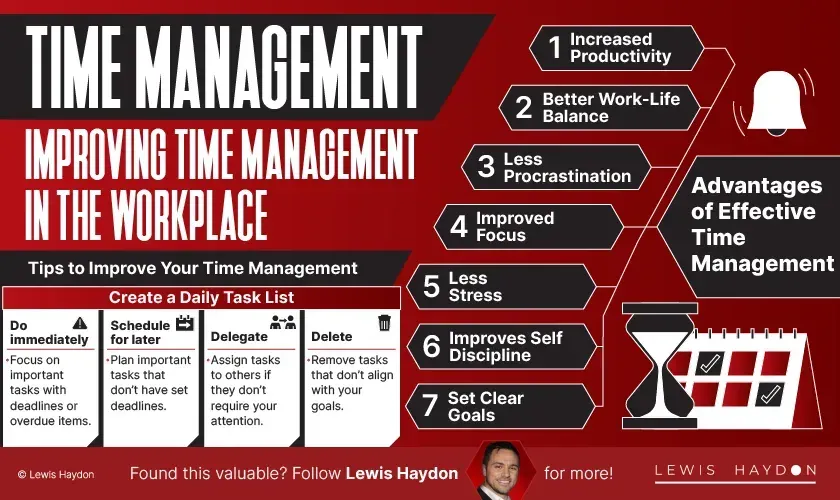
For a business owner, time management isn’t about fitting more into the day. It’s about deciding what only you should be doing, and getting everything else off your desk. Track a week or two in half-hour blocks, colour-code what only you can do, put your non-negotiables in the diary first, delegate or drop the rest, and review it every week. Busyness does not equal effectiveness.
Show me your diary each week and I’ll show you where you’ll be in six months.
Why owners run out of time
Everybody gets the same 24 hours. It doesn’t matter whether you run a £300k business or a £20m one. What changes is what you fill them with.
I once coached a founder whose business was turning over 2.5 million a year. On paper it looked successful. But he was spending half his week firefighting: answering messages, checking in on marketing, double-checking sales reports. When we tracked his week, over 30% of his time was going on reactive, low-value work. And he thought he was being really productive.
That’s the trap. The work that got the business off the ground was you doing everything, with energy, because you cared. What got you here won’t get you there. At some point the most valuable thing you can do is stop doing that work yourself.
Do the maths on it. If 10 hours a week of your time goes on things someone else could do, that’s over 500 hours a year. That’s a full working month, gone.
Time management tips that work for owners
1. Do a proper time audit
For one week, or two if your weeks vary, write down what you did every half an hour. Do it as you go, not at the end of the day from memory. Memory always flatters you.
It’s like keeping a food diary when you’re trying to lose weight. Everyone knows the answer is eat less and move more. The diary just shows you where the calories really come from. A time audit does the same for your week.
People don’t like the word “audit”. It sounds corporate. It isn’t. Time is the one thing you can’t cheat, and the audit is just the truth about where yours goes.
2. Colour-code what you find
Take three coloured pens and go through the audit:
- Only you can do it, and it moves the business towards your goal. Strategy, key relationships, the big decisions, holding your senior people to account.
- Someone else could do it. Most admin, most operational work, a lot of selling and a lot of firefighting.
- Nobody should be doing it. Meetings with no purpose, reports nobody reads, re-explaining the same task for the fourth time.
The first colour is your job. The second colour is someone else’s job. The third colour stops.
3. Put your non-negotiables in first
Before anything else goes in the diary, put in the things that matter most to you. For me that’s the school run: you won’t get me between half eight and nine in the morning, and my clients know it. For you it might be family time, your fitness, holidays, a day a week on the business rather than in it.
Then build the work around them. If you wait until the work is done to make time for the things you started the business for, you’ll never get to them. Remember, the business is a vehicle for your life, not the other way round.
4. Work out what an hour of your time is worth
Look at the tasks in your second colour and ask what it would cost to pay someone to do them. If you can hire someone at a fraction of what your hour is worth, they should be doing it, not you. Your time goes on the work that would still grow the business if you only did it once a month: the strategic meeting, the senior hire, the big customer, the plan.
5. Stop being the emergency fixer
Every time you jump in to fix someone else’s mistake, you teach them that you’ll always fix it. Let them fix it. That’s how they learn they can.
A football coach doesn’t run on the pitch and start kicking the ball because the team is struggling. Coach them, then let them play. The same goes for customers: if a customer only wants to deal with you, it’s usually because you’ve trained them to. Call them, check the team looked after them, and step back.
6. Cut meetings without a purpose
A 90-minute meeting you didn’t need to be in is 90 minutes you could have spent writing the job advert for the manager who’d run that meeting, going through your P&L, or finding the constraint in your sales. Every meeting needs a reason, an owner and an outcome, or you don’t go.
7. Hire people who save you time, not cost you time
One of the biggest changes I’ve made in any business is to stop hiring the cheapest person for senior roles. A cheap hire you have to train, check and correct costs you more of your time, not less. Juniors and apprentices earn their way up. Senior roles need a track record, so that within a few months they’re paying for themselves several times over and giving you hours back.
8. Block time for deep work and review it weekly
Protect blocks in your diary for the work that needs real thinking, and treat them like a meeting with your most important customer. At the end of each week, look back at the diary. What moved the business forward? What crept back in that shouldn’t have? Adjust next week.
The research behind it
My doctorate interviewed fifteen people running client-dependent advisory practices in the UK, ten of them owners. All fifteen named flexibility, control of their own time and being judged on results rather than hours, as a reason they did the work. One put it this way: “you don’t have to work 12 hours, 15 hours a day, you can manage your own time, as long as the results that you want, are within that time”.
But it didn’t happen by itself. As another said: “we’re not immune to having to be really deliberate in making that happen in our businesses”. The full findings are in what keeps owner-operators going, and what nearly stops them.
That matches what I see with owners. Control of your time is one of the reasons you started. You only get it by designing your diary on purpose.
Stop thinking operator, start thinking architect
Every time you step back into sales, delivery or admin, nobody is sitting in the managing director’s chair. That’s the real cost of poor time management for an owner: not the hours, but the decisions that don’t get made, the people who don’t get developed, and a business that stays dependent on you.
Stop being the hero. Start building the system. Your diary is where that starts.
What to read next
- How to build a high performing team that runs the business without you.
- When and how to hire employees, so the right work comes off your desk.
- How to pay yourself as a business owner, the number your time should be serving.
- Sales KPIs, so you can check the numbers without doing the work.
If the business still needs you in every part of it, that’s the kind of thing I work on with owners. You can see how I work and what it costs.