Article
Servant Leadership: What It Is, and When It Works for a Business Owner
Topic · Team, structure and delegation · 6 min read · Published 11.03.2025 · Updated 23.10.2026
Servant leadership means the leader’s main job is to help their people grow and perform, rather than to be served by them. The idea comes from Robert Greenleaf’s 1970 essay The Servant as Leader: you lead by listening, removing obstacles and developing others, so the team can do the work without you. For a business owner, it works when it comes with clear standards and accountability. Without those, “serving the team” turns into doing everyone’s job for them.
That distinction is the whole article, so let’s take it properly.
What is servant leadership?
In a traditional business, the team serves the boss. Decisions go up, instructions come down, and the owner sits at the top of the chart.
Servant leadership turns that the other way up. The leader asks: what do my people need to do their best work, and what’s in their way? Then they go and fix that. The measure of the leader is how well the people around them grow.
I’ll put it in owner terms. When someone joins one of my businesses, I ask them what their goals are. Not as a nice-to-have. I need to know their goals so I know what to invest in them, how much of my time they need, and what they’ll take ownership of. Their goals become part of the business’s goals. That’s servant leadership in practice: you serve the person’s growth because it’s how the business grows.
The principles of servant leadership
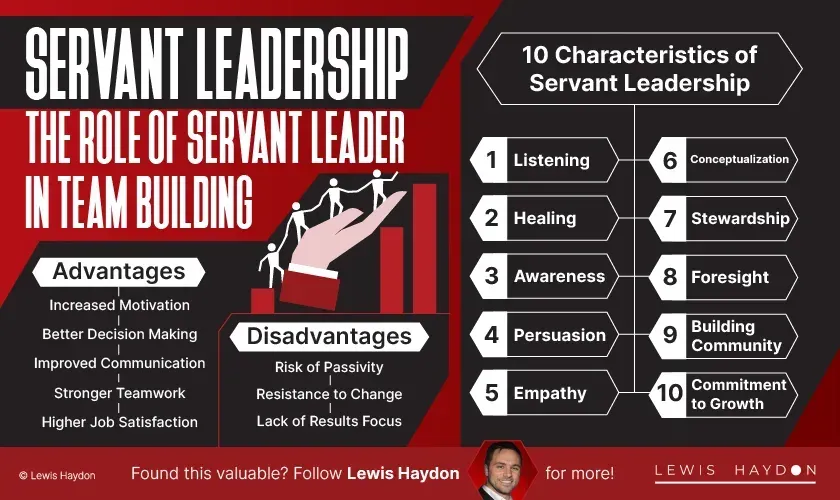
Larry Spears, who led the Greenleaf Center, set out ten characteristics of a servant leader. In short:
- Listening: hearing what people say, and what they don’t.
- Empathy: understanding the person, not just the task.
- Healing: helping people recover from setbacks.
- Awareness: of yourself and of what’s going on around you.
- Persuasion: bringing people with you instead of ordering them.
- Conceptualisation: thinking beyond today’s firefighting.
- Foresight: learning from the past to see what’s coming.
- Stewardship: holding the business in trust for others.
- Commitment to people’s growth: developing every person, not just the stars.
- Building community: a team that looks after each other.
All good. But a list of virtues doesn’t tell an owner what to do on Monday morning. Here’s how I’d translate it.
Servant leadership in an owner-led business
Build the dance floor, and let them dance in it
Serving your team doesn’t mean telling them how to do everything. It means building the conditions they need: clear goals, the right systems, the tools, the authority to decide. Then you step back. Build the dance floor and let them dance in it. They find their own way of doing the work, and they learn and grow because of it.
Systems first, then people
Before you blame someone for falling short, ask whether you gave them a system that works. The systems run the business; the people run the systems; nobody is above the system, including you. Serving your people means fixing the system before you judge the person.
Don’t undermine your managers
The fastest way to destroy a manager’s authority is to go round them. As soon as you pick up the phone to their team or their customer yourself, you’ve told everyone who really makes the decisions. A servant leader backs the people they’ve put in charge, in public, and has the hard conversation in private.
Be direct, from a place of care
Servant leadership isn’t being soft. Being candid and direct is only ever okay as long as it comes from a place of care: wanting the best for the business and, most of all, for the person. Tell people where they stand, early and plainly. Wrapping it in praise so it doesn’t sting just leaves them guessing.
Coach, don’t rescue
Coaching is bringing out the best in people. It isn’t doing it for them. When someone brings you a problem, ask what they think the options are and what they’ll commit to by next week. Then hold them to it. If you keep solving it yourself, you’ve built a team that brings you every problem.
The pros and cons of servant leadership for an owner
| Pros | Cons |
|---|---|
| People grow, so the business can grow without everything going through you | Can slide into the owner doing everyone’s job “to help” |
| Capable people stay: there’s something for them to own | Slower decisions if every view has to be heard first |
| Problems surface early, because people trust you with them | “Yes, boss” agreement can hide problems if you only listen and never check |
| Managers grow into leaders, which is what makes the business sellable | Doesn’t work without clear standards and consequences |
| The culture you want happens on purpose | Hard to sustain when cash is tight and decisions are urgent |
When servant leadership works, and when it doesn’t
It works when:
- You have capable people who want to grow.
- The goals and standards are clear and written down.
- There’s a weekly dashboard everyone can see, so serving people never means lowering the bar.
- You want the business to run without you, to scale it, step back, or sell it one day.
It doesn’t work when:
- Nobody knows what good looks like. You can’t serve people towards a standard that doesn’t exist.
- There are no consequences. If the same number stays red week after week and nothing happens, that isn’t service. Your best people will notice, and they’ll leave, because capable people don’t stay in a business that isn’t winning.
- It’s a crisis. When the house is on fire, people need someone to say clearly what happens next. Lead from the front, then go back to serving once it’s out.
- It’s really the owner avoiding a hard conversation and calling it kindness.
Servant leadership vs other leadership styles
- Servant vs authoritative: an authoritative leader sets the direction and expects people to follow it. A servant leader sets the direction and then asks what people need to get there. Good owners do both: clear on the destination, generous on the support.
- Servant vs pacesetting: a pacesetting leader sets a high standard by doing it themselves and expects others to keep up. It gets fast results in the short term and burns people out in the long term. Servant leadership is slower to start and lasts longer.
- Servant vs laissez-faire: hands-off leaders leave people alone. Servant leaders stay involved in people’s growth; they just stay out of the way of the work.
How to start
- Ask each person in your team what their goals are, in work and outside it.
- Write down what good looks like in their role, as numbers where you can.
- Put the numbers on a weekly dashboard and review them together.
- Ask one question more often: “What’s getting in your way?” Then go and remove it.
- Stop answering questions your managers should be answering.
What to read next
- How to build a high performing team that runs the business without you.
- Qualities of a good leader, from an owner’s side of the desk.
- Pacesetting leadership, and why leading from the front stops working.
- When and how to hire employees, so you hire people worth serving.
If everything in the business still comes back to you, that’s the kind of thing I work on with owners. You can see how I work and what it costs.