Article
What Is Business Min-Maxing? Why Entrepreneurs Need to Know About It
Topic · Growth and scaling · 11 min read · Published 13.11.2026

Full episode transcript and chapters
Business min-maxing is using the resources you already have, and putting them into the one area of the business that’s holding the rest back. You score marketing, sales and operations out of 10, find the constraint, and maximise what you’ve already got in that area, rather than spending money you don’t have on an expert to run it for you. It starts once every area is above a 7 and the easy gains have gone. The small gains left feel trivial, but they compound inside the department and across the business. It’s what I do in my own businesses and with the owners I coach, and it works because the parts of a business multiply. They don’t add.
What does min-maxing mean?
The term comes from gaming. A player who min-maxes a character puts the fewest points into what doesn’t matter and the most into what does, so the character wins with the points it’s got. An owner’s time, cash and people are limited in the same way. Business min-maxing is the same idea applied to a business: minimum spend, maximum effect, in the right place.
Why the parts of a business multiply, not add
The parts of a business multiply. Rather than 2 plus 2, we work on 2 multiplied by 2. At small numbers it’s the same result. But 3 plus 3 is 6, and 3 times 3 is 9. 10 plus 10 is 20, and 10 times 10 is 100. Now put another variable in: 10 plus 10 plus 10 is 30, and 10 times 10 times 10 is 1,000. That’s how compounding works.
Those three variables are the parts of your business: marketing, sales and operations. Marketing has to bring in a certain amount of leads. Sales has to convert them. Operations has to deliver it profitably. Because they multiply, a weak one drags down everything the other two do.
What is the theory of constraints?
The theory of constraints says every business has one part that limits what the whole thing can produce, and improving anything else leaves the output where it was. It comes from Eliyahu Goldratt, who set it out in his novel The Goal and then in Theory of Constraints (Goldratt, 1990). I don’t use his system; I use the idea, with the scores above.
How do you find the constraint in your business?
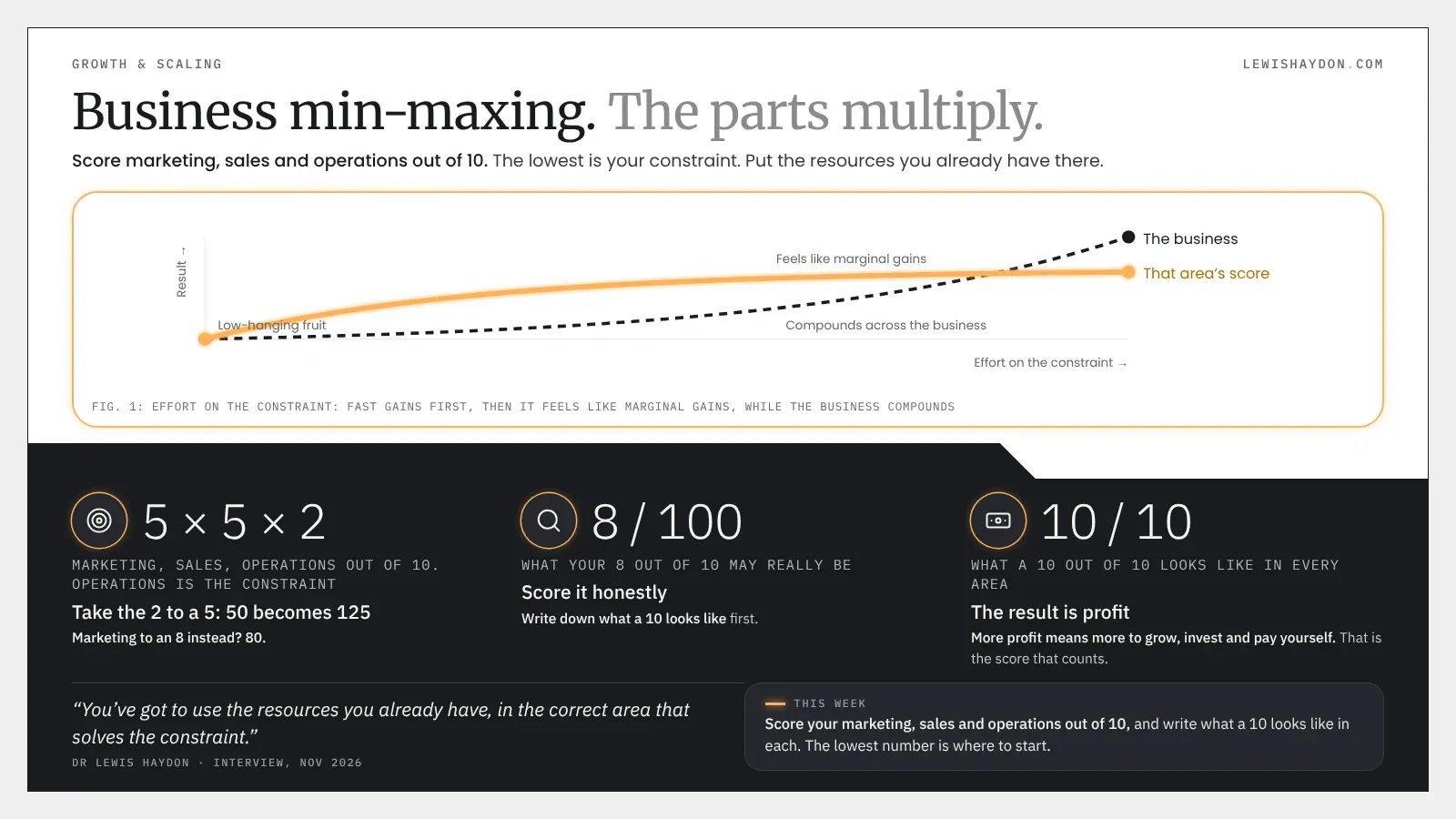
Score each part out of 10. Say your marketing is a 5 out of 10, your sales is a 5 out of 10, and your operations is only a 2 out of 10, because you aren’t very profitable. The area to focus on is operations. We call this the constraint.
If you increased the leads coming into the business with better marketing, and improved your sales conversion, you’d see an increase. But the most impact comes from increasing your profitability in operations, and it’s also where the most opportunity is. If you’re doing a 2 out of 10, there’s 8 out of 10 of potential improvement sitting there. Run the numbers: 5 times 5 times 2 is 50. Take operations to a 5 and it’s 125. Take marketing to an 8 instead and it’s only 80.
So the first step of anything I do when coaching a new client is to ask them: what is 10 out of 10 in their business? What does it actually look like? When we get really logical about it, that comes down to the profit in the business. More profit means more opportunity to grow and invest, and it’s how the owner gets paid dividends. If the owner’s goal is to get their time back, they still need more profit, because a general manager or a managing director to run the business for them doesn’t come for free.
What is a bottleneck in a business?
A bottleneck is the same thing as the constraint: the part with the lowest score, where everything the rest of the business does gets squeezed. Most owners have a feel for where theirs is. The score out of 10 turns the feel into a number you can act on.
Not sure which of the three is your 2? Take the free scorecard: five areas, scored out of 30, in about five minutes.
Is min-maxing just going for low-hanging fruit?
No. The low-hanging fruit comes first, and min-maxing is what you do when it’s gone.
What does low-hanging fruit mean in business?
The low-hanging fruit is the easy gain in your lowest-scoring area. When operations is a 2, the first improvements are obvious and cheap, and they move the whole business because of the multiplication. That’s where every owner should start.
Quick wins versus min-maxing
Eventually, with clients, those low-hanging fruits start to disappear. Then it gets difficult. Min-maxing starts when marketing, sales and operations are all above a 7 out of 10. Below that you don’t min-max: you work the constraint, the lowest score, because the easy gains there are still on the table. Getting an area from a 7 to an 8 is hard, because all the easy stuff is done. So what happens next? This is where we have to sit down and really figure out where the most effort and the most energy are needed in the business.
The danger for an SME is that it becomes really expensive when you have to get an expert, or somebody from another company, to come and run a department for you. Even if you do, that’s like getting Gordon Ramsay to sit in your kitchen when you’re selling fast-food burgers. They’ll want to do it their way, from their experience, and they’ll cost a lot of money. It can completely change a business’s culture. And sometimes it isn’t even an option, because the business can’t afford that person.
That’s where business min-maxing comes in. You’ve got to use the resources you already have, and make sure you’re maximising that resource in the correct area, the one that solves the constraint of your business.
Is business min-maxing the same as marginal gains?
No. The difference is what you get out at the other end. Marginal gains only gets you a small gain as a result. Min-maxing is finding the constraint and really diving deep on personal development, human development and business development there, so that the small gains land in the one area that maximises the business’s results: profitability. Marginal gains is doing things that don’t have much impact on the other side.
Small gains, day in, day out, refining the process in that area. The compounding works inside the department too. Marketing breaks down into all the activities that lead to the result marketing has to deliver, which is more leads into the business. Each of those activities has its own score, and they multiply in the same way. So the smallest gain on one marketing activity feels trivial on its own, but it moves marketing’s score, and marketing’s score multiplies through the business. The same gain anywhere else doesn’t.
What is the aggregation of marginal gains?
The phrase comes from British Cycling under Dave Brailsford: improve everything by 1% and the improvements add up. In a business they don’t add up, they multiply, and only through the constraint. Min-maxing is marginal gains pointed at the constraint. Marginal gains everywhere is busywork: 1% better at everything, spread across an owner’s week, is what keeps you paid last.
How do you min-max your business?
- Score marketing, sales and operations out of 10, and write down what 10 out of 10 looks like for each. Be honest. What you think is an 8 out of 10 might actually be an 8 out of 100 when you look at the full scope of what’s possible in marketing.
- Take the low-hanging fruit in the lowest score first. That’s the constraint, and the easy gains there move everything.
- When the easy gains are gone and every area is above a 7, min-max the lowest score. The constraint is still the constraint. Say the business is now an 8 in marketing, a 7 in sales and an 8 in operations. Sales is where the work is, even though a 7 feels fine, because remember what the result is: profit. A 7 in sales caps what marketing’s leads and operations’ delivery can turn into profit. 8 times 8 times 8 beats 8 times 7 times 8, and nothing you do in marketing changes that.
- Break that department into its activities and score each one. Sales breaks down into everything that leads to the result sales has to deliver, from the first conversation to the signed order. Those activities multiply too. The smallest gain on one of them feels trivial, but it moves the department’s score, and the department’s score moves the whole business.
- Sit in that seat yourself. Rather than paying an expert the profit can’t cover yet, use the resources you already have. When you sit in that seat, you understand it more. You can feel what needs to be done, and you can do it your way.
- Build the system, then hire for it. The owner’s goal is to build the system and let the people you employ run it. By min-maxing the system first, you find the right person, rather than hiring someone who may not be right at all. If it isn’t right for them, you don’t get a result, so they aren’t right for you. Min-max first, and your hiring gets better.
- Then move to the next area. Min-maxing one department doesn’t always equal profitability on its own, because the other areas will need improving too. Once that department is min-maxed, there’s more profit in the business, and you go round again.
If you want to see where your own week is going before you choose, go to lewishaydon.com/tools and use the free owner time audit.
What’s the one thing to do this week?
Score your marketing, your sales and your operations out of 10, and write down what a 10 looks like in each. The lowest number is your constraint. If the easy gains there are still on the table, take them. If they’re gone and everything is above a 7, that’s the area to min-max, with what you’ve already got.
What is a lack of min-maxing costing your business?
Go back to the scores. Marketing 5, sales 5, operations 2 is 50. The same three areas at 5, 5 and 5 is 125. That business is running at 40% of what it could do with the people, the leads and the customers it already has, and the 60% isn’t missing because the owner isn’t working hard. It’s missing because the work is going everywhere except the 2. Every month that stays true, the leads marketing brings in get squeezed through the same weak spot, the owner works harder for the same money, and the business pays everyone before it pays you. That’s the cost: not a bad year, a normal year, repeated.
Now picture it min-maxed. Operations is a 5, then a 7, then every area is above a 7 and you’re working the small gains in one department at a time. Profit goes up, and that profit pays for the next hire rather than you hoping the hire pays for itself. Each round there’s someone in the seat you used to sit in, and you get paid more for owning the business, not for running it.
First steps with me
- Score your business out of 10 in marketing, sales and operations, and write what a 10 looks like in each. Takes 20 minutes.
- Take the free scorecard to find the gap, and run the owner time audit to see how much of your week is going to the constraint and how much is going elsewhere.
- Bring your scores to a virtual coffee. I’ll tell you where I’d start and what the first gains are. If you’d rather, WhatsApp me the three numbers. 1:1 coaching is from £800 a month; how I work with owners and my prices are on the site.
The sooner you know your lowest score, the sooner you stop paying for it. Every business is different; there’s no one-size-fits-all model.
FAQs
Does min-maxing mean ignoring the other areas of the business?
No. The parts multiply, so the lowest score caps the other two whatever you do to them. You work the constraint until it’s no longer the lowest, then the next lowest becomes the constraint and you go round again. Over a year every area gets worked on, in the order that pays.
Should I hire an expert to fix my weakest area?
Not first. An expert from a bigger company costs a lot, wants to do it their way, and can change the culture of a small business. Min-max the area with the resources you already have, build the system, and then hire someone to run that system. The profit from min-maxing is what pays for them.
Is business min-maxing the same as the theory of constraints?
It uses the same idea: one part of the business limits the whole. The theory of constraints came from manufacturing. Business min-maxing is how I apply it to an owner-run business: three scores out of 10, the low-hanging fruit first, and then deep work on the constraint once every area is above a 7.
How long does business min-maxing take?
The low-hanging fruit in the lowest area usually moves the business within weeks. After that it’s small gains, day in, day out, in one department, and it feels slow, because the curve flattens. The business result doesn’t flatten, because every gain at the constraint multiplies through the other two areas.
Can a small business min-max?
It’s built for small businesses. The whole point is to get the result from the people, time and cash you already have, in the one area that’s holding the business back, rather than spending money you don’t have on a department head. Larger businesses do the same thing one level down, inside each department.
How does working with you on min-maxing start?
With your three scores. Bring them to a virtual coffee or WhatsApp me the numbers, and I’ll tell you where I’d start and what the first gains look like. If we work together, we min-max one area at a time, with the resources you’ve already got, and 1:1 coaching is from £800 a month.
References
- Goldratt, E.M. (1990) Theory of Constraints. Great Barrington, MA: North River Press.