Article
Entrepreneur Coaching: What an Entrepreneur Needs From a Coach
7 min read · Published 15.11.2026
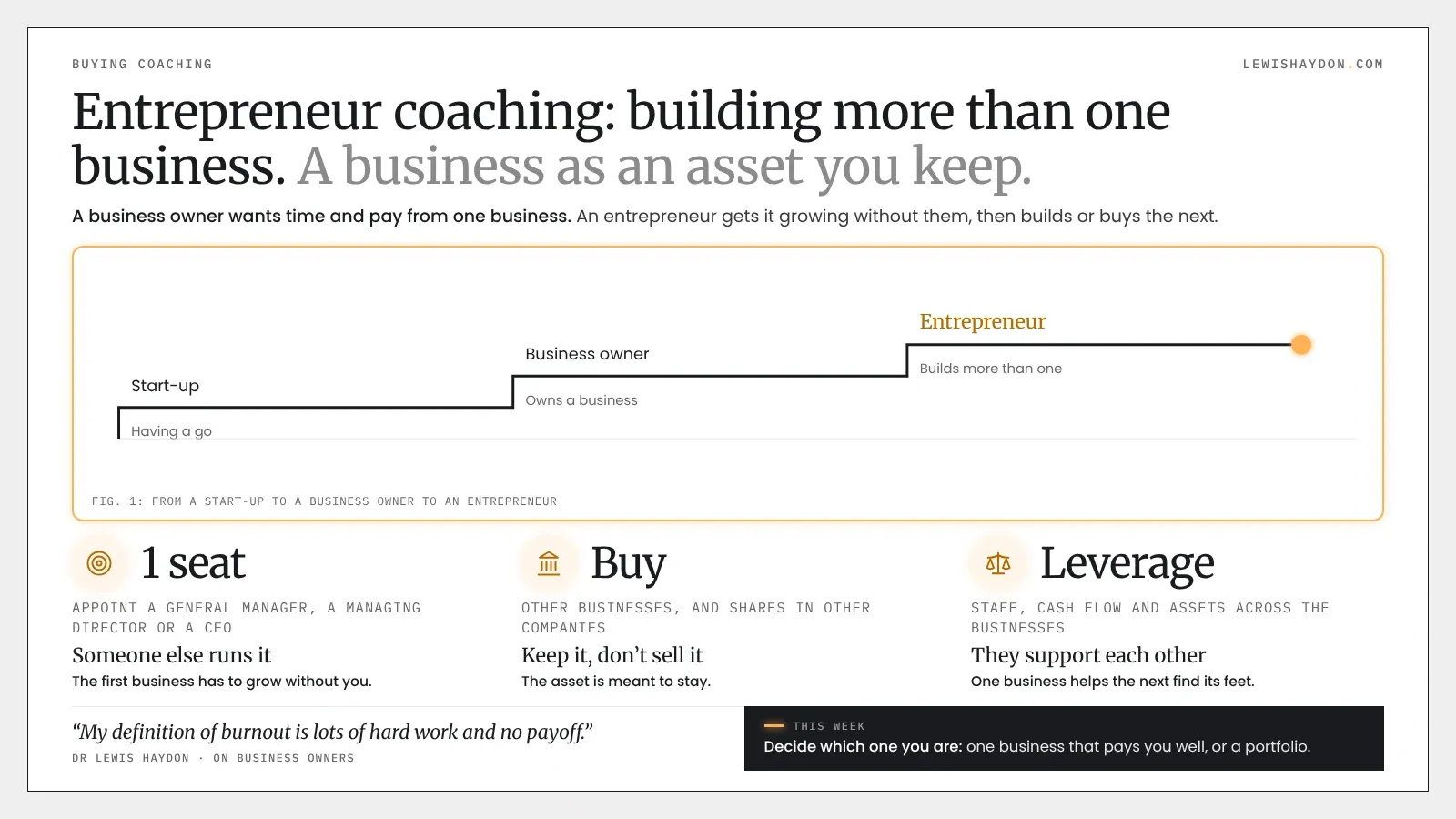
Entrepreneur coaching is for someone who treats a business as an asset and plans to build more than one. A business owner usually comes to a coach for time and pay. An entrepreneur comes to get the first business growing without them, so they can buy or build the next.
Before any of that makes sense, you have to define what an entrepreneur is. I think the word gets used too loosely.
What is an entrepreneur?
Lots of people go on Instagram with an idea for a business. They might be vibe coding something they have in mind. They’ve never done it before and they’re not making any sales yet. It’s good to have a go, and it’s how entrepreneurs first start out.
But then “entrepreneur” goes in the bio as a title. That’s somebody doing a start-up, which is great. It doesn’t make them an entrepreneur yet.
The dictionary is looser than I am. It will tell you an entrepreneur is a person who makes money by starting or running businesses, especially when that means taking financial risks. By that definition, anyone with a business qualifies.
My definition is narrower. A business owner is somebody who owns a business. That one is pretty clear. An entrepreneur is somebody who thinks about businesses as assets and builds a portfolio of them, where the businesses support each other.
There’s also a big difference between thinking like an entrepreneur and behaving like one. Thinking like an entrepreneur is spotting opportunities to solve problems. Behaving like an entrepreneur is scaling businesses as assets. One is having the idea and the other is doing it.
Entrepreneur vs business owner: what’s the difference?
The business owner has one business and wants more from it. In my experience they want their time back. They want to get paid more and don’t know how. They want to see results from their hard work and they don’t know what direction to take. Some want to build a legacy, sell one day, or pass the business on to a family member.
They’re usually burnt out. My definition of burnout is lots of hard work and no payoff.
The entrepreneur sees the business as a vehicle. It’s a stepping stone to the next stage of what they want in life. When the first business starts to grow on its own, they keep it and build or buy another.
Once you own more than one, they can leverage from each other. You can leverage the staff, the cash flow and the assets you already have. One business can support another while it finds its feet.
Researchers who study this have names for it. Westhead and Wright (1998) separated novice founders, on their first business, from serial founders, who sell one business and later start another, and portfolio founders, who keep the first and own others at the same time. What I’m calling an entrepreneur is their portfolio founder.
Neither one is better. Plenty of owners want one good business that pays them well and gives them their life back, and that’s a fine thing to want. Be clear about which one you are, because the coaching is different.
What does a business owner need from a coach?
A way out of the hard work with no payoff. The work is usually about finding the one constraint stopping the business growing and paying you more, fixing it, then finding the next. That might be sales, margin, the team or the systems.
If that’s you, start with how working with me goes. If you run a smaller business, see small business coaching.
What does an entrepreneur need from a coach?
An entrepreneur coaching session looks at a different question. How do you build this business so it can grow without you, as an asset? The asset is meant to stay. You’re building it so you can build more businesses once it’s growing on its own.
Here’s what we work on.
- Putting someone else in the seat. An entrepreneur appoints a general manager, a managing director or a CEO. I’ve written about what a managing director does and when to appoint one, and I work with the person in that seat through CEO coaching.
- Buying other businesses. An entrepreneur keeps the one they have and looks at buying more, where a business owner might sell.
- Buying shares in other businesses. That’s investing in other companies, where you own part of it and someone else runs it.
- Looking wider. Some get interested in start-ups. Some want to do more in their community.
The aim is multiple businesses and multiple cash flow vehicles. Over time the entrepreneur becomes more of an investor in businesses than the person running one.
That’s where I sit now. I own and invest in several businesses, some of them have managing directors, and I attend each one once a week for leadership and accountability. So when an entrepreneur asks me how to get from one business to several, I tell them what I did.
If you want to see how much the first business still depends on you, go to lewishaydon.com/tools and use the owner time audit. The business valuation calculator shows what the business is worth as an asset today, and what it would be worth if it didn’t depend on you.
How do you choose a coach for entrepreneurs?
You’ll see it called entrepreneurship coaching, entrepreneurial coaching or business coaching for entrepreneurs. Whatever the name, ask whether they’ve done it. A coach who has only ever owned a coaching business can’t tell you what it’s like to have a managing director run your company, or to buy shares in someone else’s. Think about it: why would you learn how to lose weight from somebody who’s never had to lose any?
Then ask to see the evidence, and ask what it costs. I’ve set out the types of coach and what to check in business coaches for entrepreneurs, and if you’re starting with a search for someone local, read business coach near me first.
What is staying in one business costing you?
If you want to be an entrepreneur and you’re still the one running the first business, everything you own sits in one place. Your income depends on one company in one market, and you’re the one running it. If that company has a bad year, so do you and your family.
You also can’t take the next opportunity. A business comes up for sale, or someone offers you shares, and you have no time to look at it and no one to leave in charge.
When it works, the first business has someone running it and reports to you on its numbers. Its cash flow and its people help you get the second one going. You spend your week across several businesses as their owner, and you’re not relying on any single one.
First steps with me
- Decide which one you are. Write down whether you want one business that pays you well, or a portfolio. Both are fine, and it changes what you work on.
- Use the free owner time audit to see how much of your week the first business still takes, and the scorecard to find what’s holding it back.
- Bring the answer to a virtual coffee and we’ll talk through the bigger entrepreneur picture: 30 minutes on Zoom, no charge. Or WhatsApp me. Mentoring is from £800 a month plus VAT, and every price is published.
FAQs
What is entrepreneur coaching?
Coaching for someone building more than one business. It works on getting the first business to grow without you, with someone else running it, so you can buy or build the next. It also covers buying shares in other companies and how the businesses support each other.
Is entrepreneur coaching different from business coaching?
Yes. The aim is different. Business coaching usually helps an owner get more time and more pay from one business. Entrepreneur coaching treats that business as an asset to keep, and works on building a portfolio around it.
Am I an entrepreneur or a business owner?
If you own a business, you’re a business owner. By my definition you’re an entrepreneur when you think of the business as an asset and you’re building, or planning to build, more than one. If you’ve got an idea and no sales yet, you’re doing a start-up, and that’s where most entrepreneurs begin.
Do I need a managing director before I start a second business?
In my experience you need someone in the seat first, whatever the title. If the first business still needs you there every day, a second one splits your attention and both suffer. Get the first one growing without you, then look at the next.
Is it better to sell a business or keep it and buy another?
It depends on what you want. A business owner might sell to retire or pass it on. An entrepreneur usually keeps it, because a business that grows without them pays dividends and helps fund the next one. Take professional advice on your own position before you buy or sell.
How does working with you start?
With a virtual coffee: 30 minutes on Zoom, no charge. Bring your biggest question about getting from one business to the next and I’ll give you a straight answer. If it’s worth going further, mentoring starts from £800 a month plus VAT and every price is published.
References
- Oxford University Press (no date) ‘entrepreneur’, Oxford Learner’s Dictionaries. Available at: https://www.oxfordlearnersdictionaries.com/definition/english/entrepreneur (Accessed: 15 November 2026).
- Westhead, P. and Wright, M. (1998) ‘Novice, portfolio, and serial founders: are they different?’, Journal of Business Venturing, 13(3), pp. 173–204.
Want to talk through the bigger entrepreneur picture?
If you’re a business owner and you want to talk through the bigger entrepreneur picture, book a virtual coffee and bring your numbers. We’ll look at what the first business needs before you can build or buy the next. I’m Dr Lewis Haydon, a business coach and mentor who ACTUALLY owns businesses, and I’ll tell you what I’d put in place first. My prices are published if you’d like to see them first.