Article
What Does a Managing Director Do, and When Do You Appoint One?
Topic · Team, structure and delegation · 10 min read · Published 14.11.2026
A managing director runs the business day to day. They turn the plan into results, lead the senior team, own the numbers and answer for how the business performs. In most owner-managed businesses the owner holds the title by default. That works until the business needs to grow past the hours and attention of one person.
On the podcast I put the role like this. Once you’ve got a senior team, “eventually you need somebody who’s going to make sure that all these lions and lionesses, these seniors, are all singing off the same hymn sheet. You need a conductor, and that’s the managing director.”
Some of the businesses I own have managing directors in that seat today. This article covers what the job is, the difference between falling into the title as the owner and appointing someone to it, how it differs from a CEO or a general manager, and what has to be true before you hand it over.
What does a managing director do day to day?
The conductor doesn’t play an instrument. A managing director isn’t the best salesperson or the best engineer in the building. Their job is to get the heads of each department pulling the same way, every week.
In practice that means:
- Agreeing the priorities for the quarter with the senior team, and holding each of them to their numbers.
- Making the decisions that cross departments, so sales, operations and finance aren’t each waiting on the owner.
- Hiring, developing and, when it’s needed, replacing the senior people.
- Watching cash, margin and the pipeline, and acting before a problem reaches the bank account.
- Reporting to the owner or the board on what happened, what’s next and what they need.
- Protecting the culture, because people copy what the person at the top does.
That last one matters more than owners expect. As I said on the podcast, “the company will always reflect the limitations of its founder.” The same is true of whoever sits in the managing director’s chair.
The owner who falls into being managing director vs appointing one
A lot of business owners call themselves managing director. Most of us fell into it. You started the business, somebody had to have the title, and it went on your email signature. Nobody appointed you, and nobody ever wrote down what the job was.
That’s a different thing from appointing a managing director.
When you fall into it, the title sits on top of everything else you do. You’re the best salesperson, the one customers ask for, the one who fixes the problem at four o’clock on a Friday, and the managing director as well. On the podcast I called that being an operator, not an owner: “They feel that they’ve got to be there 50 hours, 60 hours, 70 hours a week, because there’s all this stuff that needs doing.” You’ve got the title, and you’re still doing a job.
When you appoint one, it’s a decision. The role is written down, the person is chosen for it, they have the authority to run the business, and they answer to you for the numbers. You stop being the conductor and become the owner of the asset. That’s what lets a business grow without you.
This is where owners get stuck. As I said on the podcast, “you need a conductor, and that’s the managing director, but you’re the managing director.” The seat is taken, and it’s taken by you.
So ask yourself which one you are. If the title came with the company and your week is still full of doing, you fell into it. The rest of this article is about getting to the second kind, whether that’s someone else in the seat or you doing the job properly for now while you build towards it.
Managing director vs CEO: is there a difference?
In a lot of UK businesses it’s the same job under two titles. Managing director is the traditional title in a private limited company. Chief executive is more common in larger companies and groups, and in businesses that deal with American customers or investors.
Where a group has both, the CEO usually leads the whole group and each company in it has its own managing director. If you’re the owner and you’re moving out of the day-to-day, the shift is the one I work on in CEO coaching: from thinking like an employee or a manager to thinking like the person who owns the asset.
General manager vs managing director: which title should you use?
It depends on the business. I’d weigh up the structure of the business, the title you want to give as an incentive, how much you want to pay, and how you want the role to be seen inside the business and by customers and suppliers. Most of all, think about how it may influence the culture.
A general manager title often suits someone running the operation while you still set the direction. A managing director title tells the team, the bank and your customers that this person now runs the company. Neither is right for every business. What matters is that the title matches the authority you’re really handing over.
When do you appoint a managing director?
I won’t give you a turnover figure, because it isn’t one. Revenue differs by business. The real trigger is that the business needs a full-time conductor and you can’t, or don’t want to, be that person any more.
Finding someone is the easy part. Letting go of the decisions is what most owners struggle with. On the podcast I said: “If you are the managing director of your baby, your company, it’s very difficult to step away. One, because it’s a nice title. And two, because it’s your baby. You want to make sure everything is done right.”
I use a property example for this. A business is an asset, just like a property. You wouldn’t buy a house, rent it to a family, then sit in the corner of their living room while they watch television. But that’s what a lot of owners do in their own business. “There has to be a shift from you being the person who lives in the house to now owns the house as an asset.”
And you can’t do both. “If you need a managing director or a general manager, you can’t sit in that seat any more.” If you appoint someone and keep making their decisions, you’ve hired an expensive assistant.
If you want to figure out how much of your week is still managing director work, go to lewishaydon.com/tools and use the owner time audit.
What has to be in place before you appoint a managing director?
Three things, and they build on each other.
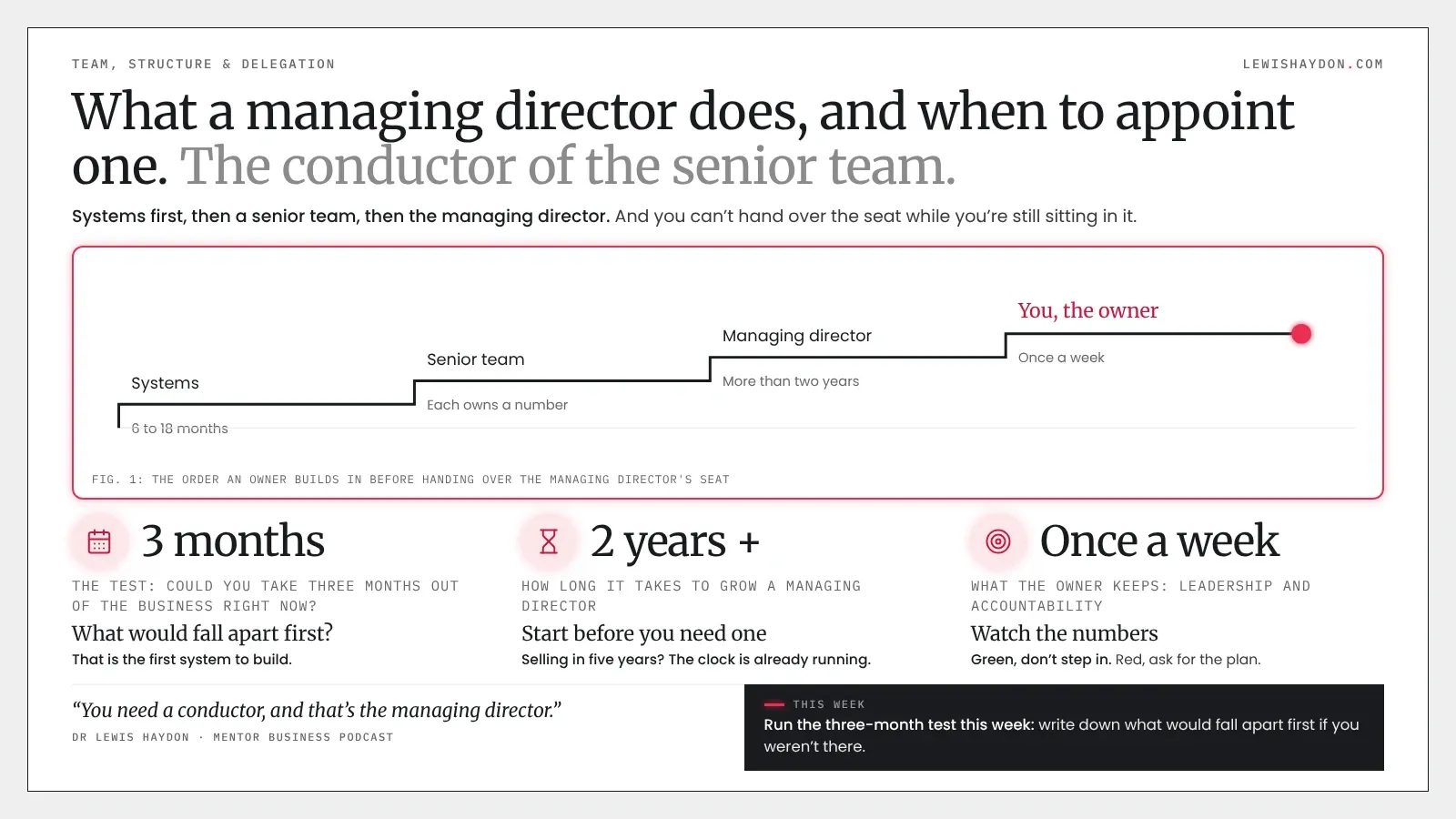
The first is systems. “All the systems in that business need to be in place. From marketing to sales to operations to finance.” I mean your own systems, written down, so someone else can run the business from them. In my experience that takes six to eighteen months. Standard operating procedures is the place to start.
The second is a senior team. People who each own a part of the business and its numbers. A managing director with no senior team under them ends up doing everything, the same as you do now. See how to hire the right person. If you want that team coached alongside you, I run executive coaching in Birmingham and across the UK.
The third is the managing director. And here’s the part owners underestimate: “It’s going to take you longer than two years to grow a managing director.” If you’re thinking of selling in a few years, or you want the business to pay you dividends without you there every day, the time to start is now.
Here’s a good test. Could you take three months out of the business right now if you really had to? If the answer is no, ask what would fall apart first. That’s the first thing to fix, and it tells you what your managing director will need in place.
 With the team at one of the businesses I own. A managing director’s job is to keep a team like this pulling the same way.
What do you do once a managing director is in the seat?
You don’t disappear. I attend each of my businesses once a week. I’m a business investor in them, so I need to know the investment is going in the right direction and that everybody is aligned. The one thing I always show up for is leadership and accountability.
What changes is where you look. You look at the numbers. If the number is green, don’t step in. If it’s red, you ask what’s happening and what the plan is. You still don’t take the seat back.
That’s how a business grows without you while you stay the person it answers to.
What is being your own managing director costing your business?
A business that relies on its owner is worth less. A buyer looks at the numbers and asks what happens to them when you’re gone. If the answer is that they fall, the buyer pays less, or walks away. A business with a managing director, a senior team and written systems gives you options: sell it, or keep it and take dividends from the profit it makes.
There’s a cost before any sale too. Every decision waits for you, so the business grows at the speed of your diary. As I said on the podcast, “the danger here is you’re going to reach 50, 60, 70 and not get what you want from all the hard work that you put into it.”
Here’s what it looks like when it works. The senior team meets on Monday without you. The managing director brings you the numbers and the plan for the next 90 days. Your time goes on the next opportunity, the next business or your family, and decisions in the business don’t wait for you.
First steps with me
- Run the three-month test this week. Write down what would fall apart first if you weren’t there. That’s your first system to build.
- Use the free owner time audit to see how much of your week is managing director work, and the scorecard to find which area of the business would hold a managing director back.
- Bring the result to a virtual coffee and I’ll tell you what I’d put in place first, or WhatsApp me. If you already have someone in the seat, CEO coaching is from £2,500 a month plus VAT, and every price is published.
FAQs
Does a small business need a managing director?
In a small business the owner is usually doing the job already, whatever the title on the door. The question is when someone else should do it. That’s when the business needs a full-time conductor for the senior team and the owner is ready to stop being that person.
Is a managing director legally a director of the company?
Not automatically. A job title on its own doesn’t make someone a company director. If they are appointed as a director of the company, they take on the general duties of a director set out in the Companies Act 2006, and the same can apply to someone who acts as a director without being formally appointed. Take legal advice before you appoint, and before you hand out the title.
How long does it take to develop a managing director?
Longer than most owners plan for. In my experience it takes more than two years to grow one, on top of the six to eighteen months it takes to get the systems in place. That’s why an owner who wants to sell or step out of the day-to-day in five years needs to start now.
What is the difference between a managing director and an operations manager?
An operations manager runs delivery. A managing director runs the whole business: sales, marketing, operations and finance, and the people who lead each one. An operations manager usually reports to the managing director.
Can the owner stay involved after appointing a managing director?
Yes, and you should, as the owner. I attend each of my businesses once a week for leadership and accountability. What you can’t do is keep making the managing director’s decisions for them.
How does working with you start?
With a virtual coffee: 30 minutes on Zoom, no charge, bring your biggest question about handing over the day-to-day and I’ll give you a straight answer. If it’s worth going further, 1:1 mentoring starts from £800 a month plus VAT and every price is published.
References
- Companies Act 2006, c. 46, Part 10, Chapter 2: General duties of directors, ss. 171–177. Available at: https://www.legislation.gov.uk/ukpga/2006/46/part/10/chapter/2 (Accessed: 14 November 2026).
- Haydon, L. (2025) ‘From operator to owner’, Mentor Business Podcast, 21 November. Available at: https://lewishaydon.com/podcast/from-operator-to-owner-the-leadership-development-approach-every-founder-needs-to-build-a-business-that-works-without-them/
Want a straight answer on your managing director?
If you’re not sure whether the business is ready, or whether you are, book a virtual coffee and bring your three-month test. I’m Dr Lewis Haydon, a business coach and mentor who ACTUALLY owns businesses, and you’ll leave with a straight answer. My prices are published if you’d like to see them first.