Article
How to Scale a Business That Grows Without You
Topic · Growth and scaling · 8 min read · Published 04.11.2026

You scale a business by making revenue grow faster than your costs and faster than your own hours. Fix price and margin before you chase volume. Forecast the cash the growth will eat, and fund it. Write down how the work gets done so other people can do it, build a management team to run it, and then move yourself out of the day-to-day so the business grows without you.
Growing means more sales. Scaling means more sales without the costs, the headcount and your diary all rising at the same rate. The formal definition, used by the OECD and the ScaleUp Institute, is a business with at least 10 employees growing turnover or staff by more than 20% a year on average over three years (ScaleUp Institute, 2017). For an owner there’s a second test that matters more: does the business pay you more, in money and in time, as it gets bigger?
On the podcast I put the idea like this: “When we pay for help, we’re not just stuck with our own 40, 50, 60 hours in the business. We double our hours, so we’ve got 80. Hire somebody else and you’ve got 120. And this is the idea of scaling a business. Without it, you can’t scale, because you’re just limited to time.”
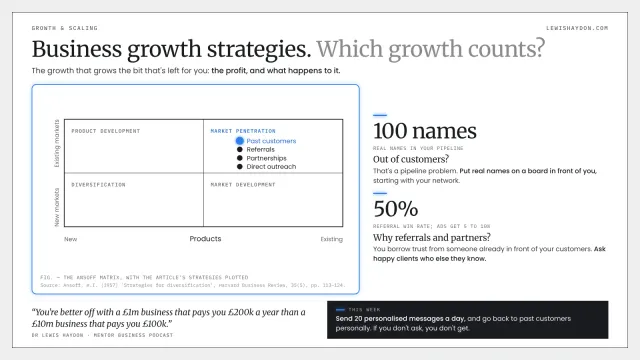
If what you need right now is more customers, start with business growth strategies. This article is about what comes after that: making the growth hold, and making it pay.
Why does a growing business stop paying its owner?
Because the turnover grows and nothing in the plan grows for you. More sales bring more staff and more overheads, and they all get paid before you do. Owners who are paid last usually aren’t short of revenue. I’ve had the best revenue year a business of mine has ever done and been paid less for it, and I’ve written up how to fix that in how to pay yourself as a business owner.
A business doing £10m at 2% net profit makes £200k. Get the margin to 10% and the same turnover makes £1m. Look, a lot of owners at that size get told they’ve got a marketing problem or a sales problem. Often they haven’t. They’ve got a profitability problem, and it’s operational.
As I said on the podcast earlier this year: “You can add a lot more clients and not be making money. You need to do both. You need to scale sensibly.”
Fix price and margin before you chase more sales
Scaling on a thin margin multiplies the problem, because every new customer brings the same cost and the same risk and leaves very little behind.
Start with gross margin: what’s left of each sale after the direct cost of delivering it. That’s what pays for the managers, the systems and you. More sales on a thin margin just means more work for the same money. Watch the quiet leaks as you grow too, like discounting to win work and bonuses nobody has costed properly.
If you want to figure out whether your margin can pay for the growth and pay you as well, go to lewishaydon.com/tools and use the profit margin calculator.
How do you fund growth without running out of cash?
Growth eats cash before it makes any. You pay staff, suppliers and stock now, and the customer pays you 30, 60 or 90 days later. The faster you grow, the bigger that gap gets, and that’s how profitable businesses run out of money.
So forecast it. I want to know where we’ll be in 30, 60 and 90 days: what sales are coming in, what’s being invoiced, what’s landing in the bank and what’s going out. That’s what lets me sleep at night. Put the cost of each hire and each new system into that forecast before you commit to it, along with the dividend you plan to take.
Fix the thing that’s capping the business and more cash comes in. That’s what pays for the people and the systems, and a higher dividend for you. Set out a good, a bad and an ugly version of the year, so you know what you’d do in each before it happens.
Systemise the work that doesn’t need you first
Operations, service delivery and admin can all be delegated and automated, and there are usually people out there who’ll do them better than you. Then the systems the business runs on: marketing, sales, operations and finance, plus how you plan, whether that’s yearly, quarterly or monthly. Getting those in place can take six, 12 or 18 months.
Don’t buy a generic system and bolt it on. Build it around how your business wins work and delivers it. You don’t need to be an expert in every area, but you do need to know enough to spot when someone’s pulling the wool over your eyes.
This isn’t just me saying it. In a field experiment with large textile firms in India, plants that were helped to adopt standard management practices raised productivity by 17% in the first year, and within three years the firms had opened more plants (Bloom et al., 2013).
Build the management team sooner than you think
A management team takes longer to build than most owners expect. Finding the people is the hard part for most growing firms. In the ScaleUp Institute’s 2023 survey, 58% of scaleups ranked access to talent among their top three barriers to scaling (ScaleUp Institute, 2023).
Start with the roles that free up most of your week. Then hire people who each own a number: sales owns revenue, operations owns gross profit, finance owns net profit and the cash. Eventually someone has to conduct them, and that’s a managing director or general manager. If you need one, you can’t keep sitting in that seat yourself. Growing a managing director takes longer than two years, so the time to start is well before you need one.
I’ve covered building the team itself in high-performing teams. Before you hire anyone, write down where your hours really went last week. The jobs someone else could do are your first hires.
What breaks at each stage, from £250k to £20m
Each stage of growth breaks something the last one relied on. Larry Greiner set this out in the Harvard Business Review in 1972: each phase of a company’s growth ends in a crisis, first of leadership, then of autonomy, then of control (Greiner, 1972). For owners of established businesses, it tends to look like this.
| Turnover | What usually breaks | What to fix first |
|---|---|---|
| £250k to £1m | Everything goes through you. You’re the best salesperson and the bottleneck, prices are set by feel, and you see the real numbers once a year. | Price and margin, a 90-day cash forecast, and your first hires in delivery and admin so your hours go on sales. |
| £1m to £5m | The team that got you here. An external accountant doing year-end accounts, or a family member doing the books, can’t run the finances of a business this size. Managers still check everything with you. | Monthly management accounts, a financial controller or a fractional finance director, and managers who each own a number. |
| £5m to £20m | You’re still the managing director. Decisions queue up for you, directors start agreeing among themselves that the plan can wait, and growth slows. | A managing director or general manager, quarterly planning, directors who own revenue, gross profit and net profit, and you holding them to it. |
The jump past £1m is where a lot of owners stall. Moving from an external accountant to someone in-house, or replacing people who’ve been loyal since the early days, is a decision you’ve never had to make before. Some owners have to take a cut in their own income for a while to get through it.
How do you get out of the day-to-day without the business stalling?
Hand over the tasks, not the leadership. I did a whole episode busting the myth of the business that needs nothing from its owner, and the line that matters is this one: “Just because a business can operate without you doesn’t mean it will grow without you.”
Most owners who get stuck here have confused stepping back from tasks with stepping out of leadership. Most either hire and still check everything, or hand it over and vanish. The day-to-day can carry on without you, but growth still needs you on the strategy and on holding the directors to what everyone agreed. I turn up to each of my businesses once a week, partly to make sure everyone is aligned and heading the right way, and partly because I enjoy being part of them.
Try this. If you had to take three months out of the business tomorrow, what would fall apart first? Whatever you name is your next system to build or your next hire.
Scaling, or just getting bigger?
Check these once a quarter:
- Turnover is growing faster than overheads.
- Gross margin is holding or rising as you take on more work.
- Your hours are going down, and fewer decisions wait for you.
- Your dividend is in the budget, and it’s going up.
- The cash forecast shows you can fund the next hire before you make it.
If turnover is up and the rest isn’t, the business is getting bigger around you, and you’re still paid last.
Quick answers on scaling
How long does it take to scale a business?
Longer than most plans allow. Getting the core systems in place usually takes six to 18 months, and developing a managing director to take over from you takes more than two years. The formal measure of a scale-up looks at growth over three years.
Can you scale a business without hiring more people?
Partly. Better pricing, better margin and better systems, including automation, let the same team handle more work. Past a point, though, scaling means using other people’s hours as well as your own. That’s where the leverage comes from.
References
- Bloom, N., Eifert, B., Mahajan, A., McKenzie, D. and Roberts, J. (2013) ‘Does management matter? Evidence from India’, The Quarterly Journal of Economics, 128(1), pp. 1–51. Available at: https://doi.org/10.1093/qje/qjs044.
- Greiner, L.E. (1972) ‘Evolution and revolution as organizations grow’, Harvard Business Review, July–August. Reprinted with commentary in Harvard Business Review, May–June 1998.
- ScaleUp Institute (2017) ScaleUp Index 2017. London: ScaleUp Institute. Available at: https://www.scaleupinstitute.org.uk/wp-content/uploads/2017/11/ScaleUp-Index-2017.pdf (Accessed: 2 November 2026).
- ScaleUp Institute (2023) ScaleUp Review 2023: Talent and skills. London: ScaleUp Institute. Available at: https://www.scaleupinstitute.org.uk/scaleup-review-2023/talent-and-skills/ (Accessed: 2 November 2026).
Want a straight answer on what’s capping yours?
I’m Dr Lewis Haydon, a business coach and mentor in Birmingham, UK, who ACTUALLY owns businesses, in medical technology, manufacturing and accountancy. If something in here sounds like your business, book a virtual coffee and bring your biggest question about scaling it. If you’d like to see what working together costs first, my prices are published.