Article
Standard Operating Procedures: Which to Write First and How
Topic · Team, structure and delegation · 11 min read · Published 07.11.2026
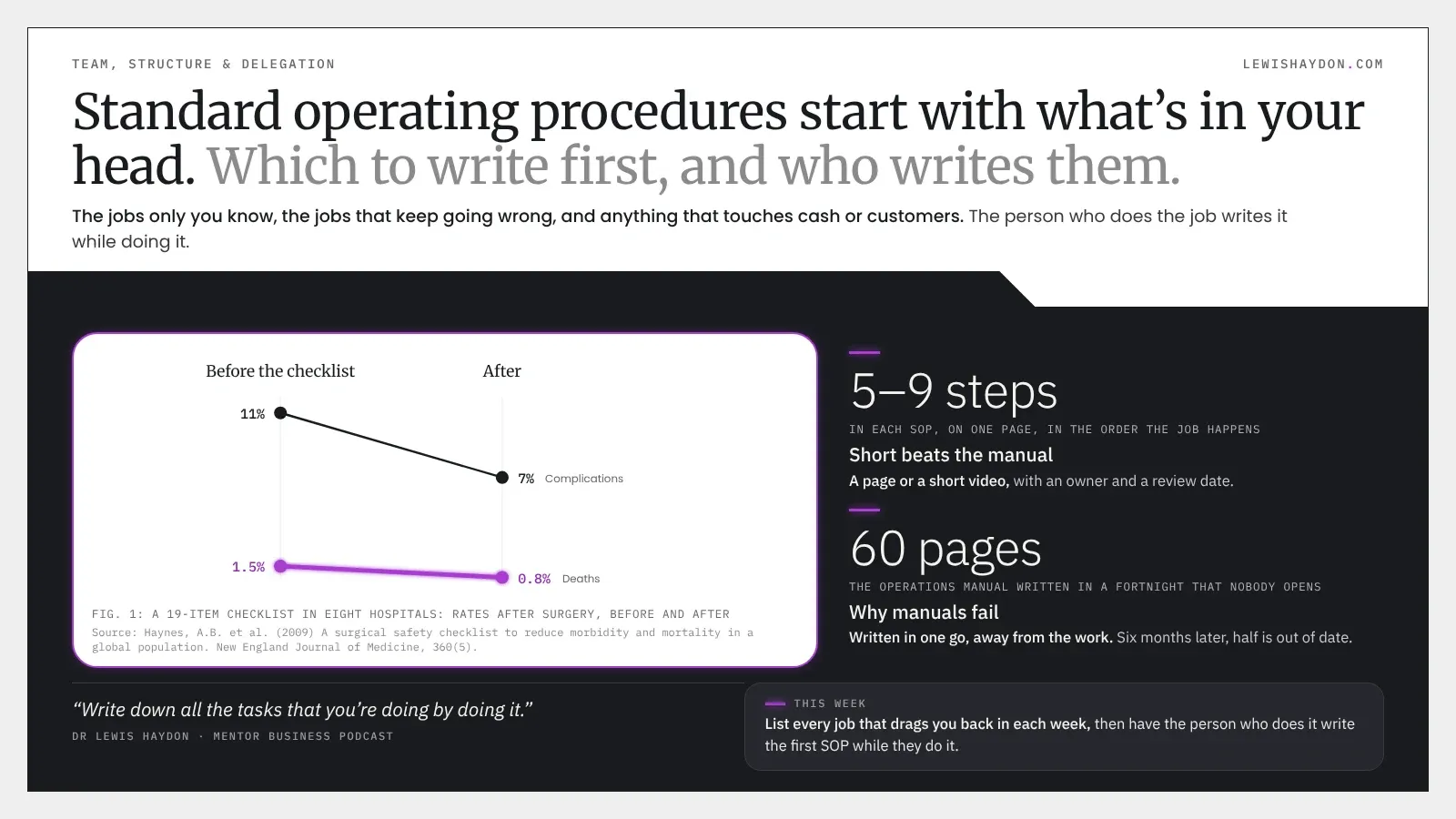
Standard operating procedures (SOPs) are short written instructions for how one recurring job gets done in your business, so anyone trained on them gets the same result without asking you. Write the first ones for the jobs that only live in your head, the jobs that keep going wrong, and anything that touches cash or customers. Get the person who does the job to write it while doing it, keep each one to a page or a short video, give it an owner and a review date, and use it to train new starters.
In a £2m business with 20 staff, most of the know-how usually sits with two or three people, and one of them is the owner. That works until one of them is off sick or hands in their notice. SOPs are how that know-how gets out of people’s heads and into something the rest of the team can follow.
I’ve covered the wider job of systemising a growing business in how to scale a business.
What is a standard operating procedure?
An SOP describes one task from start to finish: what triggers it, the steps, and what a good result looks like. “Sending a quote”, “onboarding a new customer” and “month-end payroll” are each one SOP.
It sits under your policies. A policy says what the business has decided, such as “we don’t start work without a signed order”. The SOP says how someone in the team actually does it on a Tuesday afternoon, step by step.
A set of short documents works better than one thick operations manual, as long as each is small enough that someone will open it while doing the job.
Write the ones that only live in your head first
Start with three kinds of job.
- Jobs only you know how to do. If you were off for a month, which tasks would stop or be done badly? Quoting bigger jobs and the monthly numbers you pull together yourself are common ones.
- Jobs that keep going wrong. Look at complaints, rework, credit notes and anything someone has had to redo in the last three months. Each repeat mistake points to a step nobody wrote down.
- Jobs that touch cash or customers. Quoting, invoicing, chasing payment, onboarding a new customer and handling a complaint. A mistake here costs money or a customer, so these earn their place early.
In an episode on getting out of daily operations, the first step I gave was to map your weekly bottlenecks: “Write down every recurring task or problem that drags you back into operations.” Anything on that list that repeats every week is a candidate for an SOP.
If you want to figure out which of your own jobs should be written up first, go to lewishaydon.com/tools and use the owner time audit.
Delivery is one of five areas in the free scorecard. Score all five out of 30 in about five minutes and see whether operations is the one capping you.
Who should write your SOPs?
The person who does the job, while they’re doing it. Writing from memory at a desk leaves out the steps people do without thinking, and those are the ones that go wrong when someone new picks the task up.
That includes you, for the jobs that are still yours. On the podcast I put it like this: “It all takes you stepping into that role and doing it first, then systemise what you do. Write down all the tasks that you’re doing by doing it. Because if you don’t do it yourself and you just take a generic system, you’ll be systemising someone’s job that isn’t right for your business.”
So for the work your team already does, they write it and you review it. For the work that still sits with you, you write it as you go, then hand it to the person taking it over. Let them run it a few times and rewrite it in their own words. They’ll spot what you assumed, and they’ll own it more if it reads like them.
How to write an SOP your team will use
Keep it short and keep it in the order the job happens. A checklist beats paragraphs for most tasks.
Atul Gawande’s The Checklist Manifesto passes on advice from Daniel Boorman at Boeing, who wrote checklists for pilots: keep it to roughly five to nine items, fit it on one page, and decide in advance the exact point in the job where it gets used (Gawande, 2010). Boorman also split checklists into two kinds. “Read-do” is followed step by step like a recipe, which suits a new starter or a job done once a month. “Do-confirm” is done from experience and then checked against the list, which suits a skilled person doing a job they know well.
Short checklists hold up in places where mistakes are expensive. When eight hospitals in eight cities around the world brought in a 19-item surgical safety checklist, the death rate after surgery fell from 1.5% to 0.8%, and inpatient complications fell from 11% to 7% (Haynes et al., 2009). Quoting and invoicing go wrong for the same reason surgery does: skilled people under time pressure skip steps they know perfectly well.
For anything done on a screen, like raising an invoice, a short screen recording with the person talking it through is often quicker to make and easier to follow than text. Put the checklist underneath it, so people can check they’ve done every step without watching the whole thing again.
A simple SOP template
Use the same layout for every SOP so people know where to look.
| Section | What goes in it |
|---|---|
| Title | The job, in the words the team uses for it. |
| Purpose | One sentence on why the job matters to the business or the customer. |
| Owner | The one person who keeps this SOP up to date. A role, and a name next to it. |
| When | What triggers the job, and any deadline. |
| Steps | Five to nine numbered steps, in the order they happen. Link any template, form or video. |
| What good looks like | How you can tell it was done right: a time, a number or a check. |
| Review date | When the owner next checks it still matches how the job is done. |
Standard operating procedure example: sending a quote
This is an illustration, not a real client’s process. Picture a building maintenance firm doing £2m a year with 20 staff, where quotes used to go through the owner.
Title: Sending a quote for planned maintenance work
Purpose: Every complete enquiry gets an accurate quote at a margin the business can live on, so we win work that pays.
Owner: Sales coordinator
When: Within two working days of a site survey or a complete enquiry.
Steps:
- Check the enquiry has the site address, scope, access details, contact name and the customer’s deadline. If anything is missing, call the customer before pricing.
- Price labour from the current rate card in the quoting spreadsheet. Never copy prices from an old quote.
- Add materials at cost plus the agreed mark-up, and travel from the zone table.
- Check the gross margin is at or above the minimum the directors have set. If it’s below, send it to the operations manager to approve before it goes out.
- Build the quote from the standard template: scope, exclusions, price, payment terms and 30 days’ validity.
- Log it in the CRM with its value and a follow-up date.
- Send it from the shared sales inbox, not a personal one.
- Phone the customer on day three and day seven, and record the outcome in the CRM.
What good looks like: Quotes go out within two working days, every one is at or above minimum margin, every one is in the CRM, and no job needs re-pricing after it’s accepted because something was missed.
Review date: Every six months, or straight away if a job loses money because of how it was quoted.
The owner’s judgement is still in there, as the margin floor in step 4 and in the rate card. The owner sets both, and only sees the quotes that fall below the line.
Why does nobody read the operations manual?
Usually because the owner wrote it in one go, away from the work it describes. The owner blocks out a fortnight, writes 60 pages about how everything should work, saves it to a shared drive and tells everyone it’s there. Six months later nobody has opened it, half of it is out of date, and the team do the jobs the way they always did.
I made the point in a myth-busting episode about the business that supposedly needs nothing from its owner: “You’re always developing those systems, because if you didn’t and you just left it to run without you, what starts to happen then is, one, the people start to make their own systems and, two, those systems become outdated.” A handful of short SOPs that the team opens every week will do more for you than the manual.
Keeping SOPs alive once they’re written
Give every SOP an owner who isn’t you. That person updates it when the job changes and checks it on its review date. Put the review dates in someone’s calendar, or they won’t happen.
Use them to train people. A new starter should learn each job from its SOP, with the SOP’s owner watching the first few times. Talking about hiring senior people on the podcast, I said it “came with massive accountability, making sure that my hiring was right, making sure that my processes were right, making sure that the new A-Players that came in followed my processes and not their previous processes.” Experienced people arrive with their old ways of doing things, so the SOP is how they learn yours.
When something goes wrong, check whether there was an SOP and whether anyone followed it before you blame the person. Often the procedure is missing or out of date, and that’s a fix for the SOP’s owner that week.
And keep them where the team already works, linked from the CRM or job system, so nobody has to go looking.
What is know-how in your head costing your business?
In a £2m business with 20 staff, two or three people hold most of the know-how, and one of them is you. The day one of them is off sick or hands in their notice, quoting stops, the month-end numbers don’t get done, and jobs get re-priced after they’re accepted because a step got missed. Look at the last three months of complaints, rework and credit notes: each repeat mistake is a step nobody wrote down, paid for again every time. And while it stays in your head, you can’t hand the job over, you can’t take a month off, and a buyer values the business as your job, not an asset.
With a handful of short SOPs that the team opens every week, the same business trains a new starter from the document, quotes go out at or above minimum margin without you seeing them, mistakes get fixed in the procedure rather than blamed on the person, and the know-how is something the business owns. That’s what makes it sellable, and what lets you leave for a month.
First steps with me
- List every recurring task that dragged you back into operations last week. The ones that repeat weekly are your first three SOPs.
- Run the free owner time audit to see which jobs should be written up first, and the scorecard to see whether delivery is the constraint.
- Bring the jobs you can’t hand over yet to a virtual coffee, no charge, 30 minutes, or WhatsApp me. 1:1 mentoring is from £800 a month plus VAT, every price published.
Step into the role, do it, write it down as you go. Then hand it over.
FAQs
What is the difference between an SOP and a policy?
A policy says what the business has decided, such as “we don’t start work without a signed order”. An SOP says how someone in the team actually does it, step by step. Policies are few and rarely change; SOPs are many, short, and reviewed when the job changes.
How many SOPs does a small business need?
Start with three: the job only you know how to do, the job that keeps going wrong, and the job that touches cash or customers. Most £1m to £5m businesses end up with a few dozen one-page procedures. A handful the team actually opens beats a 60-page manual nobody reads.
How long should an SOP be?
One page, or one short screen recording with a checklist underneath. Five to nine steps, in the order the job happens, with what good looks like at the end. If it needs more than that, it’s probably two jobs.
What software should I use for SOPs?
Whatever the team already works in. Keep them linked from the CRM or the job system so nobody has to go looking. A shared drive, a wiki or a dedicated SOP tool all work; the format matters less than the owner, the review date and whether people open it.
How often should SOPs be reviewed?
Every six months as a default, and straight away when a job loses money or a customer because of how it was done. Put the review dates in the owner’s calendar, because if they aren’t in a calendar they won’t happen.
How does working with you start?
With a virtual coffee: 30 minutes on Zoom, no charge, bring the jobs you can’t hand over yet and I’ll tell you which to write first. If it’s worth going further, 1:1 mentoring starts from £800 a month plus VAT and every price is published.
References
- Gawande, A. (2010) The Checklist Manifesto: How to Get Things Right. London: Profile Books.
- Haynes, A.B., Weiser, T.G., Berry, W.R., Lipsitz, S.R., Breizat, A.H.S., Dellinger, E.P., Herbosa, T., Joseph, S., Kibatala, P.L., Lapitan, M.C.M., Merry, A.F., Moorthy, K., Reznick, R.K., Taylor, B. and Gawande, A.A. (2009) ‘A surgical safety checklist to reduce morbidity and mortality in a global population’, New England Journal of Medicine, 360(5), pp. 491-499. Available at: https://doi.org/10.1056/NEJMsa0810119.
Want a straight answer on which process to write first?
I’m Dr Lewis Haydon, a business coach and mentor who ACTUALLY owns businesses, and I work with owners of established businesses from £250k to £20m turnover. If your know-how is still mostly in your head, book a virtual coffee and bring the jobs you can’t hand over yet.