Article
Family Business Succession Planning: Pass On an Asset, Not a Job
Topic · Exit and succession · 11 min read · Published 16.11.2026
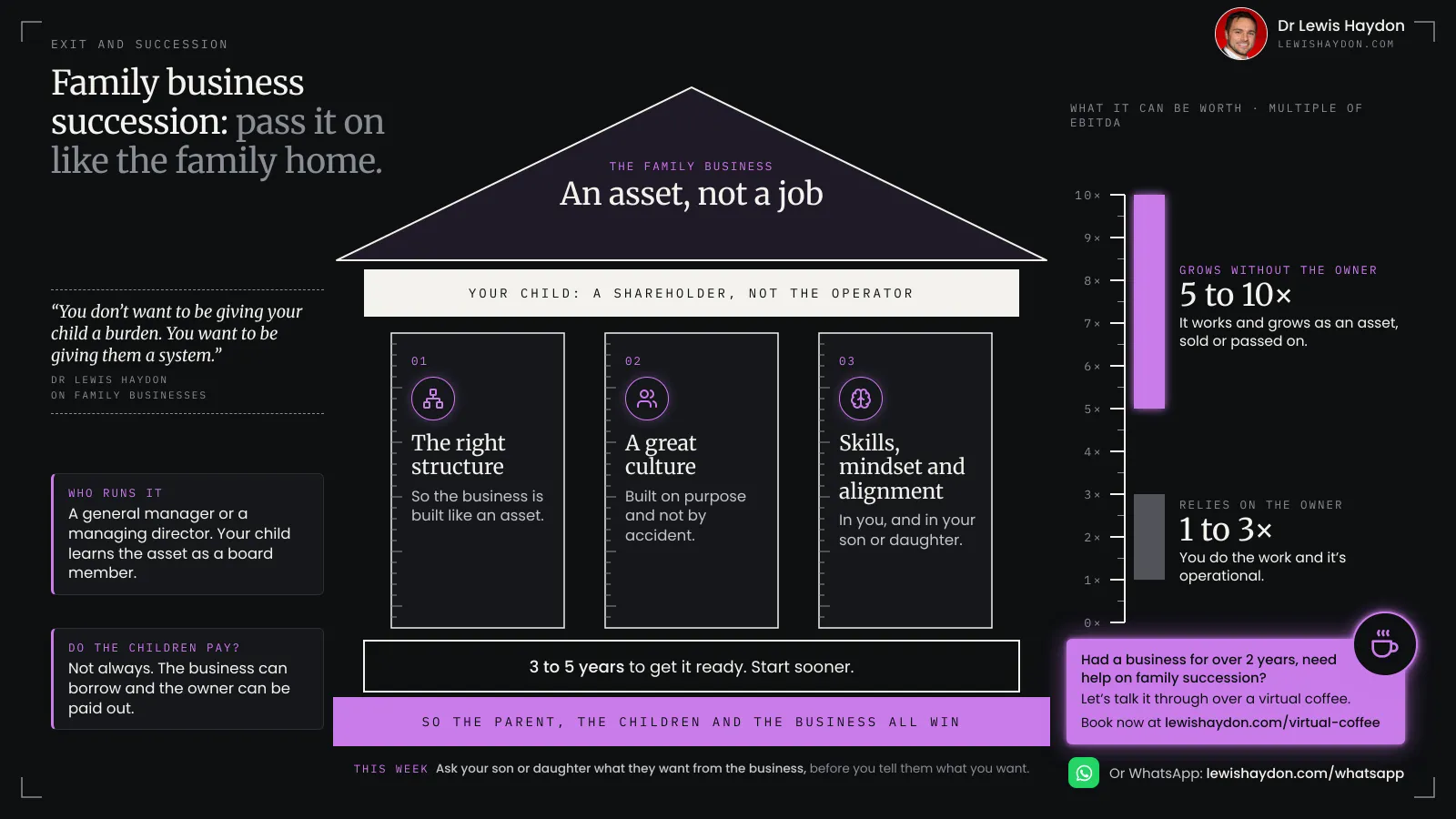
Family business succession planning is deciding how the business passes to your children, and getting it ready years before it does. The mistake most owners make is handing over a job. What you want to hand over is an asset: a business that works and grows without the person who owns it.
This is for the owner whose son or daughter works in the business, or might one day, and who doesn’t want it to be a burden on them.
I’m writing this as someone who has been through it, not only advised on it. I’ve been on the receiving end of a family business sale, as one of four brothers the business was passed to, and I own and invest in businesses today. What follows is how every party can get the most from it: the parent, the children and the business.
What is the most common mistake in family business succession?
The parent has used the business as a lifestyle business. They’ve treated it like their own personal bank account, when it should have been built as an asset, something that can operate and live beyond them.
Two things follow from that. First, they teach the child to do exactly the same thing and treat the business as their bank account. Second, they teach the child that what they’ll inherit is a job. The child ends up doing all the work and the business relies on them, the same as it relied on you.
It’s a bigger job too. The business is usually a bigger entity than when it started, so the child takes on all that hard work, bigger than ever.
Why can a family business feel like a burden to your children?
The drivers that got you into business don’t always pass on. You wanted to work for yourself and create a legacy. Your child didn’t choose that. More times than not, the child feels the business is a burden they have to take on.
That isn’t always the case, and it’s a matter of perspective. But remember the timescale. We’re talking 365 days a year, over a decade or a few decades. People go through ups and downs in that time, and how they see the business changes. In the hard times especially, it can feel like something they’ve been landed with.
No parent wants that. You want the best for your children. To you it’s an offering. They can see it differently, because people aren’t generic. Your children see life differently and behave differently, age is a big factor, and personalities are hard to change and may not be the same as yours.
Is your son or daughter the right person to take over?
I’d remove that question. Why does it have to be your son or daughter who runs it?
Think of how you’d pass on the family home. The home is an asset. If the business was an asset too, like handing over a house, it wouldn’t matter whether they were great at running it or not. They’d just need to be a shareholder of the company.
That’s how a business should be built. A general manager or a managing director runs it. The systems are in place and it’s scalable. Your child is taking on an asset and not a busy job, so there’s a lot less for them to be burdened with.
It doesn’t remove every variable. Being a good owner and shareholder still takes work. Your child still has to understand the asset: the decisions that get made, the leadership that needs to be seen, and how to manage the people running the business for them. They do that as a board member.
It’s better for the parent and better for the child. I’ve written about what a managing director does and when to appoint one, and I sit on boards as a non-executive director for owners who want that experience around the table while the next generation learns it.
What has to be in place before you hand over a family business?
You don’t want to be giving your child a burden. You want to be giving them a system, something that can grow from all the hard work you’ve put in. Three things have to be in place.
- The right structure, so the business is built like an asset.
- A great culture, one you’ve built on purpose and not by accident.
- The right skills, mindset and alignment, in you and in your son or daughter, so the business can flourish in the future without you there.
That takes time and consistency. There will be ups and downs, and there will be disagreements. It can be a three to five year process.
So if you’re planning to do this one day, it needs doing sooner. Don’t kick the can down the street and wait for tomorrow. This is your family business and your legacy. Treat it with the utmost importance.
If you want to figure out how much the business still depends on you, go to lewishaydon.com/tools and use the owner time audit. The wider plan for any owner is in business succession planning, and I talked this through with a family business owner on the podcast in how to build a business that continues without you.
Selling or passing it on: how do you get rewarded for the work?
A lot of owners think they can sell the business and walk away. If you’re selling, the business needs to work and grow without you for it to be worth a lot more money. Otherwise you may be disappointed with what you get for it.
If it relies on you to do the work and be operational, sometimes you’re only looking at one, two or maybe three times EBITDA. If it can work and grow without you as an asset, that could be five or ten times.
There’s a reason that multiplier exists. If you’re not there, it isn’t only your skills that are missing. All your wisdom, your drivers and the lessons from the resilience you’ve had to put in disappear with you, unless they’re structured and systemised inside the company.
Does that still apply when you’re passing it to a son or daughter and not selling it? Yes, more than ever. You want to give them the most valuable asset you can, just as though you were selling it to a stranger.
The business valuation calculator shows what each point on the multiple adds. There’s more in business exit planning.
Do your children have to pay you for the business?
You want to walk away with the largest amount you can get. You also don’t want to leave your son or daughter, or several children, with a huge debt. So what do you do?
A common misconception is that the children have to pay the owner. That isn’t always the case. There are ways of structuring the finance so the owner gets what they want, the business wins and so do the children. The business can borrow from a bank or a lender and the owner can be paid out. It doesn’t always have to touch anybody’s personal money, because the business can pay for it.
It has to be done right, and you have to lend against the asset. If you haven’t built an asset, this is where it becomes a problem. So start planning today: build the asset, finance it correctly, make it a win-win for the children, and don’t put too much stress on the business when you hand it over.
Tax matters here too. If it isn’t planned correctly, the owner and the business can end up paying a lot of it. Get a tax planner, a good solicitor and a good accountant involved, and keep a good relationship with your bank or lender.
The emotional problems nobody talks about
Logically it makes sense. You’ve thought all your life that you’d build this business and in ten, twenty or thirty years pass it to the kids. What people don’t talk about is how it feels.
How does your child feel when you’ve given them a lot of work? What about the years leading up to it? Five years may seem a short time when you’re 50 and want to retire at 55. To a 25-year-old, five years is a long time.
Then there are your own worries. Have they got the skills? What will they do with the business? All those people’s livelihoods will be in their hands, along with the finance, the operations, the marketing and the sales. Do they have what it takes?
This is why they need a great mentor who isn’t you. We all know what it’s like to mentor your own kids. It doesn’t work. They need someone from outside, so it doesn’t feel like a telling-off from mum and dad. Someone who’s aligned to your goals, wants the best for them and has been there before.
It gets harder when there are brothers and sisters. How do you split it? I’ve been on the receiving end of a business sale where the business was passed to four brothers, and it isn’t always logical. There are a lot of feelings about fairness: who does what, who takes which department, who’s in charge of what, and who wants the best for the business. Some of them may have children of their own and be thinking about how it passes on again.
Logical advice from an accountant, a tax adviser or a financial planner is necessary. It isn’t the whole of it. You also need someone who has sat in that seat, who has been passed a business or bought one from a parent, and has seen the parent rewarded for the hard work and what it’s like for the children to receive it, especially with siblings involved.
What does most family succession advice miss?
Most advice on family succession is about the process: the valuation, the tax, the legal agreement and the finance. You need all of that, and you need good people doing it. It covers the months when the handover happens.
What it rarely covers is the years before, and the family afterwards. In my experience that’s where the most is won or lost. In the years before, you can build the business into an asset that’s worth more to you and is easier on your children. And the way you handle it decides whether the family is still close when it’s done.
That’s what I work on with owners: how the parent, the children and the business each get the most out of it, and how the relationships come through it.
What is leaving it too late costing your family?
If you wait, you hand over a business that still needs you in it. Your child gets the hours, the staff problems and the bank to deal with. They never chose to start it. Some will do it out of duty and resent it. Some will walk away, and then there’s nobody to pass it to.
It costs you as well. A business that relies on its owner is worth less, so you get less if you sell and your children get less if you don’t. And the conversation gets harder every year it’s put off.
Starting early means the business has someone running it and the systems written down. Your son or daughter learns to own it from the board, at their own pace. You get paid for what you built, and the family keeps a business that earns for them.
Seeking advice from a business coach or mentor who has done this can save you a lot of money, a lot of time and a lot of upset. You want the best for your kids and your legacy, so make sure you do it right.
First steps with me
- Ask the question this week. Sit down with your son or daughter and ask what they want from the business, before you tell them what you want.
- Use the free owner time audit to see how much of the business still runs through you, and the business valuation calculator to see what it’s worth as an asset today.
- Bring both to a virtual coffee and I’ll tell you what I’d put in place first: 30 minutes on Zoom, no charge. Or WhatsApp me. Mentoring is from £800 a month plus VAT, and every price is published.
FAQs
When should I start family business succession planning?
Three to five years before you want to hand over, and earlier if you can. The structure, the culture and the people all take time, and there will be disagreements along the way.
What if my children don’t want to run the family business?
They don’t have to. If the business is built as an asset, with a general manager or managing director running it, your children can own it as shareholders without doing a job inside it.
How do I know if my son or daughter is ready to take over?
Ask a different question: is the business ready to be owned by someone who doesn’t run it day to day? If it is, your child needs to understand the asset, the decisions and the leadership, and how to manage the people running it from the board.
How much is a family business worth when it’s passed on?
It depends on whether it relies on you. In my experience a business that needs its owner to operate might be worth one to three times EBITDA. One that works and grows without the owner could be five or ten times.
Do my children have to buy the business from me?
Not always. The business can borrow from a bank or lender against what it’s worth as an asset and pay you out, so it doesn’t have to touch your children’s personal money. It has to be structured properly, with tax, legal and lending advice.
How do I split a family business between several children?
Carefully, and not only on logic. There will be feelings about fairness, who does what and who’s in charge. An outside mentor who has been through a family handover with siblings can help you get to something everyone can live with.
Who should advise me on family business succession?
A tax planner, a solicitor, an accountant and your bank or lender, for the process itself. Alongside them, a coach or mentor who has been through a family handover, for the years leading up to it and the effect on the family.
Should I sell the business or pass it to my children?
Either way, build it as an asset first. It’s worth more to a buyer and it’s less of a burden to your children. Take advice from your accountant and solicitor on the tax and legal side of whichever you choose.
How does working with you start?
With a virtual coffee: 30 minutes on Zoom, no charge. Bring where the business is today and what you’d like to happen, and I’ll give you a straight answer. If it’s worth going further, mentoring starts from £800 a month plus VAT and every price is published.
Want a straight answer on handing over your business?
If you’re thinking about passing the business to your children and you have questions, book a virtual coffee and bring your numbers. I’m Dr Lewis Haydon, a business coach and mentor who ACTUALLY owns businesses, and I’ve been through a family handover from the receiving end. I’ll tell you what I’d put in place before you hand anything over. My prices are published if you’d like to see them first.