Article
How to Write a Sales Pitch That Sounds Like a Conversation
Topic · Growth and scaling · 5 min read · Published 04.02.2025 · Updated 23.10.2026
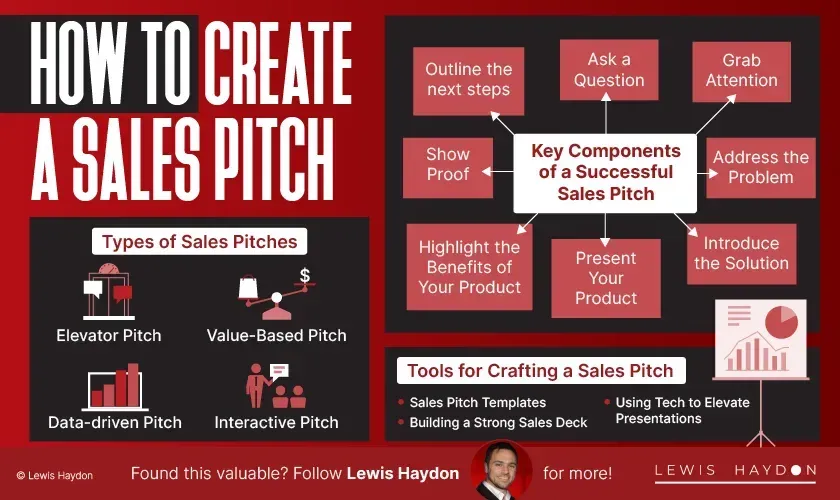
How to write a sales pitch that works: build it around the customer’s problem, not your company. Open with where they want to be, ask questions before you present anything, show how you’ve solved the same problem for someone like them, deal with their concerns, and finish by agreeing a clear next step. Then record yourself delivering it, because how you say it matters as much as what you say.
The pitch most businesses use does the opposite: founded in, offices in, our services, our team, any questions? By slide three the customer is thinking about something else.
What a sales pitch is for
A sales pitch isn’t a performance. It’s the part of the conversation where you show someone how they get from where they are to where they want to be, and help them decide whether you’re the right way to get there.
So the aim isn’t “close them”. It’s a clear decision: yes, no, or a specific next step. A good pitch makes that decision easy.
Don’t use one generic pitch
One generic sales pitch or script, used on every customer, is never going to work. People aren’t generic. What a finance director needs to hear is different from what the owner needs to hear, and both are different from what the operations manager is worried about.
You need a structure you follow every time. What goes into it changes for every customer.
How to write a sales pitch in six steps
1. Start with their “after”
Sales trainer and author Andy Bounds, on the Mentor Business Podcast, calls this the “afters”. Before you say anything about yourself, find out where the customer wants to be after working with you. What do they want their sales, their team or their week to look like a year from now? Why don’t they think they’ll get there on their own?
Your pitch is the bridge from today to that “after”. Nobody wants what you do; they want how they’re better off after it.
2. Find the driver
Everyone who talks to you has a reason for doing it now. Something has become painful enough, or a better future has become real enough, that they’ve stopped putting it off.
Find that reason, because it fades. The urgency someone felt when they first got in touch is rarely as strong a fortnight later. Part of your job is to remind them, without hype, what happens if nothing changes, and what changes for them if it does. A good pitch has both logic and emotion: the numbers that make sense, and the reason it matters to them personally.
3. Show them the process
People buy more easily when they can see how it works. Lay out the steps you’ll take them through, and ask permission: “To get the best result, this is the process we use. Is it okay if I take you through it?”
That one question does a lot. It shows you’ve done this before, it gives the customer a sense of control, and it tells you straight away whether they’re with you.
4. Build certainty with a story
Once you know where they want to be, show them you’ve got someone there before. A short, true example works better than any claim about being the best: a customer with the same problem, what you did, what changed. Keep it real. If you don’t have a story for this exact situation, say so, and explain why you’re confident anyway.
5. Bring concerns into the open
Ask: “Do you have any concerns about this?” It’s one of Andy’s favourite closing questions because it gives the customer permission to say what’s really stopping them. Deal with it now, or you’ll lose the deal to an objection you never heard.
6. Agree the next step
Offer clear options rather than a single take-it-or-leave-it price, and ask which suits them. Then agree what happens next and when. A no is a perfectly good answer. Win-win or no deal.
How to deliver it
Record yourself
One of the first things I ask owners to do is record themselves pitching, or just talking to a prospect, and listen back. Very few do it. The ones who do learn more in ten minutes than from any sales book.
Elisa James, the public speaking coach and a mentor on MentorBusiness.com, takes it further: record yourself on video for one minute, then watch it twice. Once with the sound on and the picture away, asking whether you’d want to keep listening. Once with the sound off, looking at your body language and energy. Most people are surprised by both.
Don’t read your slides
If you’re reading the slides, the customer will too, faster than you, and then stop listening. Slides should carry pictures and numbers. You carry the story.
Keep the hype out
British buyers have a finely tuned nose for nonsense. The moment something sounds like a line from a sales course, they switch off. Talk like you would to a customer you already know and like.
Make it short
When I’m the one being pitched to, I’ve usually made my mind up within five minutes. Get to their problem quickly, and give them room to talk. If they want more detail, they’ll ask.
A simple sales pitch structure
- Their situation. What you’ve heard about where they are now. Check you’ve got it right.
- Their “after”. Where they want to be, and why it matters.
- The gap. What’s stopping them getting there.
- The process. How you’d get them there, step by step.
- The proof. A short, true example of doing it before.
- The options and the price. Two or three ways forward.
- The next step. Agreed before you leave the room.
What to read next
- Sales closing techniques that don’t feel pushy.
- How to improve sales skills, yours and your team’s.
- What a buyer persona is, so you know who you’re pitching to.
- How to increase sales in an owner-led business.
If you’re the only person in the business who can pitch, that’s the kind of thing I work on with owners. You can see how I work and what it costs.