Article
How to Improve Sales Skills: A Business Owner's Guide
Topic · Growth and scaling · 5 min read · Published 23.10.2024 · Updated 23.10.2026
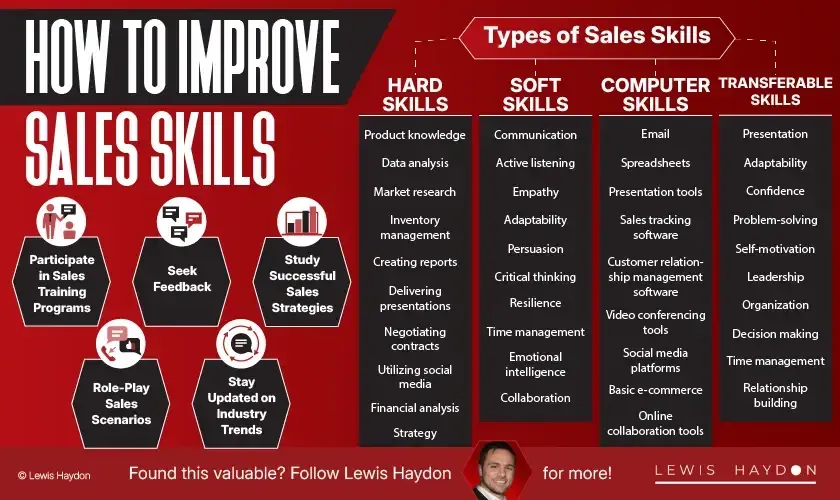
To improve your sales skills, stop trying to sell and start trying to solve. Ask better questions than your competitors, listen for the problem behind the request, show the customer how they’re better off afterwards, follow up until you get a clear yes or no, and measure what happens at each step. Then write down how you sell, so your team can do it without you in the room.
That last part is the one most owners skip, and it’s why sales stalls the moment they step back.
Why sales skills matter more than marketing
Here’s my take. Why would you turn the marketing tap on if your sales are weak? More leads into a process that doesn’t convert just costs you more money to lose the same deals.
Most owners I work with don’t have a lead problem. They have a conversion problem, a follow-up problem, or a pricing problem dressed up as a sales problem. Fix sales first, and every pound you then spend on marketing works harder.
What are sales skills?
Sales skills are the abilities that turn a conversation into a customer. For a business owner, they fall into three groups:
- Finding the problem: asking questions, listening, and working out what the customer actually needs, which is often not what they first ask for.
- Making the case: explaining what changes for the customer, in their terms, and handling objections honestly.
- Getting to a decision: following up, asking for the business, and being comfortable with a no.
Product knowledge, a CRM and a good proposal template help. They don’t replace those three.
How to improve your sales skills: seven things that work
1. Sell by solving, not by pushing
The most common mistake I see is owners and salespeople trying to sell rather than solve. If it feels pushy, it’s wrong. Your job in a sales conversation is to coach the customer to a decision, and a no is an okay answer. A good no is better than a maybe that eats your time for six months.
2. Ask more questions than you think you need
Before you mention price or product, find out what’s really going on. What’s prompted them to look now? What have they tried? What happens if they do nothing? What would good look like in a year? The person who asks the best questions usually wins the work, because the customer feels understood before they feel sold to.
3. Sell the outcome, not the service
Sales trainer Andy Bounds put it best on the Mentor Business Podcast: nobody wants what you do; they want how they’re better off after it. Customers don’t buy your process, your machine or your hours. They buy the result. Describe the “after” in their words and in their numbers.
4. Follow up, properly
Most deals aren’t lost to a competitor. They’re lost to silence. Agree the next step before every conversation ends, put it in the diary, and follow up until you get a decision. Then look at your pipeline every week. You show me your diary each week and I’ll show you where your sales will be in six months.
5. Stop chasing the close
The “closer” mentality costs you money. Pushing a one-off deal over the line can lose you the customer’s next ten orders and every referral they’d have given you. Think in lifetime value: a customer who trusts you buys again and sends you others.
6. Get in front of people
Posting is not prospecting, and likes don’t pay the wage bill. Content helps people find you, but some of the largest orders I’ve ever won came from sitting in a room with somebody. Pick up the phone. Go to the meeting. Visit the customer.
7. Measure each step
If you can’t measure it, you can’t improve it. Track how many enquiries you get, how many turn into a proper conversation, how many get a proposal and how many buy. The weak step is where your sales skills need work. Data takes the emotion out of the decision: you’ll often find the problem isn’t where you assumed.
How to improve your team’s sales skills
Improving your own selling is the start. The business only scales when other people can sell as well as you do, without you on every call.
- Write down how you sell. The questions you ask, the order you do things in, how you handle the common objections, when you follow up. The system runs the business; the people run the system.
- Have them sit in, then swap. Let new salespeople watch you, then lead while you watch, then do it alone and review it with you afterwards.
- Role-play the hard conversations. Price objections, the customer who wants a discount, the one who’s “just looking”. Practise them in the office, not in front of the customer.
- Pay for outcomes. Reward the results you want, including margin and repeat business, not just signed orders.
- Don’t undermine them. Once someone owns a customer relationship, don’t jump in over their head. As soon as you pick up the phone to the customer yourself, you’ve told everyone who really makes the decisions.
One-to-one sales coaching and training
Some owners and salespeople improve fastest with one-to-one sales coaching or sales training: someone who reviews real conversations with you and holds you to the changes, rather than a generic course. With my weekly mentoring and above, training for your team is included.
If you can’t find people who can sell, look at how you’re recruiting before you blame the market. Hiring is marketing: you have to sell the job as well as you sell the product. My guide to when and how to hire employees covers that.
What to read next
- How to write a sales pitch that sounds like a conversation, not a script.
- Sales closing techniques, and when not to use them.
- Sales KPIs for the numbers worth tracking each week.
- Cold calling tips for B2B owners who hate cold calling.
If sales is the part of the business that still depends on you, that’s exactly the kind of thing I work on with owners. You can see how I work and what it costs.