Article
What Is Personal Branding, and What's the Point for a Business Owner?
Topic · Growth and scaling · 4 min read · Published 20.11.2024 · Updated 23.10.2026
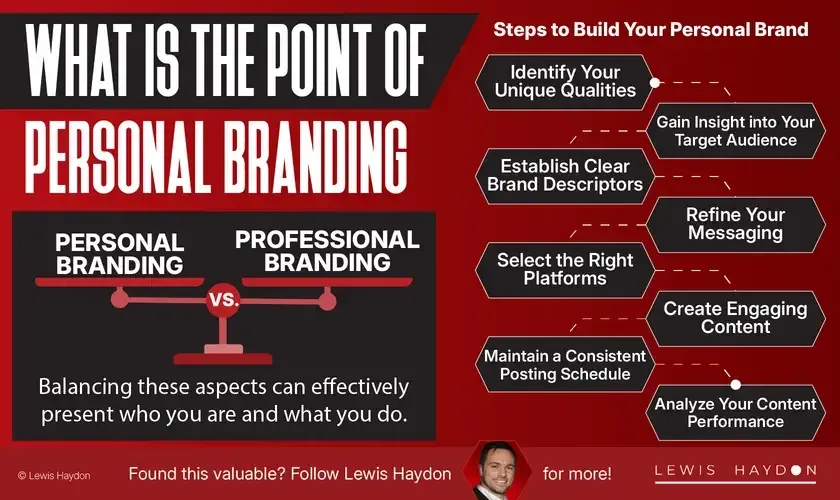
Personal branding is what people think, say and trust about you when your name comes up, and the deliberate work of shaping it. For a business owner it’s your values, your reputation, the proof of what you’ve done and how you show up, online and in the room. Done well, it wins you work before you’ve pitched, and later it attracts the people who’ll grow the business for you. It isn’t your follower count.
Your name is your personal brand. It follows you wherever you go.
Why personal branding matters for a business owner
People buy from people. That’s truer in an owner-led business than anywhere else, because in the early years the person is the business.
Think of Virgin and Richard Branson. Virgin is the company brand. But a lot of people trust Virgin because of what they think Branson stands for. His personal brand carries the company’s.
It works the other way too. If something damages Branson’s name, it damages Virgin, which is why a strong personal brand is protected as carefully as the company one.
You don’t need to be famous for the same thing to happen in your market. When a customer asks around for someone in your field, the answer they get back is your personal brand. When a good candidate looks you up before an interview, they’re checking it. When a buyer looks at your business one day, they’ll want to know whether the reputation is in the business or only in you.
Personal brand vs company brand
It isn’t one or the other. They work together, and the balance shifts as the business grows:
- At the start, your personal brand is the company brand. Customers are buying you. Your reputation, your network and your word are what the business runs on.
- Next, you use it to sell. The trust people have in you opens doors and shortens the sales conversation, because they already know what you stand for.
- Later, it attracts great people. The brand stops being mainly about finding customers and becomes about attracting the people who can win and look after customers without you. That’s how the business stops depending on you.
If your people want to build their own personal brands too, let them. A business is just a group of people. A team of people with good reputations makes the company brand stronger, not weaker.
How to build a personal brand as an owner
1. Start with your values
Before you post anything, get clear on what you stand for. A simple way to find your values: draw a line down the middle of a page. On the left, write the things that really annoy you. On the right, write the opposite of each one. Pick the five that matter most. Those are your values, and they’ll guide what you say yes and no to.
2. Don’t try to impress everybody
If you try to be vanilla and appeal to everyone, you appeal to no one. A personal brand that stands for something will put some people off. That’s fine. The ones it attracts are the ones you want to work with.
3. Collect the proof
Reputation needs evidence. Ask for reviews and testimonials, and make the effort to collect them as you go. Keep a record of results you’ve helped people get, with their permission to share them. When someone looks you up, what they find should back up what you say.
4. Show up in person
Posting is not prospecting, and likes don’t pay the wage bill. Content helps people find you and get to know you, but some of the biggest pieces of work I’ve ever won came from sitting in a room with somebody. Go to the events your customers go to. Take the meeting. Pick up the phone.
5. Make your content pre-sell
Good content does part of the sales job before anyone calls you. It answers the questions your customers are asking, in your words, so that when they get in touch they already know how you think and whether you’re right for them. Aim each piece at one kind of customer and one problem.
6. Be consistent
A personal brand isn’t built in a burst of activity. It’s built by turning up, saying the same things you believe, and delivering on them, for years. Most people stop after a few months because nothing seems to happen. That’s usually just before it does.
What about thought leadership?
Thought leadership is a personal brand built on having something useful to say that others in your field don’t: an original view, real experience or evidence, shared generously enough that people come to you for it.
It’s earned, not claimed. Calling yourself a thought leader doesn’t make you one. What makes you one is that people quote you, ask your opinion and pass your thinking on. For an owner, the strongest base for it is what you know from running businesses, backed by numbers you can show. In my case that’s the businesses I own, the research from my doctorate and the owners I interview on the Mentor Business Podcast. Opinion is easy to find. Evidence isn’t.
What personal branding isn’t
- It isn’t a follower count. You can’t pay a mortgage with followers.
- It isn’t a logo or a colour scheme. Those help people recognise you. They don’t make people trust you.
- It isn’t pretending. If the brand online doesn’t match the person in the room, people notice quickly.
What to read next
- How to get more clients without paid ads, with Peter Boolkah.
- How to start email marketing for a small business, to stay in touch with the people who already know you.
- What a buyer persona is, so your content speaks to one customer.
- Sales and marketing alignment, so your reputation turns into sales.
If the business still runs on your name alone, that’s the kind of thing I work on with owners. You can see how I work and what it costs.