Free tool · Marketing plan template
Marketing plan template: start with the sales, work backwards.
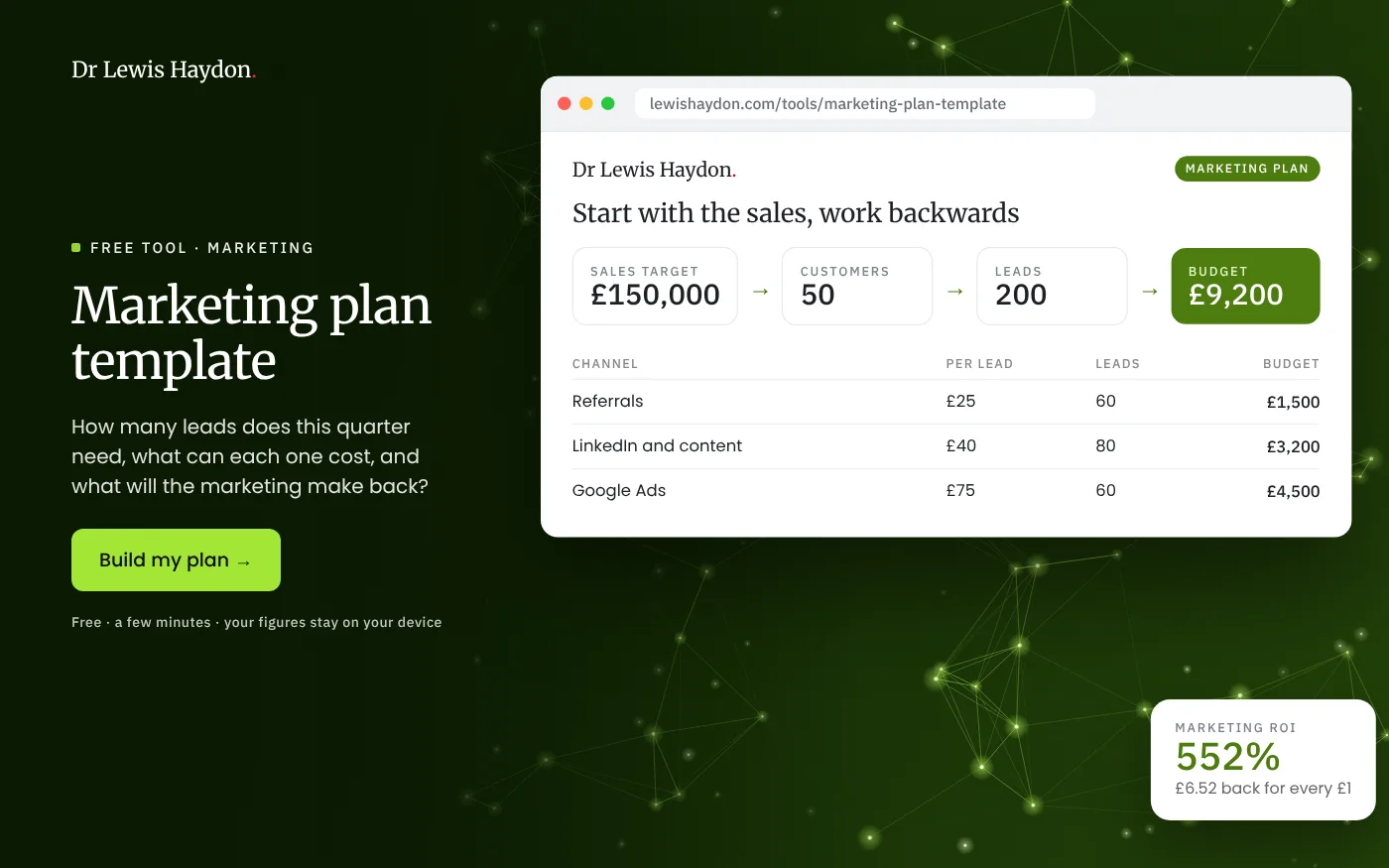
Most marketing plans start with the channels. This one starts with the number that says you won the quarter, then works back to the customers, the leads, what each lead can cost and the budget, so you can see what the marketing has to make before you spend a penny. Download it for Excel when you’re done.
Strictly private. The figures you type stay on your device. They are never sent to us or kept on our servers. The only details we hold are your name and email.
How to use it
How do you write a marketing plan?
Start with the end in mind. Dr Lewis Haydon’s method, the one he uses in his own businesses and with the owners he coaches:
1. Who are we talking to?
The right marketing for the right person. Different platforms reach different people, so find the audience first, then the channel.
2. What number says you won the quarter?
“Focusing on a week’s results is too trivial. A quarter gives you enough of an average to know whether the marketing worked.” For most owners the number is sales: “You can have all the leads you want, but if you didn’t make any money, what’s the point?”
3. Work backwards to the leads
For those sales to happen, what needed to be true week on week? How many customers, from how many leads, converting at what rate.
Leads needed = (sales target ÷ average sale) ÷ conversion rate4. Work out what each lead can cost
Put a cost per lead against each channel and the share of leads you want from it. That is your marketing budget, and it tells you where to invest the next pound.
5. Test, then stay on it
“People move from thing to thing too fast.” Pick the channels, measure the leads and sales every week against the plan, and give each one a quarter before you judge it. More on how to split test.
Marketing budget calculator: how much should you spend on marketing?
Not a percentage of turnover you read somewhere. The budget is what it costs to buy the leads your sales target needs:
Marketing budget = leads needed × cost per leadBefore you raise it, look at the conversion rate. Dr Lewis Haydon’s point on the podcast: 200 leads at a 10% conversion rate is 20 customers; at 20% it’s 40, from the same marketing spend. Doubling the conversion rate costs nothing extra in marketing; doubling the leads doubles the bill. Listen to how much should you spend on marketing, and if conversion is the gap, see sales coaching.
How do you calculate marketing ROI?
Marketing ROI % = (gross profit from the sales − marketing cost) ÷ marketing cost × 100Use gross profit, not sales. £150,000 of sales at a 40% margin is £60,000 of gross profit; spend £9,200 to get it and the return is 552%, or £6.52 back for every £1. If the return is below zero, the marketing is costing more than it makes, however busy the phone is.
How do you calculate cost per lead?
Cost per lead = channel spend ÷ leads from that channelCost per customer = marketing budget ÷ customers wonCost per lead tells you which channel is cheap. Cost per customer tells you which channel is worth it. A £75 lead from Google that converts at 40% is cheaper per customer than a £25 lead that converts at 5%.
Marketing plan example
The template opens with an example. An owner wants £150,000 of sales this quarter at an average sale of £3,000 and a 40% margin, and one in four leads becomes a customer. That’s 50 customers from 200 leads, about 16 a week. Taking 30% of the leads from referrals at £25, 40% from LinkedIn and content at £40 and 30% from Google Ads at £75, the marketing costs £9,200: £46 a lead, £184 a customer, 6.1% of the sales, and a 552% return on gross profit.
Questions people ask
Do you keep my figures?
No. The sums run on your own device: the figures you type are never sent to us or kept on our servers, and they stay strictly private. To see your result you enter your name and email, and those are the only details we hold.
What should a marketing plan include?
Five things: who you are talking to and the problem you solve for them; the sales number that says the quarter worked; the customers and leads it takes to hit that number; the channels you will use, with what each lead costs; and the weekly numbers you will check to know whether it is working. Anything else is detail.
How much should a small business spend on marketing?
Work it out from the sales you want rather than a percentage you read somewhere. Customers needed, times leads per customer, times cost per lead, is the budget. Then check the return: if every pound of marketing brings back more than a pound of gross profit, the question becomes how fast you can spend more, not whether you can afford it.
How do you calculate marketing ROI?
Take the gross profit the marketing brought in, subtract what the marketing cost, and divide by what it cost. £60,000 of gross profit from £9,200 of marketing is a return of 552%, or £6.52 back for every £1 spent. Use gross profit, not sales, or you will overstate it.
How do you calculate cost per lead?
Divide what you spent on a channel by the number of leads it brought in. £3,200 on LinkedIn that brings 80 enquiries is £40 a lead. Divide by the customers it won, not the leads, and you have the cost per customer, which is the number that matters.
Is this a marketing strategy template or a marketing plan template?
Both, in practice. The strategy is the who and the why: the customer, the problem, the message. The plan is the what and how many: channels, budget, leads and the weekly numbers. This template asks for both and gives you the plan as a download for Excel or Google Sheets.
Can I use this in Excel or Google Sheets?
Yes. Fill it in here, then download it as a CSV file. It opens in Excel, Google Sheets or Numbers with your plan, your channels and a 13-week tracker with columns for what actually happened.
Built by Dr Lewis Haydon, a business coach and mentor in Birmingham, UK, who runs the marketing in businesses he owns and owns shares in a sales and marketing lead generation business. Related: marketing coaching for owners, the sales plan template and the price increase calculator.
Next step
Plan looks good on paper?
Bring it to a 30-minute virtual coffee and leave with a straight answer on which channel to test first, and what would make you stop.
Not sure I’m the right fit? Compare me with other coaches and mentors, honestly, including where others are the better choice. Want something built around your business? Request a tailored quote and I’ll call you to go through it.