Article
How to Read a Balance Sheet When It's Your Own Company
Topic · Owner payoff and profit · 8 min read · Published 05.11.2026
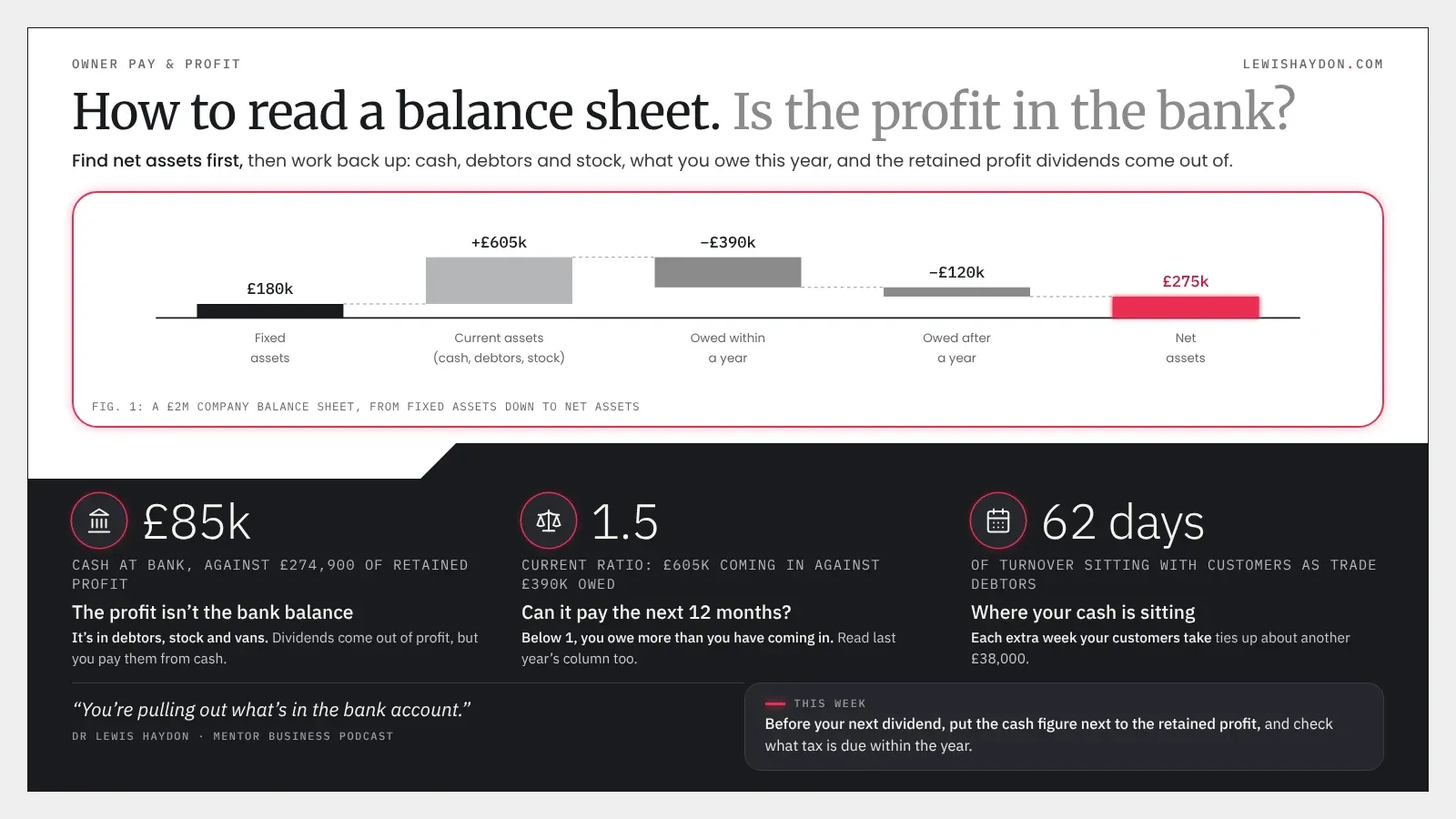
To read a balance sheet, find net assets first. That’s everything the company owns minus everything it owes, and it always equals the “capital and reserves” figure at the bottom, which is why the sheet balances. Then work back up it. Check how much is cash and how much is tied up in debtors and stock, set what you owe in the next 12 months against what’s coming in, look at the loans due after that, and find the retained profit, because that’s the pot dividends come out of.
When it’s your own company, you’re reading the balance sheet with two questions in mind: is the business healthy, and can it afford to pay me?
What does a balance sheet show?
A balance sheet is a snapshot of the company on one day, usually the last day of your financial year. It sits alongside the profit and loss account, which covers the whole year up to that day.
The accountant John Charman put the simple version like this on the Mentor Business Podcast: “A balance sheet is essentially, if you stopped trading today, how much would you be left with after you sell your assets?” Collect what you’re owed, sell the stock and the equipment, pay off the VAT, the corporation tax, the PAYE, the suppliers and the bank. Whatever is left is your balance sheet value.
On the same episode I owned up to how I used to see it: “I remember back in my journey, when I first started, it was like, great, I don’t need to know this. I just need to go out there, make more sales, make sure the customer’s happy and get more sales again.”
UK company accounts follow a set layout. For most owner-managed companies it runs top to bottom like this: fixed assets, current assets, creditors due within one year, net current assets, creditors due after more than one year, then capital and reserves (Small Companies and Groups (Accounts and Directors’ Report) Regulations 2008). Your accountant’s version will use those headings or something close.
A worked example: a £2m company’s balance sheet
Say you own a services company turning over £2m a year with 20 staff. These figures are made up, in round numbers, to show how the lines fit together.
| Balance sheet at 31 March | £ |
|---|---|
| Fixed assets (vans, machinery, IT) | 180,000 |
| Stock | 120,000 |
| Trade debtors (customers who owe you) | 340,000 |
| Other debtors, including £45,000 you owe the company | 60,000 |
| Cash at bank | 85,000 |
| Total current assets | 605,000 |
| Trade creditors (suppliers you owe) | (210,000) |
| VAT, PAYE and corporation tax owed | (150,000) |
| Bank loan repayments due this year | (30,000) |
| Total creditors due within one year | (390,000) |
| Net current assets | 215,000 |
| Total assets less current liabilities | 395,000 |
| Creditors due after more than one year (bank loan, hire purchase) | (120,000) |
| Net assets | 275,000 |
| Share capital | 100 |
| Profit and loss account (retained profit) | 274,900 |
| Total capital and reserves | 275,000 |
On paper this company is worth £275,000 to its shareholders and has £215,000 more coming in over the next year than going out. It looks fine until you read it as the owner.
Is the profit in the bank?
Usually not. The profit and loss account under capital and reserves (often called the profit and loss reserve, or retained profit) is every pound of profit the company has made since it started, after tax, minus every dividend it has paid. It isn’t a bank balance.
In the example, retained profit is £274,900 and the cash is £85,000. The rest of that profit has gone into the £340,000 customers owe, the £120,000 of stock and the vans. And £150,000 of tax is due within the year.
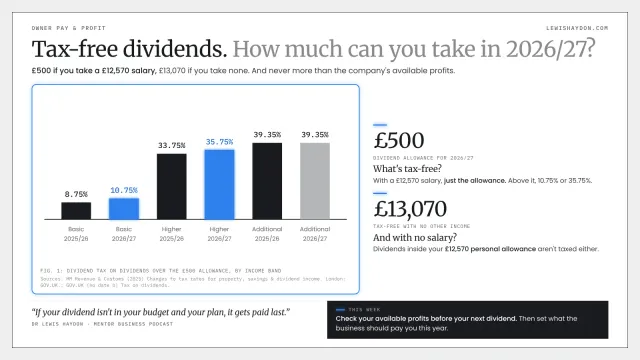
Dividends can only be paid out of available profits, and a dividend paid without them is usually treated as a director’s loan that has to be repaid (The Insolvency Service, 2026). So the £274,900 is roughly the legal ceiling, subject to your accountant’s check. It says nothing about whether the company can afford to pay it. Take £85,000 out here and the bank is empty with a tax bill coming. The detail on limits and tax is in how much dividend can I pay myself.
I made this point on a podcast about owner pay: “When you pull money out of a company, you’re not just pulling out what’s left of the profits. You’re pulling out what’s in the bank account.”
Debtors, creditors and stock: where your cash is sitting
Net current assets is current assets minus what you owe within a year. It’s the working capital that runs the business day to day. Divide current assets by creditors due within a year and you get the current ratio. Here it’s £605,000 against £390,000, about 1.5. Below 1, you owe more in the next 12 months than you’ve got coming in from cash, debtors and stock.
Then look at what’s inside it:
- Trade debtors of £340,000 on £2m of sales is roughly 62 days of turnover (a rough figure, because debtors include VAT and turnover doesn’t). Each extra week your customers take ties up about another £38,000.
- Trade creditors of £210,000 is what your suppliers are funding for you. If it’s climbing because you’re paying later, you’re borrowing from your suppliers, and they can stop.
- Stock: ask how much of the £120,000 hasn’t moved in a year, and whether it would sell for what’s on the sheet.
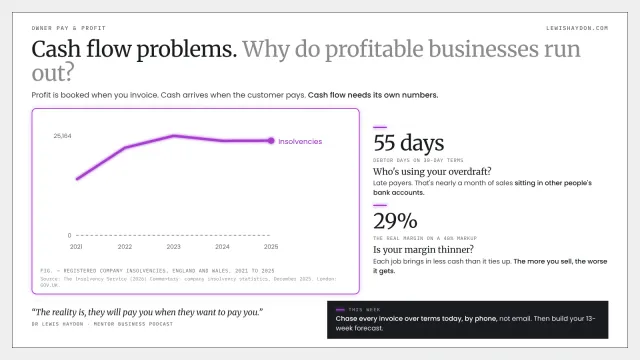
This is where profitable businesses run short of cash, and cash flow problems covers what to do about it. If you want to figure out how much cash is stuck in your own business, go to lewishaydon.com/tools and use the working capital calculator.
Your director’s loan account
The director’s loan account is the record of money you take from the company that isn’t salary, a dividend or expenses you’ve repaid, and money you’ve paid in (GOV.UK, no date). If you owe the company, it sits in debtors. If the company owes you, it sits in creditors.
In the example you owe the company £45,000. If that isn’t repaid within nine months of the end of the accounting period, the company pays tax on it. For loans made from 6 April 2026 the rate follows the dividend upper rate, so it’s 35.75%; earlier loans stay at 33.75% (HM Revenue & Customs, 2025; Sheppard, 2025). On £45,000 that’s about £16,088. The company can reclaim it, but only nine months and a day after the end of the period in which you repay the loan. And if you owe more than £10,000 at any point in the year, it’s treated as a benefit in kind with Class 1 National Insurance due (GOV.UK, no date).
The podcast version: “Your business bank account is not your personal bank account. You might not have ever been taught that, because there isn’t a driving licence you have to pass to own a business. If you’re taking it out as a director’s loan, well, guess what? After a certain amount of time, you get taxed on that as well, and the company has to pay for it. Money isn’t free.”
If the balance runs the other way and the company owes you, that’s money you’ve lent it. The company doesn’t pay corporation tax on money you lend it (GOV.UK, no date), and it’s worth knowing that figure exactly before anyone talks about buying the business.
Loans and what you owe after a year
Bank loans and hire purchase are split in two. This year’s repayments sit in creditors due within one year; the rest sits below net current assets. Add both parts together to see the full debt. In the example it’s £150,000 of borrowing against £85,000 of cash.
Borrowing is fine as long as the repayments don’t eat your working capital and an overdraft hasn’t been used to buy long-term things like vans and machinery.
What does a worrying balance sheet look like?
Your accounts show last year’s figures next to this year’s. Read across as well as down. These are the signs to act on:
- Net current liabilities: creditors due within a year are bigger than your current assets.
- Negative net assets, with a minus sign on the profit and loss reserve. There are no available profits, so there can be no dividends until it’s back above zero.
- Tax owed growing year on year while cash falls, which means HMRC is funding the business.
- Debtors growing faster than sales.
- A director’s loan you owe that gets bigger every year.
- Stock rising faster than sales.
- An overdraft that’s always fully used.
If more than one of those is on your latest balance sheet, sit down with your accountant before you take another dividend.
Two more questions owners ask
Where do I find my company’s balance sheet?
In the annual accounts your accountant prepares, and in the copy filed at Companies House. Small companies and micro-entities don’t have to file their profit and loss account there (Companies House, 2026), so for most owner-managed companies the balance sheet is the main thing a supplier, a bank or a buyer can look up about you.
Does the balance sheet tell me what my business is worth?
Not on its own. Net assets are mostly book values, such as what the equipment cost less depreciation. A buyer prices a business on its profit, usually EBITDA, then takes the debt off the price. What is EBITDA explains how that works. The balance sheet is where the buyer checks whether the profit is real and whether the cash is there. For a rough figure for your own business, use the business valuation calculator.
References
- Companies House (2026) Preparing and filing Companies House accounts. London: GOV.UK. Available at: https://www.gov.uk/government/publications/life-of-a-company-annual-requirements/life-of-a-company-part-1-accounts (Accessed: 2 November 2026).
- GOV.UK (no date) Director’s loans. London: GOV.UK. Available at: https://www.gov.uk/directors-loans (Accessed: 2 November 2026).
- HM Revenue & Customs (2025) Income Tax: changes to tax rates for property, savings and dividend income. London: GOV.UK. Available at: https://www.gov.uk/government/publications/income-tax-changes-to-tax-rates-for-property-savings-and-dividend-income/income-tax-changes-to-tax-rates-for-property-savings-and-dividend-income (Accessed: 2 November 2026).
- Sheppard, G. (2025) Consequential adjustment caused by dividend tax rate changes. London: Crowe UK. Available at: https://www.crowe.com/uk/insights/budget-2025-dividend-tax-rate (Accessed: 2 November 2026).
- The Insolvency Service (2026) Director information hub: Dividends. London: GOV.UK. Available at: https://www.gov.uk/guidance/director-information-hub-dividends (Accessed: 2 November 2026).
- The Small Companies and Groups (Accounts and Directors’ Report) Regulations 2008, SI 2008/409, Schedule 1. Available at: https://www.legislation.gov.uk/uksi/2008/409/schedule/1 (Accessed: 2 November 2026).
Want a straight answer on your own numbers?
I’m Dr Lewis Haydon, a business coach and mentor who ACTUALLY owns businesses, in medical technology, manufacturing and accountancy. If your balance sheet raised a question this didn’t answer, book a virtual coffee and bring your latest accounts with you. If you’d rather see what working together costs first, my prices are published.