Mentor Business Podcast · Episode 124
How to Build a High Performing Team So the Business Grows Without You
Topic · Team, structure and delegation · 11 min read · Ep. 124 · Published 28.09.2026

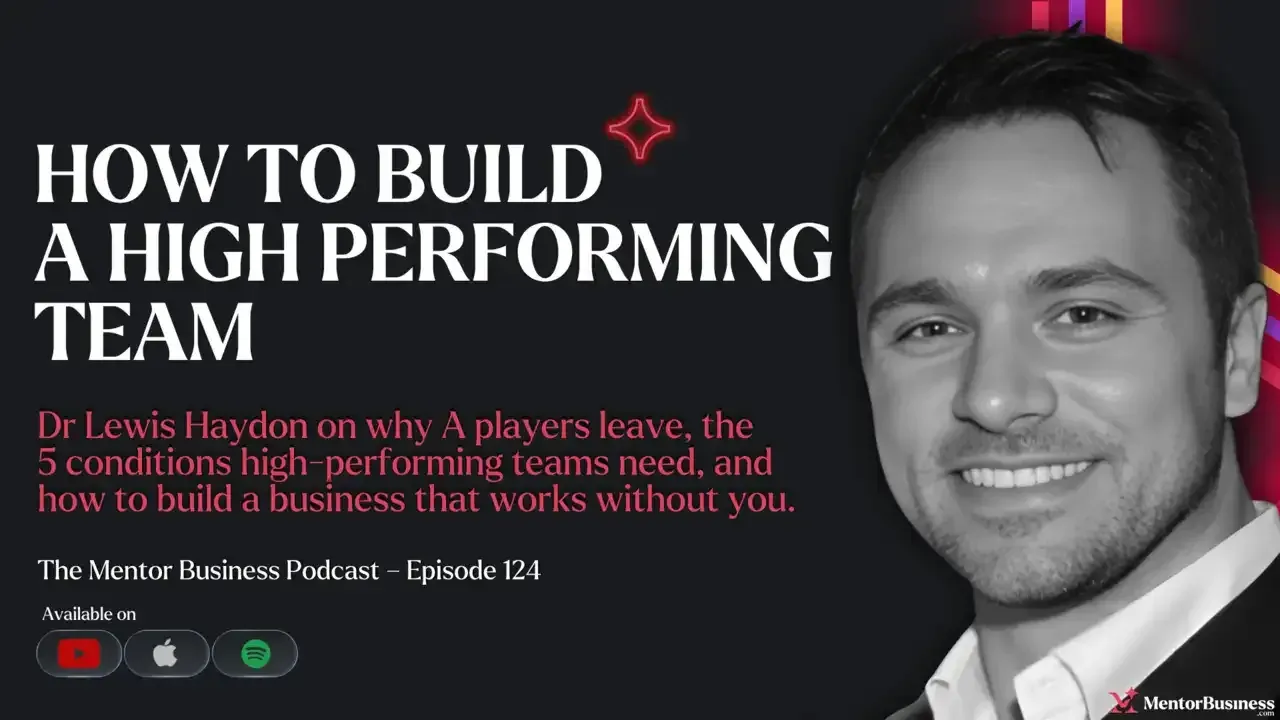
When I was hiring for somebody recently, I asked in the second-stage interview, “To what level are you coachable? For example, what are your goals?” They said they’d never really thought about it. They were there to turn up and get a job. That’s the number one flag.
Most owners think they can’t find good people. You can. You find them, you hire them, and somewhere around month six they leave, and you decide the talent market is the problem. More often, the capable ones go because every decision still routes through you, the business owner, so there’s nothing for them to take charge of. Building a high performing team starts with fixing that before you recruit anyone, and then hiring people who have goals of their own.
What is a high performing team?
A high performing team consistently delivers more than the people in it would on their own. That happens because they share a clear goal, hold each other accountable to a standard, and can make decisions without asking permission. They’re not always the most talented, the most experienced or the most motivated. Those are nice to have, but they’re not what makes the team work.
A good team does what you ask, and does it well. You need a team that does what’s needed when nobody has asked if you want a business that grows without you, because you can’t scale while you are still the person doing the work that keeps the business running.
Here’s the three-week test. Phone off, three weeks. What’s there for you when you get back? Is it a functioning business, or did it all pause, with a list of excuses: “we couldn’t do this because you were away, Lewis”, “we’re waiting on you for that decision”? Most owners have a story like “I tried taking seven days off, and it was chaos when I came back.” That pause is the diagnosis, and whatever waited for you is the constraint to work on next.
If you want to figure out what would be waiting for you, and what to hand over first, use the owner time audit.
Then ask yourself: did you really go into business, carry the payroll and take all that risk just so you could be the person who gets paid last? Pay everyone else’s salary and take no reward? Reward can be money, time, or building a legacy, instead of feeling like you’re on the hamster wheel and not getting anywhere. You need to get paid first, not last.
Walk into any office, or open any Teams chat, and everyone looks busy. Running around with their hair on fire. Are they actually moving the needle? You find out from the dashboard at the end of the week. Like the dashboard in a car, it shows whether there’s enough fuel, whether you’re at the right speed and whether you’re still following the route. When it shows you’re off course, that’s when you step in. With a good dashboard in place, you can check in from anywhere in the world.
What are the characteristics of high performing teams?
The high performing teams I’ve built and worked with all have five things in place: clarity on the numbers, control of each result, consequences when targets are missed, an owner who coaches people, and a clear line from each person’s work to the outcome. On the podcast I called them the Haydon 5 C’s. Yes, I did just make that up. The Haydon part is made up; the five C’s are real.
Clarity comes first. Numbers are the language of business, and almost everything can be measured, including how people feel, as long as you score it consistently. If a goal is subjective, nobody can tell whether they’re winning.
Control means someone other than you owns each part of the P&L. The P&L shows where the money comes in, where it goes out and how the business makes a profit, so it is the most honest map of who should be responsible for what. If your name sits against most of it, that’s the first thing to change.
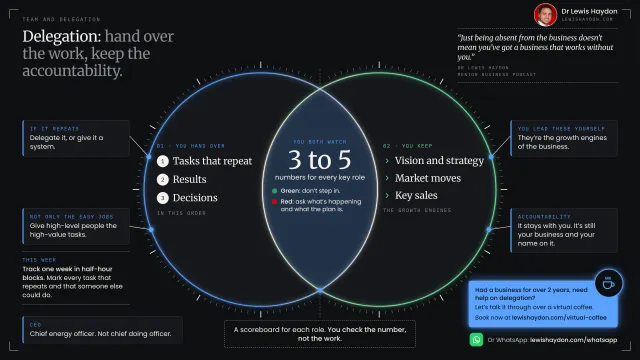
Consequence is where many owners go soft. In the businesses I work with, we run the dashboard on red, amber and green. Say marketing needs 50 new leads a week:
- Green is 50, and keeps you on track for the year.
- Amber is anything over 30.
- Red is anything below that. Week after week, it means the business is heading under break-even.
I always start with marketing because it’s the top of the funnel. If that’s red, nothing further down can make up for it.
The consequence of red doesn’t have to be punishment. It can simply be that nobody grows, and capable people won’t stay in a business that isn’t winning. You, as the owner, have the resilience to ride it out. They can decide it’s not the right vehicle for them and move on.
Coaching is the owner’s part. When someone joins one of my businesses, whether they want to be a director, a manager or a specialist, I ask what their goals are. I need to know their goals so I can fund their future: what to budget, what to invest, and how much of my time to spend coaching them. Coaching brings out the best in people. It’s being there for them, making sure they go for the gold medal, and if they get silver, keeping them pushing towards what they said they wanted.
Contribution means each person can see how their week’s work moved one of the numbers. Cut people off from the results and they drift within months. It also means thinking about the mix. A team made up entirely of star players is like fielding eleven Ronaldos: plenty of talent and a great deal of drama. What works better is one or two people who set the pace, and a strong supporting team who keep the rhythm going on the difficult days.
Which of the five C’s is missing in yours? Take the free scorecard: five areas, scored out of 30, in about five minutes.
 Running a team training session with the team at Joshua Robert.
How do you build a high performing team?
Build the conditions, then hire. That means a weekly dashboard, one owner for each result and an agreed response when numbers turn red. Only then do you recruit, and you look for people with goals of their own, because their goals become part of the business’s goals.
Hire a capable person into a business with no clarity and no control, and you’ve given them the reason they’ll leave.
That’s why the goals question in the interview matters. You need B-players too, the people who don’t want the bigger goals and keep things steady. But if someone isn’t goal-driven, how can they ever push your business forward, when their goals are part of your goals?
Whatever you agree, agree it in conversation, not by email. Then write it down and get them to sign it. That’s not some sort of legal thing. It’s just so everyone’s got clarity.
Titles matter more than owners think. If you call yourself managing director or CEO and still do everything, the business is organised around your importance rather than your team’s. The people who should be the heroes are the team.
This also changes what your business is worth. When you come to sell, the price is a multiple of your EBITDA (your profit before interest, tax, depreciation and amortisation), and that multiple depends on whether the business needs you. If it does, expect to be tied in for three, four or five years after the sale while you prove it can grow without you. If it already grows without you, it’s worth more and you can leave sooner.
How do you improve team performance?
Change less. Review the dashboard weekly, act when a number stays red, and leave working systems alone. Make fewer changes and make each one count.
If your good people keep leaving and you can’t see why, that’s the work I do with owners and their leadership teams in business coaching and mentoring. For the owner and the senior team coached together, see executive coaching in Birmingham, in person or on Zoom across the UK.
Some of the worst advice I was ever given was that you always need to be doing something, making a change to the business every week. Every change meets resistance. Even a good one causes a drop in performance while people get used to the new system, or push back against it and gossip to their colleagues about it. It’s a bit like the stock market when a new product comes out: a spike, up or down, before it levels itself out again. Keep changing things and your team never climbs out of the drop.
The research supports treating mindset as something a team can develop. A meta-analysis of 51 samples, covering more than 12,000 employees, linked psychological capital (hope, efficacy, resilience and optimism) to job satisfaction, commitment and performance (Avey et al., 2011). I summarise it in psychological capital: the evidence that a developable mindset pays.
I think of a business as a garden. At the start it needs your attention, your planning and your guidance. Once it’s growing, it needs watering and checking, not constant pruning. Prune it too often and you’ll kill it. Then you put a gardener in, whether that’s a general manager or a managing director, and you take what you learned to the next garden, where you can do it faster and more profitably.
Once that leader is in place, my role changes. I’m no longer supervising the work. I’m checking whether the leader is keeping to the culture and following the systems I built. McDonald’s is the obvious example of a business that runs on systems. Put a Michelin-star chef in one of its kitchens and they’ll want to do things their own way, because that’s what strong people do.
In my experience, a senior hire will think they know better for roughly their first 15 months, and then they start to learn why things are done the way they are. That’s normal. The balance is to protect the system without taking control away from them. The moment you take control back, the consequence sits with you rather than with them, and the whole thing starts to fall apart.
Look, if you’re working 50 or 60 hours a week in your business right now, start with the first of the five C’s, clarity, and work through them in order.
If you’d like the same ideas set out as a guide, read how to build a high performing team on Mentor Business.
What is a team that waits for you costing your business?
Three weeks, phone off. If the answer is a list of excuses, every capable person you’ve hired has been sitting in a business with nothing to take charge of, and the good ones leave around month six, which you then blame on the talent market. Each one costs you the recruitment, the training, the lost momentum, and the months you spent back in their seat. Add the 50- or 60-hour weeks that don’t come down, the decisions that queue while you’re away, and a sale price marked down because the buyer can see the business needs you for three, four or five years after they’ve paid.
With the five C’s in place, the dashboard tells you on Friday whether the week moved the needle, each number has one owner who isn’t you, red gets a response, and the people you hire have goals of their own that your business funds. You check in from anywhere in the world, the gardener runs the garden, and the business is worth more because it grows without you.
First steps with me
- Run the three-week test on paper: what would be waiting for you? That list is your constraint.
- Run the free owner time audit to see what to hand over first, and the scorecard to see which of the five areas has no owner but you.
- Bring your dashboard, or the fact you haven’t got one, to a virtual coffee, 30 minutes on Zoom, no charge, or WhatsApp me. 1:1 mentoring is from £800 a month plus VAT, every price published.
For this done with your managers, see leadership coaching for owners and their managers.
Start with clarity. The other four follow in order.
FAQs
What are the 5 characteristics of a high performing team?
Clarity on the numbers, control of each result by someone other than the owner, consequences when targets are missed, an owner who coaches people towards their own goals, and a clear line from each person’s work to the outcome. The five C’s. Get them in that order.
How do you motivate a team without raising pay?
Give people a number they own, a dashboard that shows whether they moved it, and coaching towards goals they told you about in the interview. Capable people stay in businesses that are winning and where they can see their contribution. Pay matters; being cut off from the result matters more.
Why do good employees leave small businesses?
Most often because every decision still routes through the owner, so there’s nothing for them to take charge of. They arrive capable, find no clarity and no control, and go around month six. Fix the conditions before you recruit, or you’ve given the next hire the same reason to leave.
How often should you review team performance?
Weekly, on the dashboard, with red, amber and green against each number. Monthly is too slow to catch a quarter going wrong. Review often, change rarely: act when a number stays red, and leave working systems alone.
Should every member of a team be a high performer?
No. A team of eleven Ronaldos is plenty of talent and a great deal of drama. One or two people who set the pace and a strong supporting team who keep the rhythm going on the difficult days works better. You need B-players who want steady more than they want the bigger goal.
How does working with you start?
With a virtual coffee: 30 minutes on Zoom, no charge, bring the three-week test answer and I’ll tell you which C to start with. If it’s worth going further, I work with owners and their leadership teams from £800 a month plus VAT, every price published.
References
- Avey, J.B., Reichard, R.J., Luthans, F. and Mhatre, K.H. (2011) ‘Meta-analysis of the impact of positive psychological capital on employee attitudes, behaviors, and performance’, Human Resource Development Quarterly, 22(2), pp. 127–152. Available at: https://doi.org/10.1002/hrdq.20070.
Listen or watch on your favourite platforms
Listen to the full episode: How to Build a High Performing Team, Mentor Business Podcast, Episode 124
I go deeper on team performance and building a business that grows without you in my shows on MentorBusiness.com. Sign up or log in at mentorbusiness.com.
Want help building yours? Book a virtual coffee.