Article
Delegation: What It Means and How Business Owners Get It Right
Topic · Team, structure and delegation · 7 min read · Published 16.11.2026
Delegation means giving someone else responsibility for a task or a result, with the authority to get it done, while you stay accountable for how it turns out. For a business owner, it’s how the business grows past the hours you’ve got.
On the podcast I put it like this. CEO stands for chief energy officer. “What that does mean is you’re not chief doing officer. There are people out there better than you that can do the job better than you as well.”
This is for the owner of an established business with a team, who still ends up doing most of it.
What is delegation in a business?
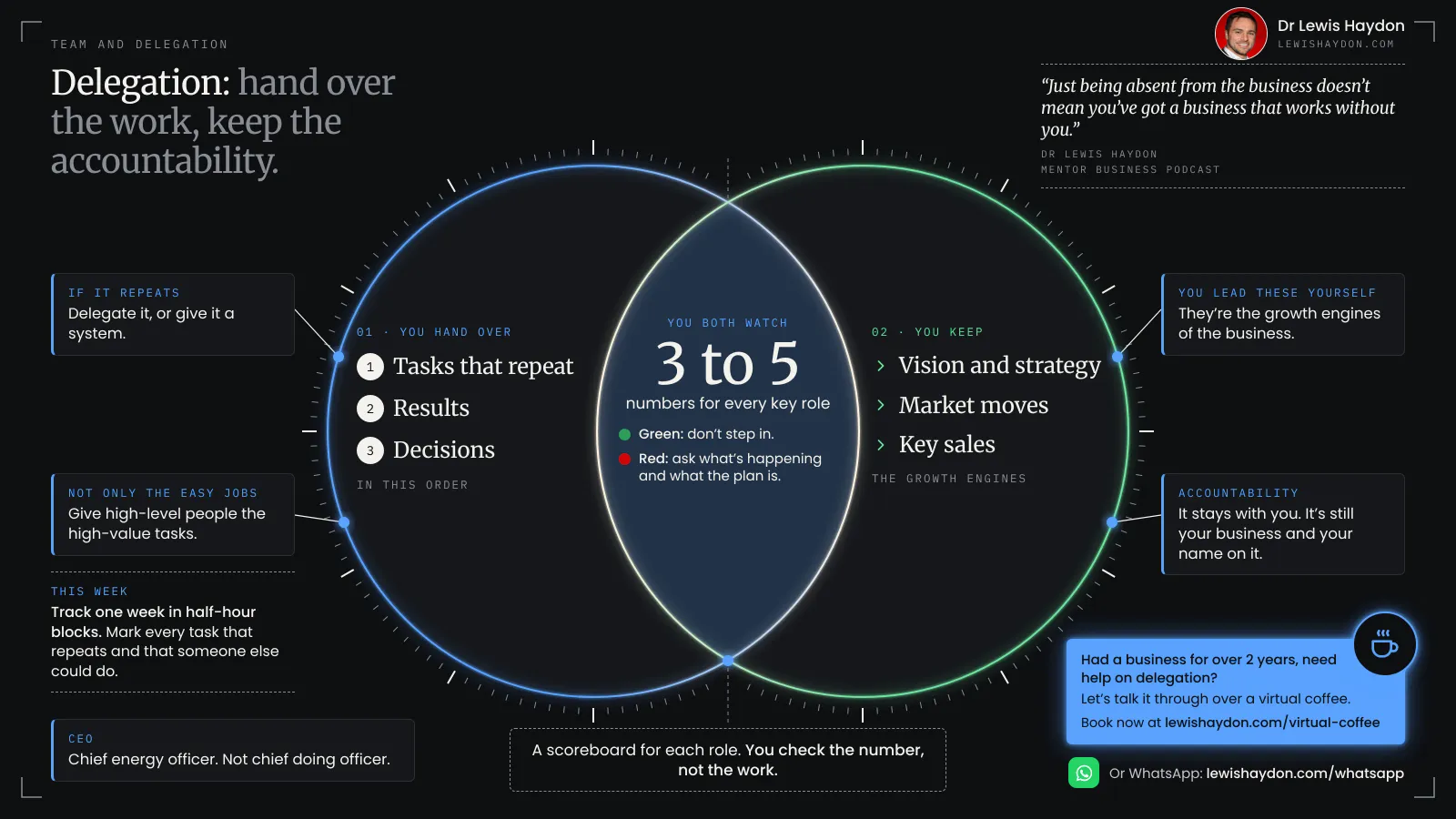
It’s handing over three things, usually in this order. First the tasks that repeat every week. Then the results, so a person owns a number and the job of hitting it. Then the decisions, so most of them get made without coming to you.
What you don’t hand over is the accountability. If it goes wrong, it’s still your business and your name on it. That’s why delegation needs a way of checking, which I’ll come to.
What should a business owner delegate first?
Start with what drags you back in. On the podcast, step one was: “Map your weekly bottlenecks. Write down every recurring task or problem that drags you back into operations.” If it repeats, it gets delegated or it gets a system.
Operations, service delivery and admin can all be delegated and automated. There are usually people out there who’ll do them better than you.
If you want a rule for what stays with you, do a brutally honest time audit of your week. In that episode I told owners at seven figures to eliminate or delegate everything under £1,000 an hour of value. Your number will be different. Work out what an hour of your best work is worth to the business, and look hard at everything below it.
If you want to figure out where your week goes, go to lewishaydon.com/tools and use the owner time audit. There’s more on the diary side in time management tips.
The mistake of only delegating the easy tasks
I used to believe you should keep the harder, high-value tasks and delegate the easy ones. “That was a big mistake of mine, by the way, that cost me and held me back a lot. Once I changed that mindset, business really opened up.”
What I did was employ high-level people, the best I could afford, and give them the high-value work. “If you hire somebody for more money, make sure you’re giving them very high value tasks, because they can smash them better than you can a lot of the time.”
It came with a condition. I had to get the hiring right and the processes right, and make sure the new people followed my processes and not the ones from their last job. That’s why written standard operating procedures come before you hand over anything that matters, and why hiring the right person is part of delegating well.
Delegation is not disappearing
Some owners hire and then micromanage, so nothing has really been handed over. Others delegate and then vanish.
As I said on the podcast, “They believe absence is success, when in reality absence often equals stagnation. Just being absent from the business doesn’t mean you’ve got a business that works without you.”
Some things need you. Operational roles can be delegated. The vision, the strategy, the market moves and the key sales are the growth engines of the business, and you have to lead those yourself.
 Walking through one of the businesses I own. I’m there for leadership and accountability, and the team does the work.
How do you delegate and still know what’s going on?
With numbers. Every key role should have three to five numbers they’re responsible for. You can call it a scoreboard or KPIs. Revenue, client delivery, pipeline, cash flow, whichever ones matter for that role.
If the number is green, don’t step in. If it’s red, that’s where you come in to find out what’s happening and what the plan is.
Two more things help.
- Let your leaders run the meetings. You get a short summary and you make the calls that only you can make. If you keep jumping in with your cape on to save the day, you’ll keep getting pulled back in.
- Build a decision filter. Define two or three principles for how decisions get made in your business. When the team knows the rules, they can make most decisions quickly without you.
The full five steps are in the podcast episode on how to delegate and get out of daily operations.
Why do business owners find delegation so hard?
Because it’s your baby, and you want everything done right. In my experience the owner’s need for control is usually the biggest bottleneck in the business.
It gets harder the better you are at the work. If you’re the best salesperson or the best engineer in the building, every task you hand over gets done a bit worse than you’d do it, at first. Most owners take that as proof they should keep it. All it means is the person needs a process, a number and some time.
If this is where you’re stuck, it’s the work I do with owners and their managers in leadership coaching. When the whole senior team needs it, that’s executive coaching. The step after delegating tasks is delegating the whole seat, which I cover in what a managing director does and when to appoint one.
What is not delegating costing your business?
Every decision waits for you, so the business can only grow as fast as you can get to things. Your best people stop bringing ideas, because the answer always comes from you anyway, and the good ones leave for somewhere they can own something.
There’s a cost to you as well. You’re paying a team and still doing the work, which is lots of hard work and not much payoff. And a business that depends on its owner is worth less to a buyer.
When it’s working, your managers bring you their numbers and their plan. You see red and green on one page. Your time goes on the things only you can do, and the business keeps moving in the weeks you’re not there.
First steps with me
- Track one week in half-hour blocks. Mark every task that repeats and that someone else could do.
- Use the free owner time audit to put a value on your hours, and the scorecard to see which part of the business needs you most.
- Bring the list to a virtual coffee and I’ll tell you what I’d hand over first: 30 minutes on Zoom, no charge. Or WhatsApp me. Mentoring is from £800 a month plus VAT, and every price is published.
FAQs
What does delegation mean?
Giving someone else responsibility for a task or a result, with the authority to do it, while you remain accountable for the outcome. In a business that usually means tasks first, then results, then decisions.
What should a business owner never delegate?
The growth engines: the vision, the strategy, the market moves and the key sales. Operational roles, service delivery and admin can be handed over. Accountability for the result always stays with you.
What is the difference between delegating and abdicating?
When you delegate, the person has a clear result to deliver and you check the number. When you abdicate, you hand it over and vanish. Being absent from the business doesn’t mean it works without you.
How do I delegate without losing control?
Give every key role three to five numbers and look at them every week. If a number is green, leave it alone. If it’s red, ask what’s happening and what the plan is.
Should I delegate the easy tasks or the hard ones?
Both, to the right people. I used to keep the hard, high-value tasks for myself and it held me back. When I hired high-level people and gave them high-value work, the businesses grew faster.
How does working with you start?
With a virtual coffee: 30 minutes on Zoom, no charge. Bring the list of what’s still on your desk and I’ll give you a straight answer on what to hand over first. If it’s worth going further, mentoring starts from £800 a month plus VAT and every price is published.
References
- Haydon, L. (2025) ‘The simple system that gets you out of daily operations’, Mentor Business Podcast, 10 September. Available at: https://lewishaydon.com/podcast/the-simple-system-that-gets-you-out-of-daily-operations/
- Haydon, L. (2025) ‘Business myth busting: a business that works without you’, Mentor Business Podcast, 12 September. Available at: https://lewishaydon.com/podcast/business-myth-busting-a-business-that-works-without-you/
- Haydon, L. (2025) ‘Why most 7 figure CEOs waste 30% of their week and don’t know it’, Mentor Business Podcast, 31 July. Available at: https://lewishaydon.com/podcast/why-most-7-figure-ceos-waste-30-of-their-week-and-dont-know-it/
Want a straight answer on what to hand over?
If everything still comes through you, book a virtual coffee and bring your week. I’m Dr Lewis Haydon, a business coach and mentor who ACTUALLY owns businesses, and I’ll tell you what I’d delegate first and to whom. My prices are published if you’d like to see them first.