Article
Sales Funnel Stages: How the Process Works in a Small Business
Topic · Growth and scaling · 4 min read · Published 22.10.2024 · Updated 23.10.2026
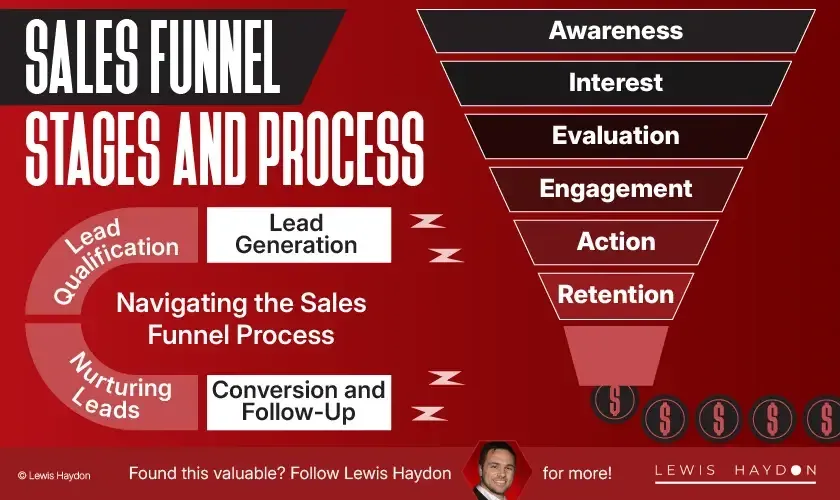
A sales funnel has six stages: awareness, interest, evaluation, decision, purchase and repeat business. At each stage some people drop out, so the funnel narrows from everyone who hears of you to the customers who buy again. The point of mapping it isn’t the diagram. It’s finding the one stage where you’re losing the most people, and fixing that first.
Most owners try to fix the top. More leads, more posts, more ads. Usually the leak is further down.
The six sales funnel stages
1. Awareness
The customer finds out you exist: a referral, a search, a post, an event, a sign on the van. Nothing is sold here. The only job is to be found by the right people.
2. Interest
They look closer. They read your website, check your reviews, look at what you’ve done for businesses like theirs. This is where most small businesses lose people without knowing it: no prices, no proof, no clear next step.
3. Evaluation
They compare you with the alternatives, including doing nothing. They want to know what it costs, what changes for them, and whether you’ve done it before. Good marketing does the heavy lifting here, so that when they pick up the phone to you, they’re already most of the way sold.
4. Decision
The sales conversation. You ask questions, find the real problem, show them how they’re better off afterwards, handle the objections and ask for the business. A clear no is fine. An endless maybe isn’t.
5. Purchase
The order, the contract, the first invoice. Make it easy. Every extra form, delay or surprise in the paperwork loses deals you’d already won.
6. Repeat business and referrals
The stage owners forget. A customer who buys again costs you far less to win than a new one, and a happy one sends you others, which feeds stage one. Think in lifetime value, not the one-off sale.
Sales funnel vs sales pipeline
They’re two views of the same thing.
| Sales funnel | Sales pipeline | |
|---|---|---|
| Looks at | The whole customer journey, from first hearing of you to buying again | The deals your team is actively working |
| Shows you | Where people drop out, as percentages | What’s likely to close, when, and for how much |
| Owned by | Marketing and sales together | Sales |
| Question it answers | “Where are we losing people?” | “What will we sell this month?” |
You need both. The funnel tells you where to fix the process. The pipeline tells you what to chase this week.
How to find the stage that’s costing you sales
Count how many people reach each stage in a month. You don’t need software to start; a spreadsheet does it.
- Enquiries: how many people got in touch.
- Conversations: how many became a proper call or meeting.
- Proposals: how many got a quote or proposal.
- Orders: how many bought.
- Repeat: how many of last year’s customers bought again.
Then work out the percentage that moves from each step to the next. The step with the biggest drop is your constraint, and that’s where your time and money should go. There’s no point damming the river at the bottom of the mountain. Fix the flow where it’s being lost.
A few patterns I see again and again in owner-led businesses:
- Lots of enquiries, few conversations. Slow responses. Leads go cold while they wait for the owner to get back to them. Fix: reply the same day, and let someone other than you do it.
- Lots of proposals, few orders. Weak follow-up or the wrong customers. Fix: agree the next step on every call, follow up until there’s a decision, and qualify harder before you spend time quoting.
- Good orders, no repeat business. Nobody owns the customer after the sale. Fix: give someone that job and measure it.
- Few enquiries. Only now is it a marketing problem. And even then, check the interest and evaluation stages first: can people see your prices, your proof and how to take the next step?
The tools that help
A CRM to log every enquiry and its stage. Email follow-ups for people who aren’t ready yet. A simple weekly report of the numbers above. That’s enough for most businesses under £20m. If you don’t have a CRM yet, start with my guide to CRM for small business.
The tool matters less than the habit. If you can’t measure it, you can’t scale it.
What to read next
- How to improve sales skills, yours and your team’s, for the decision stage.
- Sales and marketing alignment, so the stages hand over cleanly.
- What a buyer persona is, so the top of the funnel attracts the right people.
- Sales KPIs worth checking every week.
If the funnel still runs through you at every stage, that’s the bigger problem to fix. It’s the kind of thing I work on with owners: you can see how I work and what it costs.