Article
Sales Process: How to Write One That Doesn't Depend on You
Topic · Growth and scaling · 8 min read · Published 05.11.2026
A sales process is the written set of steps every enquiry goes through, from first contact to the day the customer is handed over to the people who deliver. Each step has one owner, a clear rule for when a deal moves on, and one number you track. For most established businesses there are seven steps: lead, first conversation, qualification, proposal or quote, follow-up, close, and handover to delivery. Write them down, measure the conversion from each step to the next, and someone other than you can run it.
Your sales funnel shows where people drop out. The process is what your team actually does at each step, and who does it. In a lot of owner-led businesses that only exists in the owner’s head.
Why does every sale still go through you?
Because you’re the only one who knows the rules. You know which enquiries are worth a visit, how much room there is on price and when to ring back. None of it is written down, so every deal waits for a gap in your diary.
Putting a salesperson in doesn’t fix that on its own. I had a client who systemised sales and put a salesperson in. The salesperson was mediocre. Every week it was: where are the sales numbers? They weren’t learning and they weren’t developing, so the owner ended up back in the sales seat. The leading indicators started moving again, because the owner was passionate about it and put the time into learning.
A written process gives the next person a fair chance. It still needs someone in the seat who wants to get better, and someone checking the numbers every week.
The seven sales process steps
| Step | Who owns it | What happens | The number to track |
|---|---|---|---|
| 1. Lead | Marketing, or whoever answers the phone | Every enquiry logged in the CRM with where it came from, and a reply the same working day | Enquiries a week, by source |
| 2. First conversation | Salesperson | Find out what’s prompted them to look now and where they want to be | % of enquiries that become a proper conversation |
| 3. Qualification | Salesperson | Check they can afford it, who signs it off and when they need it | % of conversations that qualify |
| 4. Proposal or quote | Salesperson, with prices signed off by the sales manager | Options and a price, with a date agreed for the next conversation | % of qualified deals quoted, and average quote value |
| 5. Follow-up | Salesperson | Planned points of contact until there’s a yes or a no | Open quotes by age, and % with a dated next step |
| 6. Close | Salesperson, with any discount signed off by the sales manager | The order and payment terms agreed in writing | Quote-to-order %, by number and by value |
| 7. Handover to delivery | Salesperson to operations | A handover note: what was sold, the price, the dates and anything unusual promised | Jobs delivered at the margin quoted |
The “who owns it” column is the one owners skip. Put one name against each step, even if it’s your name for now. When you hire, you hand over whole steps, and you can see at a glance which ones are still yours.
Lead and first conversation
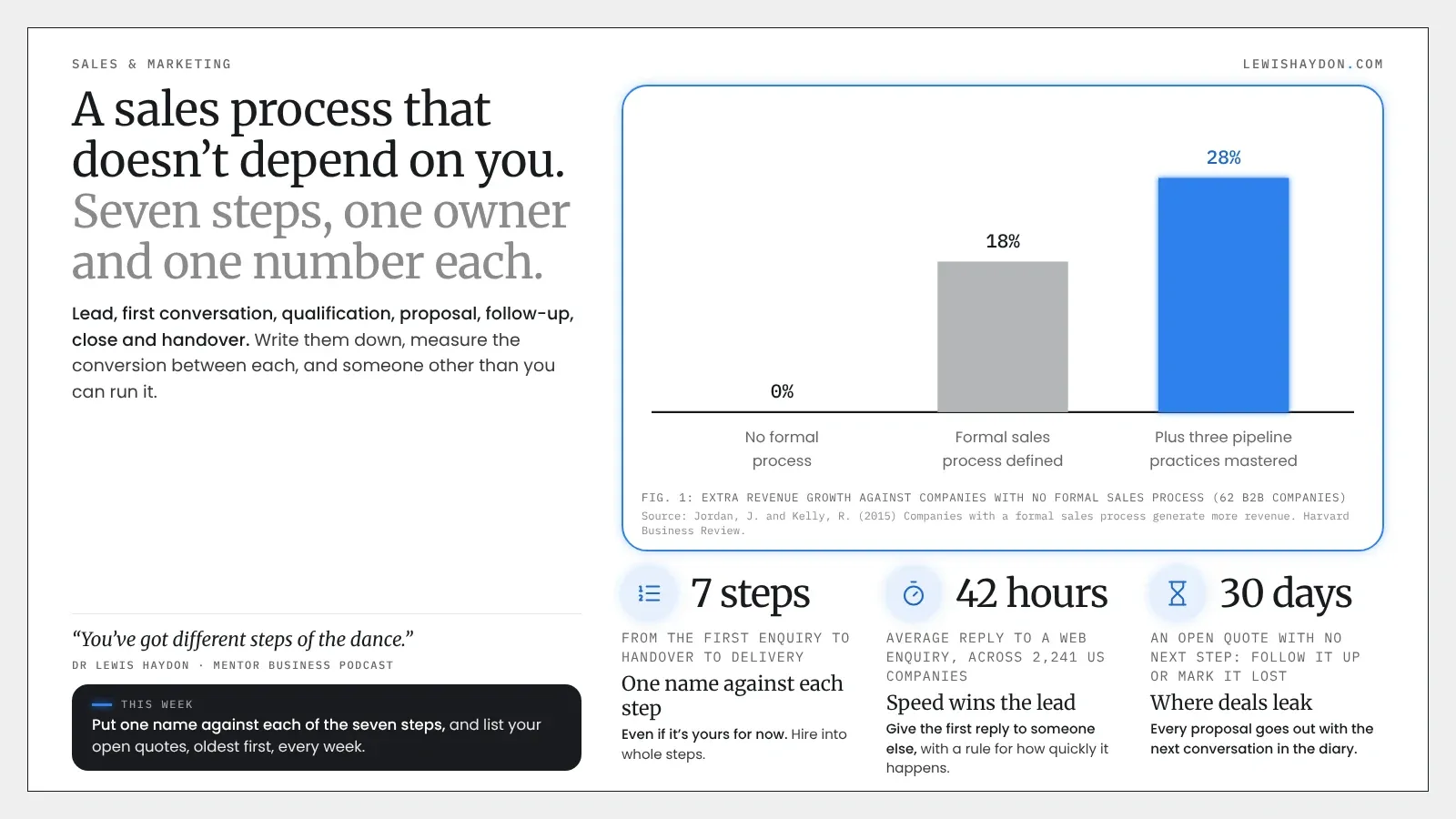
In an audit of 2,241 US companies, the average reply to a web enquiry was 42 hours, among the firms that replied at all within 30 days. A separate study by the same team, of 1.25 million leads, found firms that made contact within an hour were nearly seven times as likely to qualify the lead as those that waited even an hour longer (Oldroyd, McElheran and Elkington, 2011). Give the first reply to someone other than you, with a rule for how quickly it happens.
Qualification
This is where you decide whether a deal is worth a quote. A lot of the quotes that never come back were never qualified in the first place.
The question that gets missed is timing. As I said on the podcast: “One question that a lot of people don’t ask when they get an enquiry: when do you need it for? What does that actually mean in the language of business? You are predicting, based on your conversion rate, when you will be able to sell this product and invoice this product.” That date goes in the CRM, and it’s what turns your pipeline into a cash flow forecast.
In a B2B sales process, qualifying also means finding everyone involved in the decision, because the person you’re talking to often isn’t the one who signs. Ask early who else is involved and when they decide.
Proposal and follow-up
A quote with no date for the next conversation is usually the one that goes quiet. Every proposal should go out with a next step already in the diary, such as a call to walk through it.
On the podcast I talk about points of contact: how many times you reach out once you’ve had the enquiry. The salesperson’s job is to keep offering service until the customer can make the best informed decision, and to stay front of mind the whole time. Write down what those points of contact are for your business, so follow-up is a step in the process and not something that happens when someone remembers.
Keep a weekly list of open quotes, oldest first. Anything over 30 days with no next step needs a decision: follow it up properly, or mark it lost.
Handover to delivery
The sale isn’t finished when the order comes in. If operations don’t know what was promised, they find out from an unhappy customer, and the margin you quoted goes on extras nobody priced. A short handover note, or a quick meeting between sales and operations, covers it. Track whether jobs come in at the margin quoted. When they don’t, the cause is often back at the quote.
Does one sales process fit everything you sell?
Not always. I talked on the podcast about a company that sells some products at around £10k and others at £2m, and was using the same sales process for both. Put the £10k buyer through everything a £2m deal needs and it annoys them, because they just want the product quicker. Miss steps on the £2m deal and the customer comes back and says it doesn’t feel like you care enough. “You’ve got different steps of the dance.”
So keep the seven steps and change how much happens inside each one. A small order might close in one phone call; a big contract might need several meetings before you quote.
What should you measure in a sales process?
The conversion from each step to the next. Count how many deals reach each step in a month, work out the percentage that moves on, and look for the biggest drop. Do it by number and by value. Winning lots of small quotes while losing the big ones looks fine until you check the value.
In a survey of 62 B2B companies by Vantage Point Performance and the Sales Management Association, companies that had defined a formal sales process saw 18% more revenue growth than those that hadn’t, and those that mastered three specific pipeline practices saw 28% higher revenue growth (Jordan and Kelly, 2015).
The numbers also show you who needs help, and where. On the KPIs episode I put it like this: “How do you know who is the top performer? How do you know that someone needs help? How do you know what part of the sales process they need help with if you’re not collecting data?”
Collecting it is easier than it used to be. In our businesses, with the customer’s OK, a small recording device on the desk takes the notes from sales calls and puts them into the CRM automatically. For the weekly dashboard itself, see my guide to sales KPIs.
How do you hand the sales process to a salesperson or sales manager?
One step at a time, starting with the ones that need you least. Lead handling, follow-up and the handover to operations are where deals leak when you’re busy, so hand those over first. Qualification and quoting come next, with your pricing rules written down. Closing comes last, once the numbers show the new person converting at close to your rate.
For a first draft, look at your last ten wins and last ten losses and note what happened at each step.
Give each person the numbers for the steps they own, and review them every week. When I go into one of my businesses, I speak to the sales manager or sales director and ask for the pipeline: what’s coming in over the next 30, 60 and 90 days, and the conversion rates behind it. If they can’t tell me yet, working it out is part of the job.
A sales manager’s job is different from a salesperson’s. Sales directors often come up through go, go, go, and when you ask them to start tracking numbers they don’t like it. That’s where the management skills come in, because it stops being about them as the top performer and becomes about their team.
Mistakes owners make with their sales process
Nobody owns the follow-up on quotes. It’s the most common leak in owner-led businesses, and the dated next step and the weekly list of open quotes deal with most of it.
Anyone allowed to discount will use it to get the order over the line, and every discount comes straight off your margin. Put discounts into the process: who can give one, how much, and what the customer gives back for it, like a bigger order or quicker payment. If you want to see the other side of it, how many customers you could lose after a price rise and still make the same money, go to lewishaydon.com/tools and use the price increase calculator.
The owner is the only closer. If every deal over a certain size needs you in the room, your diary caps your sales. Write down what you do at the close, hand over the smaller deals first, and go along to the bigger ones as support while your salesperson leads.
The process gets written once and filed. Within a few months everyone is back to their own way of doing it, so review it with the numbers each week.
References
- Jordan, J. and Kelly, R. (2015) ‘Companies with a formal sales process generate more revenue’, Harvard Business Review, 21 January. Available at: https://hbr.org/2015/01/companies-with-a-formal-sales-process-generate-more-revenue (Accessed: 2 November 2026).
- Oldroyd, J.B., McElheran, K. and Elkington, D. (2011) ‘The short life of online sales leads’, Harvard Business Review, March. Available at: https://hbr.org/2011/03/the-short-life-of-online-sales-leads (Accessed: 2 November 2026).
Want a straight answer on your sales process?
If sales still go through you and you’re not sure which step to hand over first, book a virtual coffee and bring your numbers. I’m Dr Lewis Haydon, a business coach and mentor who ACTUALLY owns businesses, and you’ll leave with a straight answer. My prices are published if you’d like to see them first.