Article
Sales Training: Why It Doesn't Stick, and What Does
Topic · Growth and scaling · 6 min read · Published 28.11.2026
Sales training teaches you and your team how to take a customer from a first conversation to a decision: the questions to ask, the order to do things in, how to handle objections and how to ask for the business. In a small business, whether training sticks comes down to having salespeople who want to learn and change, and a manager who holds them to the new way of selling once the trainer has gone.
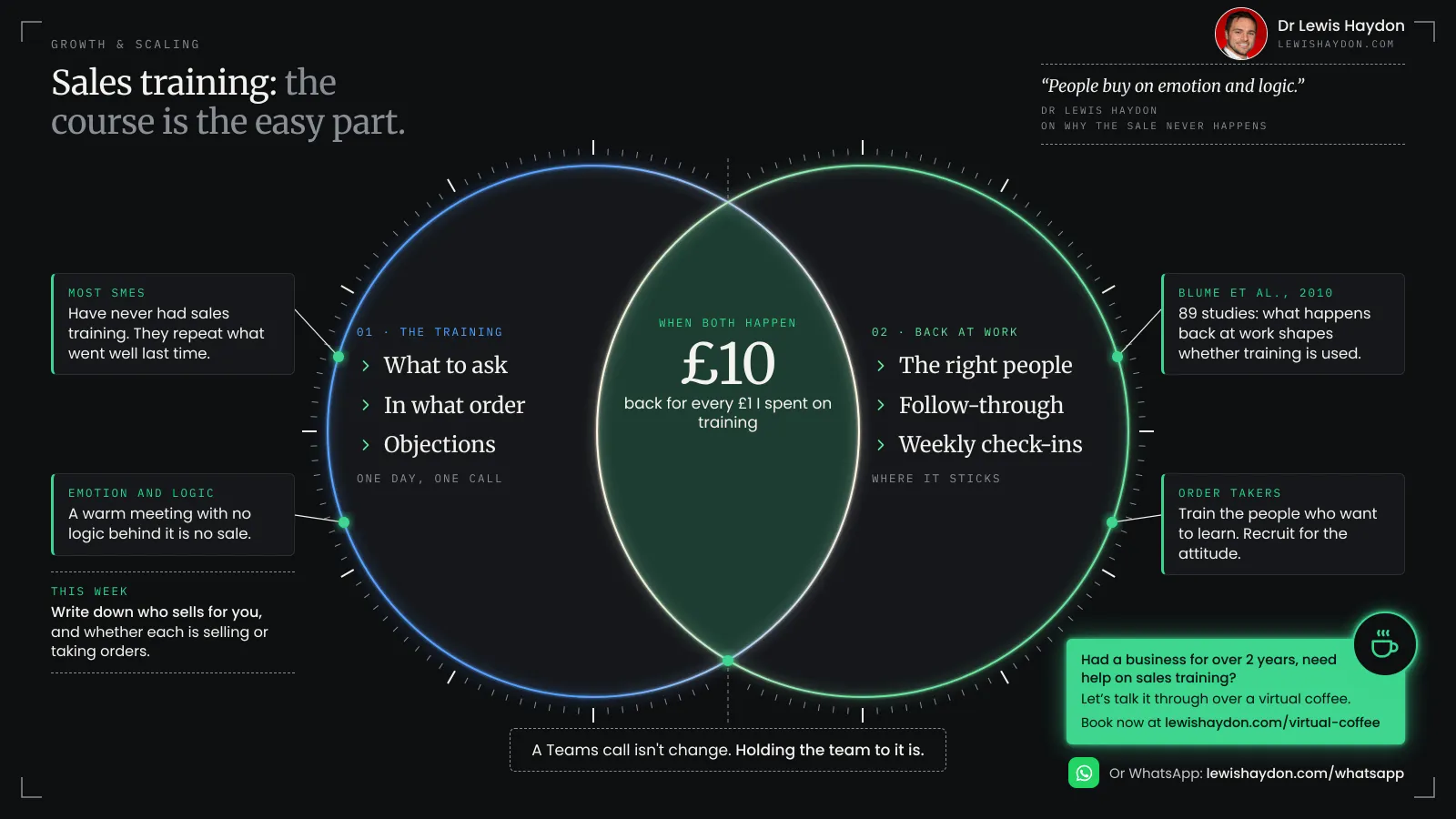
I’ve paid over £100,000 for sales training, because for every pound I spent, I got £10 back. And sales training isn’t a one-off. It’s putting a system into a business that can last for years, even decades.
What is sales training?
Sales training is structured teaching that improves how people sell. It usually covers:
- Finding and qualifying the right prospects
- Asking questions and listening for the real problem
- Showing the customer how they’re better off afterwards
- Handling objections, including price
- Asking for the decision, and following up until you get one
It can be a course, a workshop for the team, online learning, or one-to-one coaching on your real sales conversations.
Why do most SMEs need sales training?
Most businesses have never had sales training, especially SMEs. They work off what went well in their last meeting and do the same again.
They’re great at building relationships. But they never really understand where to take people, or why that person goes away feeling happy and never actually pulls the trigger. The sale never happens.
People buy on emotion and logic. A great meeting may feel nice and warm, but if it doesn’t make logical sense when they go away and think about making that payment to you, the sale will never happen. And business owners scratch their heads wondering why.
Good sales training teaches you to give the customer reasons that still hold up when they’re on their own, deciding whether to pay.
Why doesn’t sales training stick?
Because the owner wanted to see sales improve, but change management is what makes it happen. You can get your whole team onto a Teams call for sales training. It doesn’t mean they’ll change and put it into practice.
Quite often, teams just go back to what they were doing before. There are two reasons:
- The wrong people. Training sticks with salespeople who want to learn, want to grow and are driven to get a different result for your business.
- No follow-through. Management doesn’t keep the team accountable to the new sales process they learned in the training.
A meta-analysis of 89 studies found that what happens back at work, including support from managers, shapes whether training gets used (Blume et al., 2010). A review of the evidence found that the factors with the strongest, most consistent links to training being used include the trainee’s motivation and the work environment: support, the chance to use the skills, and follow-up (Grossman and Salas, 2011).
Who should you train first?
It’s up to you, the owner, to recruit the right people with the right attitude. You can teach and train people anything with enough time and work. But if a person doesn’t have the right attitude for sales, it’ll take a lot longer or never happen. Ultimately, that’s on you, for putting them in that seat in the first place.
A lot of SMEs have people in sales who came in as friends, or were hired because somebody knew them, or aren’t really salespeople at all. They’re order takers. That’s fine, but not if you want to scale. You need the right people in the right seats. If the person in sales doesn’t have the right attitude to sales, learning and growth, your business will stall.
So before you book training, look at who’s going to sit in it:
- Do they want to get better, or are they there because you asked?
- Have they changed how they work after feedback before?
- Are they selling, or taking orders?
If someone’s only there because you asked, and nothing changed the last time they had feedback, a course won’t change that either.
How to make sales training work in a small business
- Start with the owner. If you sell, learn the process first, so you can coach it and spot when it isn’t being used.
- Write the process down: the questions, the order, the common objections and the answers to them, when to follow up.
- Train on real conversations, not made-up ones. Review actual calls and meetings.
- Hold the team to it every week. Look at the numbers at each step, listen to calls, and coach the gaps.
- Recruit for attitude. Make “wants to learn” part of every sales hire.
My guides to how to improve sales skills and how to build a sales process go into the selling itself.
What is a lack of sales training costing your business?
Sales is the lifeblood of a business. It creates cash flow. You can do all the marketing you want, but if you can’t sell, all you’re doing is putting leads into a bucket with a hole in it.
If you want to see what a slower month of sales would do to your cash, put it into the cash flow forecast.
First steps with me
- Write down who sells in your business today, and be honest about whether each of them is selling or taking orders.
- Count last quarter’s enquiries, conversations, proposals and orders, and find the step where most are lost. The scorecard checks whether sales is what’s holding the business back.
- Bring your numbers to a virtual coffee, 30 minutes on Zoom, no charge, or WhatsApp me. 1:1 mentoring is from £800 a month plus VAT, every price published.
For training and coaching for you and your sales team, see sales coaching for owners and their sales teams.
FAQs
What is sales training?
Structured teaching that improves how people sell: finding prospects, asking questions, showing the value, handling objections and asking for the decision. It can be a course, a workshop, online learning or one-to-one coaching.
Is sales training worth it for a small business?
It is when the people being trained want to learn and someone holds them to it afterwards. I’ve had £10 back for every £1 I’ve spent on it. Without the follow-through, most teams go back to what they did before.
Why doesn’t sales training work?
Usually because nothing changes after the training: the wrong people are in sales, or management doesn’t keep the team accountable to the new process.
What is the difference between sales training and sales coaching?
Training is usually a course or a workshop that teaches a method. Coaching carries on after that, on your live deals and your own numbers, so the method gets used.
Who should do sales training in an SME?
The owner first, if they sell, and then anyone in a sales seat who wants to learn and grow. Order takers who don’t want to sell will slow the business down however much training they get.
How does working with you start?
With a virtual coffee: 30 minutes on Zoom, no charge. Bring your sales numbers and who sells for you, and I’ll tell you where I’d start. If it’s worth going further, 1:1 mentoring starts from £800 a month plus VAT and every price is published.
References
- Blume, B.D., Ford, J.K., Baldwin, T.T. and Huang, J.L. (2010) ‘Transfer of training: a meta-analytic review’, Journal of Management, 36(4), pp. 1065–1105. Available at: https://doi.org/10.1177/0149206309352880.
- Grossman, R. and Salas, E. (2011) ‘The transfer of training: what really matters’, International Journal of Training and Development, 15(2), pp. 103–120. Available at: https://doi.org/10.1111/j.1468-2419.2011.00373.x.
What to read next
- How to improve sales skills, yours and your team’s.
- B2B sales, when the buyer is a business.
- How to increase sales without turning the marketing tap on first.
- When and why you should be hiring, for getting the right people into sales.