Article
B2B Sales: How to Sell to a Business, Not Just a Person
Topic · Growth and scaling · 7 min read · Published 28.11.2026
B2B sales means selling to another business rather than to an individual. The big difference is how many people are involved. When you sell to a person, one person decides. When you sell to a business, you’re selling to an organisation: a buying group where the owner, the managers and the people who’ll use what you sell each want something different. Find out what the business needs, what each person in it needs, and give every one of them a reason to say yes.
Selling to a business is different from selling directly to a person. When you’re selling to a person, you’re selling the after. What do they get after buying your product or service that moves them from where they are now to where they want to be? When you’re selling to a business, you’re working with an organisation, which means more than one person. And one person’s pain is not always the organisation’s pain.
I sell business to business across the companies I own: shielding for hospitals and imaging suites, leads for other firms, mentoring for owners. This is how it works from the owner’s side.
What is B2B sales?
B2B (business to business) sales is when a business sells its products or services to another business, rather than to a consumer. A manufacturer selling to a hospital trust, an accountant selling to a limited company and an agency selling leads to a sales team are all B2B. Selling a sofa to a family is B2C (business to consumer).
| Selling to a person (B2C) | Selling to a business (B2B) | |
|---|---|---|
| Who decides | One person, sometimes a partner | A buying group, often several departments |
| What they’re buying | The after: how their life is better | The business outcome, plus each person’s own goals |
| Typical value | Smaller, often one-off | Larger, and can last for months or years |
| What wins it | Emotion and trust in you | Proof, a business case and consensus |
How is selling to a business different from selling to a person?
Each person in a business has their own pressure. A sales manager may have KPIs they have to hit to report to their director. A salesperson may have sales targets to hit so they get their bonus this month. The finance director wants the cost justified. The owner wants the problem gone. They all want something different, and you need to know what each one wants.
So when you’re working business to business, you have to think on three levels:
- The business: what outcome is the organisation after?
- The management team: what are their goals, pains and frustrations?
- Each person: what are their obstacles, and what drives them?
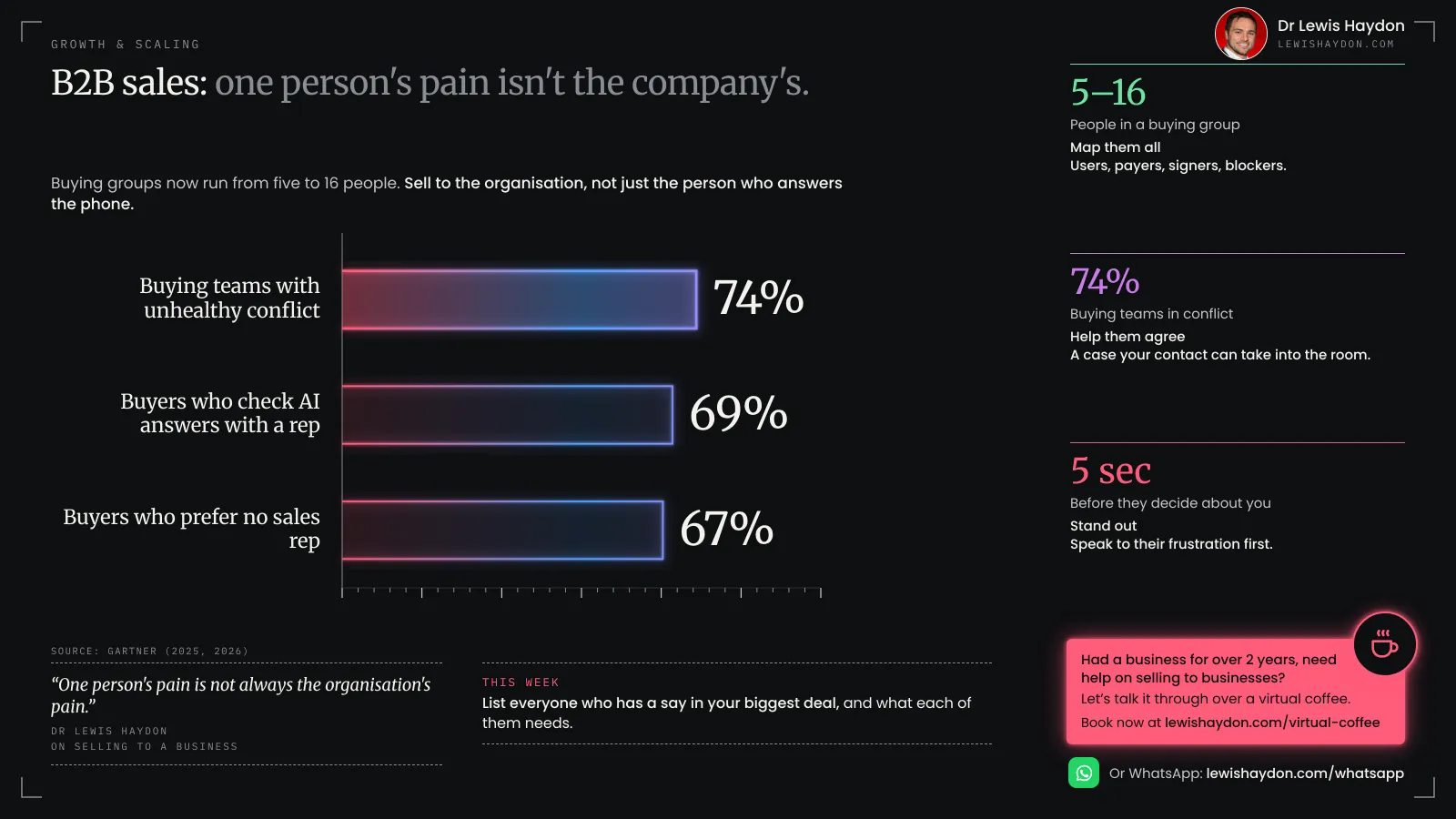
Gartner’s research shows how many people are involved. It found B2B buying groups now range from five to 16 people across as many as four functions, and that 74% of buying teams show “unhealthy conflict” during the decision. Groups that do reach consensus are 2.5 times more likely to report a high-quality deal (Gartner, 2025). So your job is to help the whole group agree.
How do you get past the gatekeeper?
First of all, they’re not a gatekeeper. They were never hired to be a gatekeeper.
So ask yourself who you’re actually getting through to. Is it a receptionist? An operations person? A manager? Then think about that individual. You only get a short time before that person makes up their mind and puts you in the bucket with every other person who calls. What do you need to say in the first five seconds, adapted to the person you’re speaking to? What are their frustrations? How do you stand out? What will make them want to put you in front of a decision-maker?
The person who answers the phone is part of the buying group too. If they can see what’s in it for them and for the business, they’ll pass you on.
How to sell to a business: five steps
- Map who’s involved. Before the first meeting, list who will use what you sell, who pays for it, who signs it off and who could block it. Ask your contact: “Who else would need to be comfortable with this?”
- Find the business outcome. What does the organisation need to be true in a year: more capacity, lower cost, less risk, a target hit? Put it in their numbers.
- Find each person’s reason. The manager’s KPI, the salesperson’s bonus, the finance director’s budget. Speak to each of them about theirs.
- Give them what they need to agree. A short business case your contact can take into the room, answers to the questions the people you haven’t met will ask, and proof you’ve done it for a business like theirs.
- Keep delivering after they’ve signed. That’s how a first order turns into years of orders.
Buyers do more of this on their own now. Gartner’s 2026 survey found 67% of B2B buyers prefer a buying experience without a sales rep, yet 69% prefer to check what AI tools have told them with a rep (Gartner, 2026). So your website has to answer their questions before they ring you, and when they do ring, they want someone who can confirm they’ve got it right.
Why is a B2B customer worth more?
A B2B deal can change a business. When you’re selling directly to a person, it might be a one-off sale or a small sale. B2B can be large values, and they can also be customers that last for months and years, if you keep delivering and solving a problem for that business and the people in it.
That changes how you should price and how you should sell. A customer worth ten years of orders is worth more time at the start, and it’s worth walking away from a deal where the margin is too thin to deliver well. My guide to how to increase sales covers going back to existing customers first, and how to build a sales process covers the stages in order.
If you want to check how many price-only buyers you could lose after a price rise and still make the same profit, use the price increase calculator.
What is selling to one person costing your business?
Pitch only to the person who picked up the phone and you’re relying on them to sell it to everyone else, without your proof, your numbers or your answers. The deal stalls in a meeting you weren’t in, and you lose the kind of customer who would have bought from you for years.
When you sell to the whole business, it goes differently. Every person in the buying group knows why it’s good for the business and for them. Your contact walks into the room with a case they can make. And the customer you win stays because you keep solving the problem.
First steps with me
- Take your biggest prospect and write down everyone who’ll have a say in the decision, and what each of them needs.
- Write the first five seconds you’ll say to the person who answers the phone, then check it against the scorecard to see whether sales is what’s holding the business back.
- Bring your biggest deal to a virtual coffee, 30 minutes on Zoom, no charge, or WhatsApp me. 1:1 mentoring is from £800 a month plus VAT, every price published.
For your sales team as well, see sales coaching for owners and their sales teams.
FAQs
What is B2B sales?
Selling a product or service from one business to another, rather than to a consumer. The buyer is an organisation, so the decision usually involves several people with different goals.
What is the difference between B2B and B2C sales?
In B2C you sell to one person, and you’re selling the after: how their life is better. In B2B you sell to an organisation, so you need the business outcome and each person’s own reason to say yes. B2B deals are usually larger and can last for years.
How many people are involved in a B2B buying decision?
Gartner found buying groups range from five to 16 people across as many as four functions (Gartner, 2025). In a smaller business it may be the owner and one or two managers, but it’s rarely one person.
How do you get past the gatekeeper in B2B sales?
Stop treating them as a gatekeeper. Work out who they are, what frustrates them and what would make them want to put you in front of the decision-maker, and say it in the first five seconds.
Is B2B sales hard?
It takes longer and involves more people, but the customers are worth more and stay longer if you keep delivering. Most of the difficulty comes from selling to one person when the decision belongs to several.
How does working with you start?
With a virtual coffee: 30 minutes on Zoom, no charge. Bring your biggest deal and I’ll tell you who you’re not selling to yet. If it’s worth going further, 1:1 mentoring starts from £800 a month plus VAT and every price is published.
References
- Gartner (2025) Gartner sales survey finds 74% of B2B buyer teams demonstrate “unhealthy conflict” during the decision process, 7 May. Available at: https://www.gartner.com/en/newsroom/press-releases/2025-05-07-gartner-sales-survey-finds-74-percent-of-b2b-buyer-teams-demonstrate-unhealthy-conflict-during-the-decision-process (Accessed: 28 November 2026).
- Gartner (2026) Gartner survey finds 69% of B2B buyers turn to sales reps to validate AI-generated insights, 20 May. Available at: https://www.gartner.com/en/newsroom/press-releases/2026-05-20-gartner-survey-finds-sixty-nine-percent-of-b-two-b-buyers-turn-to-sales-reps-to-validate-ai-generated-insights (Accessed: 28 November 2026).
What to read next
- How to build a sales process, stage by stage.
- How to improve sales skills, yours and your team’s.
- Sales funnel stages, to find where B2B deals stall.
- What a buyer persona is, so you know who’s in the room.
- Sales training, for the team doing the selling.