Article
Small Business Marketing: What to Fix Before You Spend More
Topic · Growth and scaling · 8 min read · Published 14.11.2026
Small business marketing has two jobs. It gets you seen by the right people, and it educates them on why you’re the answer to their problem. Before you spend more on either, check what happens to the enquiries you already get. If they aren’t turning into customers, more marketing fills a leaky bucket.
This is for the owner of an established business, not a start-up. You’ve got customers, a team and some marketing going on already. The question you’re asking is where the next pound should go.
What is small business marketing meant to do?
On the podcast I broke it down to two things. “The number one goal of marketing is how do people know more about you. Or are you the world’s best kept secret?” That’s visibility.
The second is positioning. “You need to be able to educate the customer on why they should be working with you.” If people have heard of you and still haven’t bought, “the reason they haven’t gone with you is because you haven’t educated them on how you solve their problem.”
There’s a third thing that sits under both, and it’s consistency. I’ve worked with a lot of owners who spent heavily straight away, called it test and measure, and stopped after three to six months. Marketing doesn’t work like that. It takes time as well as money, so decide how much of each you’re prepared to put in before you start.
How to market a small business: fix the leaky bucket first
Here’s the question I ask when an owner wants to spend more. “Why would you want to turn the tap on in marketing, spend another thousand pounds, two thousand, five thousand, to get more leads, for those leads then to go into a leaky bucket?”
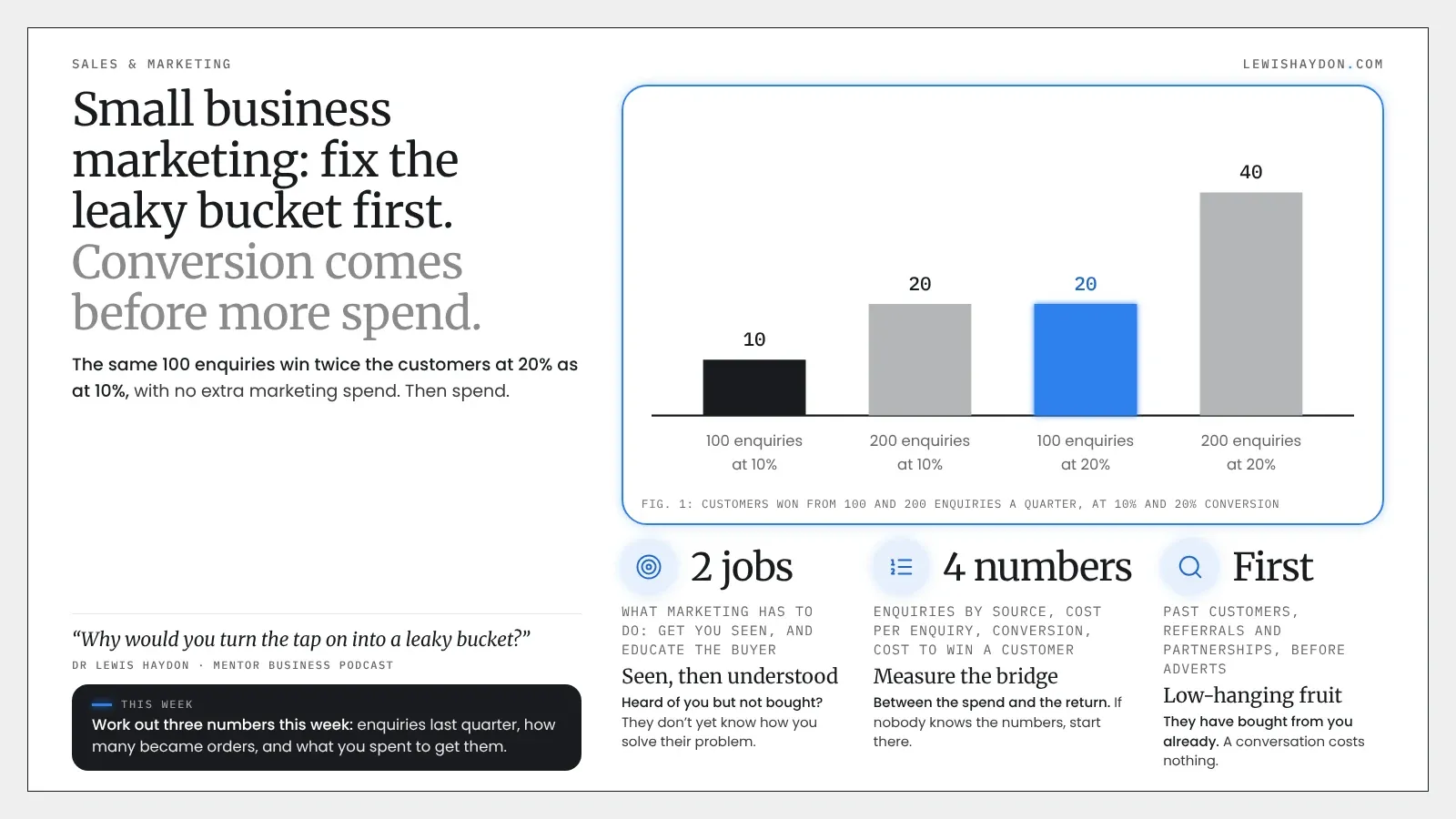
Work it through with round numbers. Say you get 100 enquiries a quarter and convert 10% of them. That’s 10 customers. You spend on marketing and double the enquiries to 200. At the same 10% you get 20 customers, and you’ve paid for every extra one.
Now leave the marketing alone and get the conversion from 10% to 20%. The same 100 enquiries give you 20 customers, without spending any more on marketing. Then turn the tap on. 200 enquiries at 20% is 40 customers.
You need both sales and marketing. Fix whichever one is leaking first.
What’s a good conversion rate? It depends on the business. A quote for a £500 job and a tender for a £500,000 contract don’t convert at the same rate. Know your own average for enquiry to order, then work on beating it. If you don’t know the number, that’s the first thing to fix. How to improve sales skills and a written sales process are where I’d start.
Start with the customers you already have
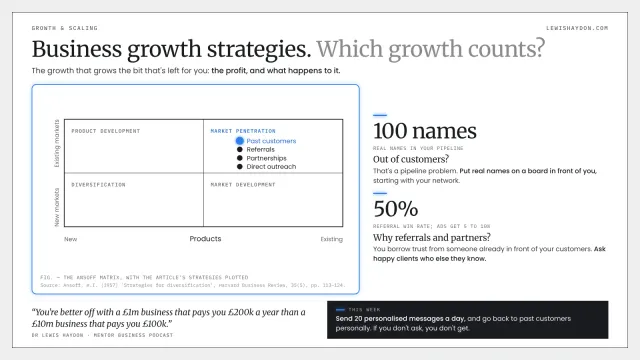
Before adverts, look at the low-hanging fruit. When an owner tells me they need more customers fast, the first thing I say is: “First of all, go back to past customers.” They’ve bought from you and they know the service. A conversation costs you nothing.
Then referrals. A lot of my own work comes from referrals, and most people agree the best form of marketing is word of mouth. The trouble is that most businesses wait for it. Ask. Reach out personally to the customers who rate you and tell them who you’d like to meet.
Then partnerships. Is there a win-win with a business that already sells to your customer and doesn’t compete with you?
One warning from the same episode: “Desperate moves don’t get you customers.” Discounting hard and chasing every enquiry brings in the wrong work at the wrong margin.
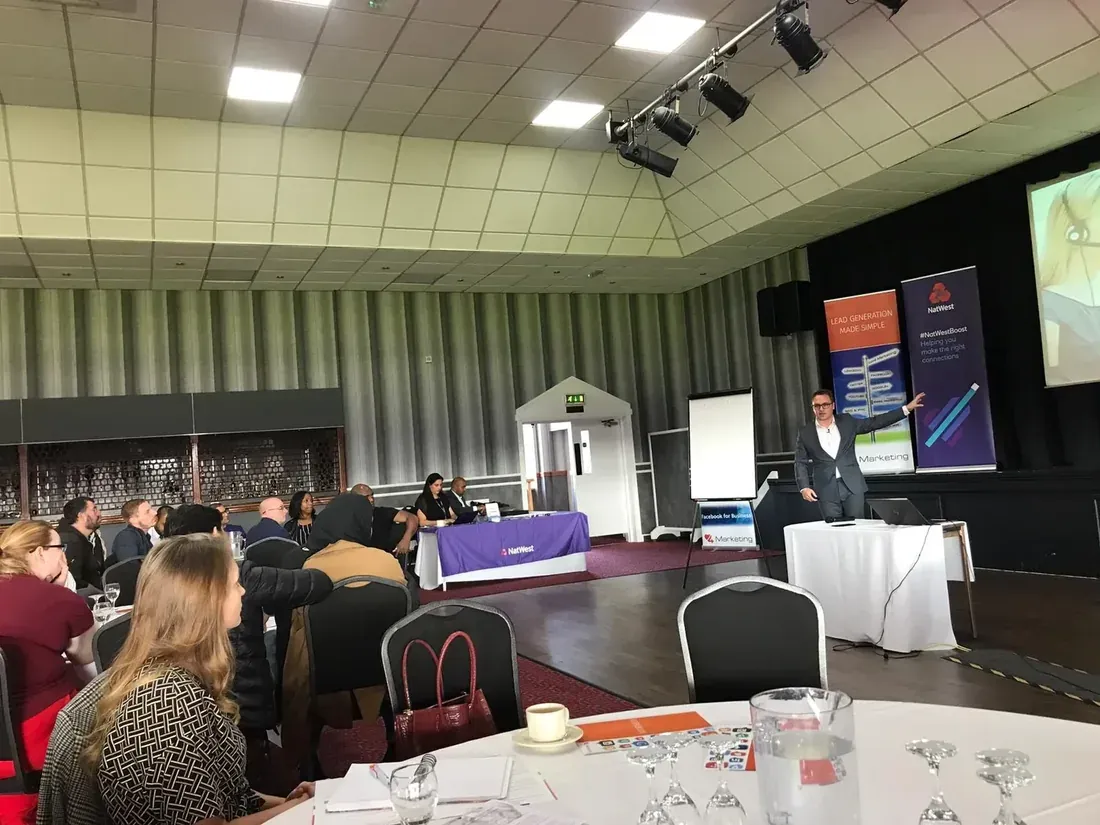 Running a lead generation workshop for business owners and their teams at a NatWest Boost event.
Small business marketing strategy: measure the bridge between spend and return
Marketing is an investment, so treat it like one. If I put £100,000 into a business, I want to see the indicators that it’s coming back with more. Your marketing spend is no different.
I describe it as a valley. “One side of the valley is the spend and the other side of the valley is the return on that investment. What is the bridge between the valley, how you link the two? Because ultimately that’s what you need to be measuring.”
Say you spend £10,000 on adverts and £50,000 comes back. What happened in between? For most established businesses the bridge is a short list:
- Enquiries by source, every week.
- Cost per enquiry: what you spent on a channel, divided by the enquiries it produced.
- Conversion from enquiry to order.
- Cost to win a customer, against what that customer is worth to you in gross profit.
Count everything in the spend. “If you employ somebody, that is part of your marketing cost as well.” The same goes for the exhibition stand and your own hours.
When someone tells you a channel can’t be measured because it’s about awareness, be careful. Often it means nobody knows the numbers. If you want to figure out your own, go to lewishaydon.com/tools and use the marketing plan template. It has the budget, cost per lead and return calculators in one place.
Digital marketing for small business: what should it get you?
The same two things as any other marketing: seen, and understood. Decide what you want from a channel before you start. Is it click-throughs, enquiries, conversations started or emails captured?
Anyone can post. As I said on the podcast, “anybody can do it. The hard work is getting a return on investment from your social media.”
Be careful with the idea that you can automate the whole thing. High-ticket work gets sold by people, through conversations. AI tools are quick, but they only help if you know what to point them at. Put the tools together with someone who knows how to execute, because they’ve tried and tested it in their own businesses, and I think that’s a secret weapon for owners today. It can save you years of rabbit holes.
Who should run the marketing in a small business?
Whoever runs it, you hold them to the numbers. An agency, an employee or a freelancer doesn’t know your standards until you set them. “If you spend the money in areas that promise a great return and they slip, then you’ve got to take ownership that you’ve let that slip.”
It also has to be a shared language. I send what I’m learning to my sales team and to my financial controllers, because they advise me on where the money goes. If sales, marketing and finance aren’t learning together, they speak different languages and no decision gets made.
If you want that built into your team, I work with owners and their marketing people as a marketing coach, one to one or in Marketing Masterminds Birmingham, a monthly group from £500 a month plus VAT. When a business needs someone leading its marketing from the board, that’s the fractional CMO seat.
What is marketing into a leaky bucket costing your business?
Every pound you add to marketing while conversion stays where it is buys you customers at full price. The spend comes out of your profit, so if the margin is thin you can grow the enquiries and still take home less. And because the numbers in the middle aren’t measured, you can’t tell which half of the spend is working, so you either keep paying for all of it or stop all of it after six months and start again.
Here’s what it looks like when it’s fixed. You know what an enquiry costs from each channel and what a customer is worth, and you can see it on one page. Your team converts more of what already comes in. When you do turn the tap on, you can see what each pound brings back.
First steps with me
- Work out three numbers this week: enquiries last quarter, how many became orders, and what you spent on marketing to get them.
- Use the free marketing plan template to put a cost against each channel, and the scorecard to check whether marketing or sales is the constraint.
- Bring the numbers to a virtual coffee and I’ll tell you where I’d put the next pound, or WhatsApp me. Marketing Masterminds Birmingham is from £500 a month plus VAT, and every price is published.
FAQs
How much should a small business spend on marketing?
There’s no single percentage that suits every business. Start from the return: what an enquiry costs you, how many convert and what a customer is worth. I go through it in the podcast episode how much should you be spending on marketing.
What is the best marketing for a small business?
For an established business, the customers you already have. In my experience past customers and referrals cost the least to win. After that, it’s whichever channel you can measure from spend through to orders.
What is a good conversion rate for a small business?
It depends on the business, what you sell and what it costs. Work out your own average from enquiry to order, then aim to beat it. Going from 10% to 20% doubles your customers from the same enquiries.
How long does marketing take to work?
Usually longer than the three to six months most owners give it. Marketing rewards consistency, so decide how much time and money you’re prepared to commit before you start, and measure the early indicators along the way.
Should a small business use a marketing agency or hire in-house?
Either can work. What matters is that you set the standard and hold them to numbers you both understand: enquiries, cost per enquiry and conversion. If nobody is accountable for those, changing who does the work won’t fix it.
How does working with you start?
With a virtual coffee: 30 minutes on Zoom, no charge, bring your marketing numbers and I’ll give you a straight answer on where the next pound should go. If it’s worth going further, Marketing Masterminds Birmingham is from £500 a month plus VAT and every price is published.
References
- Haydon, L. (2024) ‘How much should you be spending on marketing?’, Mentor Business Podcast, 2 July. Available at: https://lewishaydon.com/podcast/how-much-should-you-be-spending-on-marketing-do-this-before-you-spend-a-penny/
- Haydon, L. (2025) ‘What to do when you need more customers fast’, Mentor Business Podcast, 21 August. Available at: https://lewishaydon.com/podcast/what-to-do-when-you-need-more-customers-fast/
Want a straight answer on your marketing?
If you’re spending on marketing and can’t say what it brings back, book a virtual coffee and bring your numbers. I’m Dr Lewis Haydon, a business coach and mentor who ACTUALLY owns businesses, including a lead generation business, and you’ll leave with a straight answer. My prices are published if you’d like to see them first.